

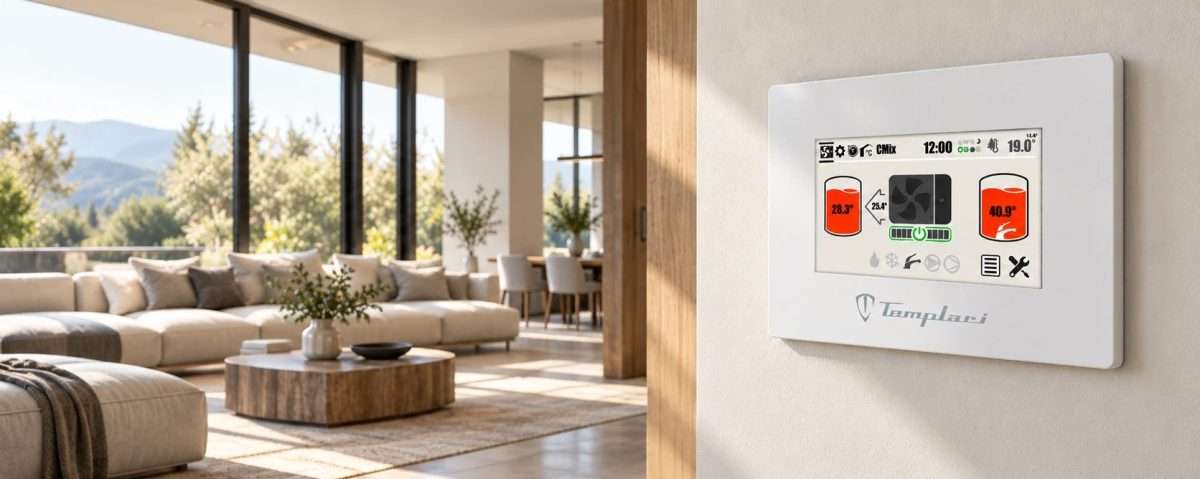
Heat pump controls: thermostats, underfloor cooling and fan coils under one system
In the previous tips we saw that a heat pump performs best when it runs steadily, at the lowest possible water temperature. But the machine is only one part of the system. Around it there are circulators, mixing valves, manifold actuators, thermostats, fan coils and dehumidifiers. If each one does its own thing, even the best heat pump works badly.
01
How most systems are built
Usually every component has its own controller. Thermostats open and close the room actuators, a separate controller drives the mixing valve, the circulator runs at fixed speed, the dehumidifier has its own humidistat. The heat pump knows none of this: it makes water at a set temperature and waits. So the machine heats water that closed actuators will not let through, the circulator pushes into a half-closed system, and the mixing valve throws away the temperature the machine worked hard to produce. Each part does its job well, and together they waste energy.
02
Thermostat or control system: the difference
A classic thermostat says only two things: the room is cold, or it is warm. With a boiler that can be enough. With a heat pump it is not, because the machine performs best when it runs long and gently, at half capacity, as explained in the tip on inverters and sizing. On-off control makes it start and stop all the time, and every start costs energy, as we saw in a heat pump is not a boiler. The machine needs to know how much each room is missing, not just whether something is missing.
03
One brain for the whole system
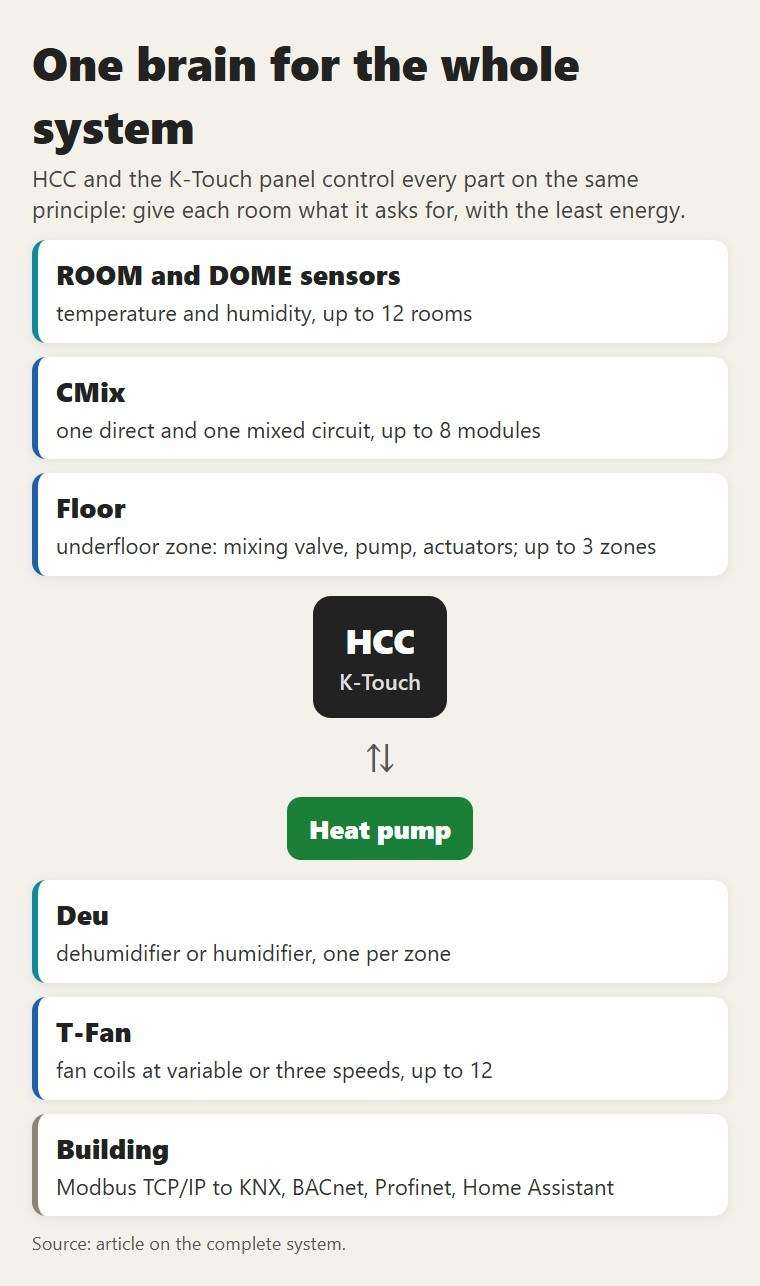
HCC, House Climate Control, is the electronics we developed to run the whole system, not just the machine. From the K-Touch panel it drives every component with the same rule: give each room what it asks for, with the least energy. It handles up to twelve rooms. The installer assigns each room its floor area: the larger it is and the further from the set temperature, the more its demand counts. The sum of the demands becomes how hard the compressor works, instead of a fixed water temperature.
On top of this runs the energy optimiser, which uses the walls of the house as heat storage and moves the machine’s work to the hours when it performs best.
04
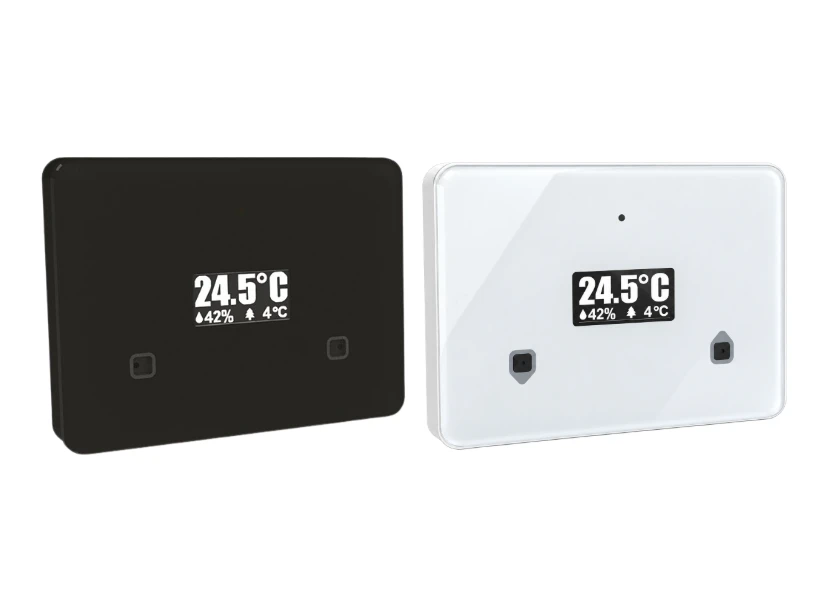
Room sensors: ROOM and DOME
Every room has a temperature and humidity sensor instead of the old thermostat. The ROOM sensor has a display and, if the installer enables it, lets you change the temperature from the room itself: it is the one for living rooms, bedrooms and studies. The DOME has no visible controls and is set only from the panel: it is the one for offices, hotels and schools, where the temperature is decided by whoever runs the building.
05
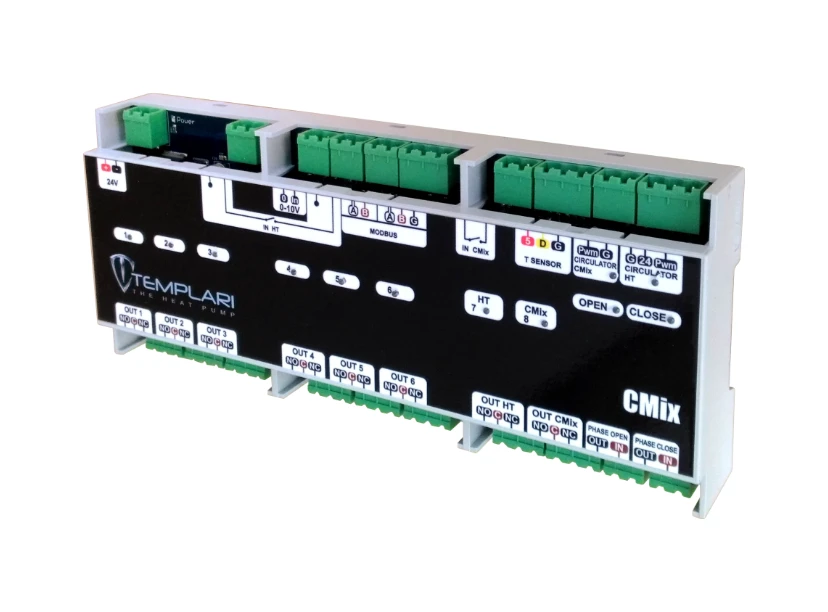
The boards: every part of the system under control
- CMix: drives two secondary circuits, one direct and one mixed, with their circulators. It is used in mixed systems, for example radiators or fan coils upstairs and underfloor heating on the ground floor, each at its own temperature. The Compact version has a single mixed circuit, to connect the heat pump to an existing system. Up to eight modules.
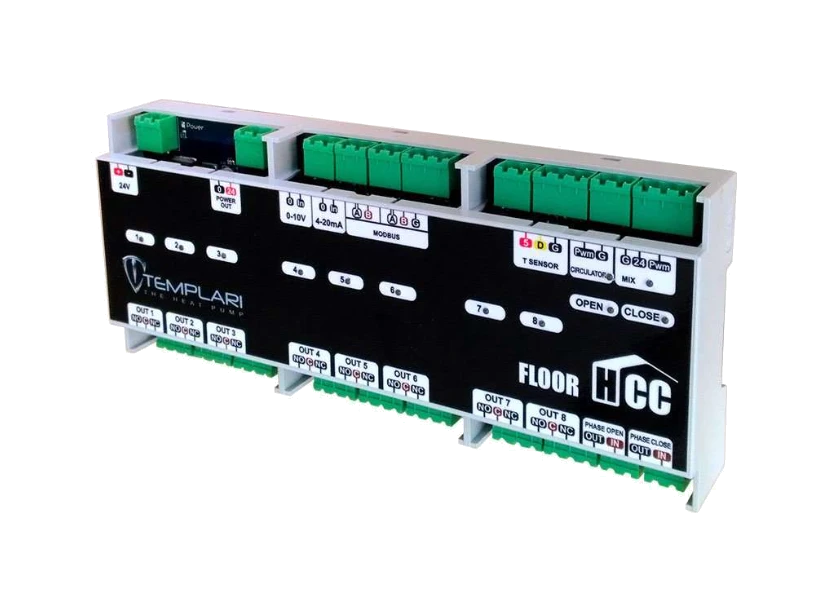
- Floor: runs a whole radiant zone, with the three-way mixing valve, the modulating circulator and the room actuators. Up to three zones.
- Deu: keeps the right humidity in every room of the zone by switching the dehumidifier or humidifier. It works together with the Floor board, one per zone.
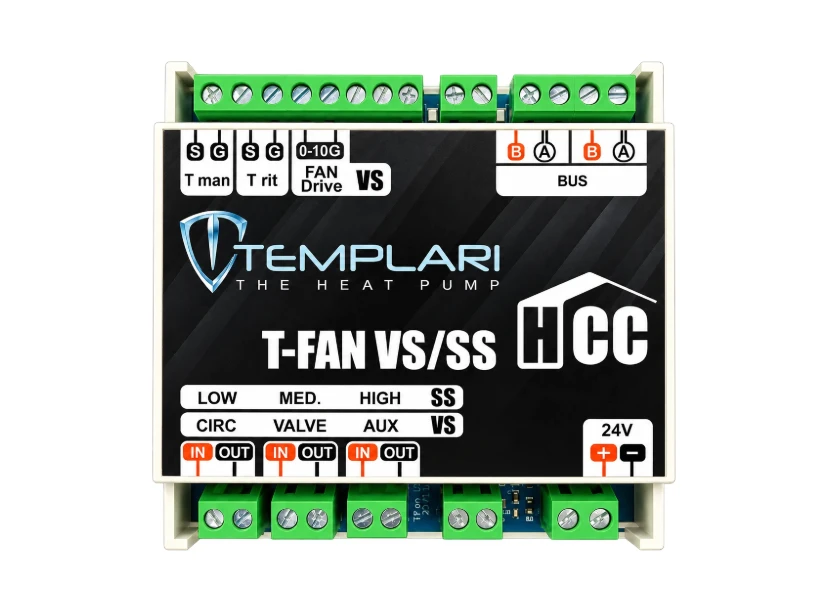
- T-Fan: drives the fan coils according to what the room asks for, at continuous speed or three speeds. Up to twelve.
Everything is on the same network: when a zone is satisfied its actuator closes, the circulator slows down and the machine reduces its output. And when no room asks for anything, the heat pump rests instead of topping up the buffer tank. No part works against another.
06
Underfloor cooling without condensation
In summer an underfloor system can cool: cool water runs through the pipes instead of warm water, and the floor takes heat out of the room with no draughts and no noise. The limit is the dew point, the temperature below which moisture in the air condenses. If the water drops below it, the floor gets wet.
That is why the Floor board measures temperature and humidity in every room of the zone and uses the mixing valve to keep the water above the highest dew point: the floor cools without ever getting wet. The Deu board switches on the dehumidifier when humidity rises. With drier air the dew point drops, the water can be cooler and the floor cools more. The floor removes the heat and the dehumidifier removes the moisture: each does its part, run by the same system.
07
Heat pumps with fan coils
Where a quick response is needed, or where in summer you want to cool the air and not only the surfaces, fan coils are used. They work well with the low-temperature water a heat pump likes to produce, and in summer they also remove some humidity. The T-Fan board runs them according to what the room asks for: at continuous speed, which follows the demand smoothly and quietly, or at three speeds on simpler models. A system can have underfloor heating on the ground floor and fan coils upstairs, each with its own water: that is the CMix board’s job.
08
It talks to the rest of the building
Larger buildings often already have a building management system. HCC speaks Modbus TCP/IP and connects to the most common systems: KNX, BACnet, Profinet, the Siemens and Schneider Electric platforms, and Home Assistant for those who build their own home automation. The heat pump does not stay an island. The system can also be controlled remotely, and remote supervision shows how it is working without going on site.
09
What to check before you buy
- ask what controls the circulators, mixing valves and actuators: the machine’s electronics or separate controllers;
- ask whether the machine knows how many zones are open and how much each one asks for, or only sees the water temperature;
- if you want underfloor cooling, ask what watches the dew point and what drives the dehumidifier;
- ask whether it connects to the building management system, and with which protocol.
Not every board is needed in every house. With radiators the Floor board is not needed, because there are no floor actuators to drive; where there is no underfloor cooling the dehumidifier is not needed; and so on. It is decided system by system, depending on how complex the house is, new or renovated. What is always there is HCC, standard on all our heat pumps. The boards, one by one, with photos and functions, are on the remote control page for air-to-water heat pumps.
10
Frequently asked questions
What thermostat does a heat pump need?
Rather than an on-off thermostat, it needs a sensor in each room that says how far the room is from the set temperature. With HCC every room has a ROOM or DOME temperature and humidity sensor, and the machine sets its output on the sum of the demands.
Does a heat pump work with fan coils?
Yes. Fan coils work well with the low-temperature water of a heat pump and cool the air in summer. The T-Fan board drives up to twelve of them, at continuous speed or three speeds.
Can you cool with underfloor heating?
Yes, as long as the water stays above the dew point. The Floor board keeps the water above the highest dew point in the zone with the mixing valve, and the Deu board drives the dehumidifier: the floor cools without getting wet.
How many zones can be controlled?
Up to twelve rooms with ROOM and DOME sensors, up to three radiant zones with the Floor board, up to eight circuits with the CMix and up to twelve fan coils with the T-Fan.
Does HCC connect to home automation?
Yes. It speaks Modbus TCP/IP and connects to KNX, BACnet, Profinet, the Siemens and Schneider Electric platforms and Home Assistant.
Is HCC an extra?
No, HCC is standard on all our heat pumps. The boards are chosen to suit the system: in a house with radiators, for example, the Floor board is not needed.
See also: Heat pump heating curve and weather compensation: what it is, why it is set 5 degrees too high, and how to do without it · Heat pump buffer tank: is it needed, which type, what size and which to avoid · Cooling with a heat pump: underfloor or fan coils, how efficient it is and what you need · How to balance radiators for a heat pump: flow, valves and the right water temperature · Fan coils with a heat pump: when to choose them, what water temperature they need and how they cool
The other technical tips are in the index of the series.


