

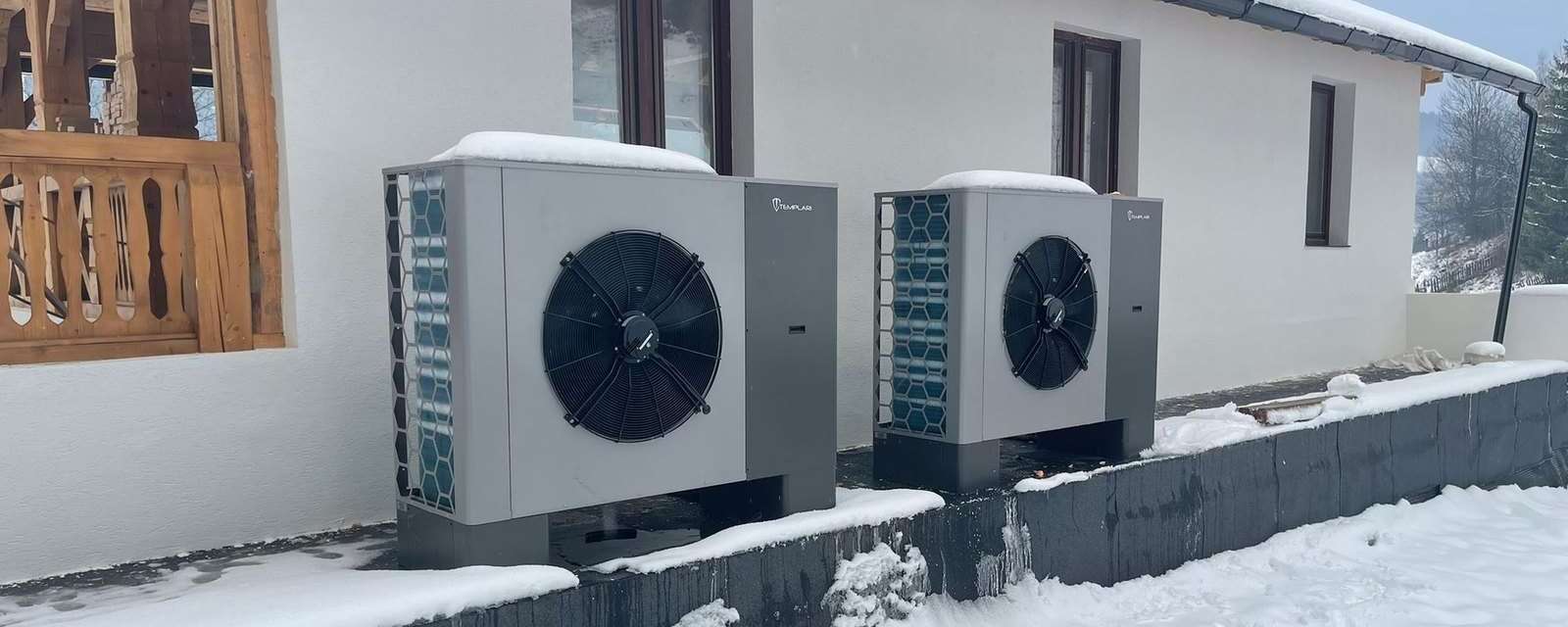
Heat pumps and radiators: does it work? Yes, and better with propane
Yes, a heat pump works with the radiators that are already there. You do not need underfloor heating and you do not need to redo the system. The right question is a different one: how hot must the water be for the house to be warm on the coldest days. Consumption, capacity and the choice of machine all depend on that temperature. Here are the figures, taken from our data sheets.
01
Why radiators want hot water
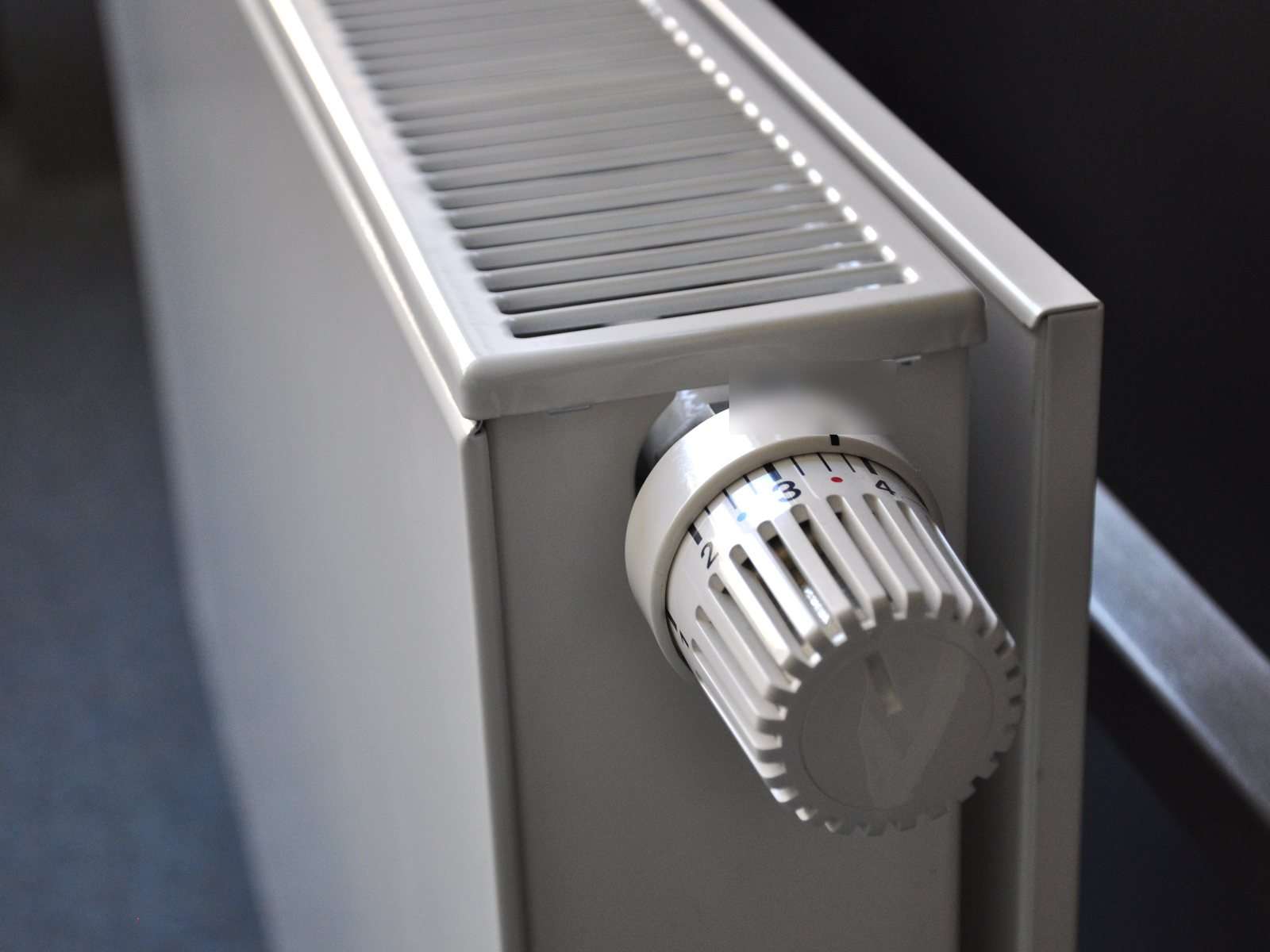
A radiator heats by the temperature difference between the water inside it and the room. The standard that rates them (EN 442) tests them with water entering at 75 °C and leaving at 65 °C, with the room at 20 °C: that is the output printed in the catalogue. With water at 65 °C the same radiator gives about three quarters of that value; at 55 °C about half. A gas boiler runs at 70-80 °C without any trouble, which is why nobody ever asked whether the radiators at home were big enough. With a heat pump it is worth asking, because the hotter the water, the more the machine consumes.

02
How much changes for the heat pump: the data sheet figures
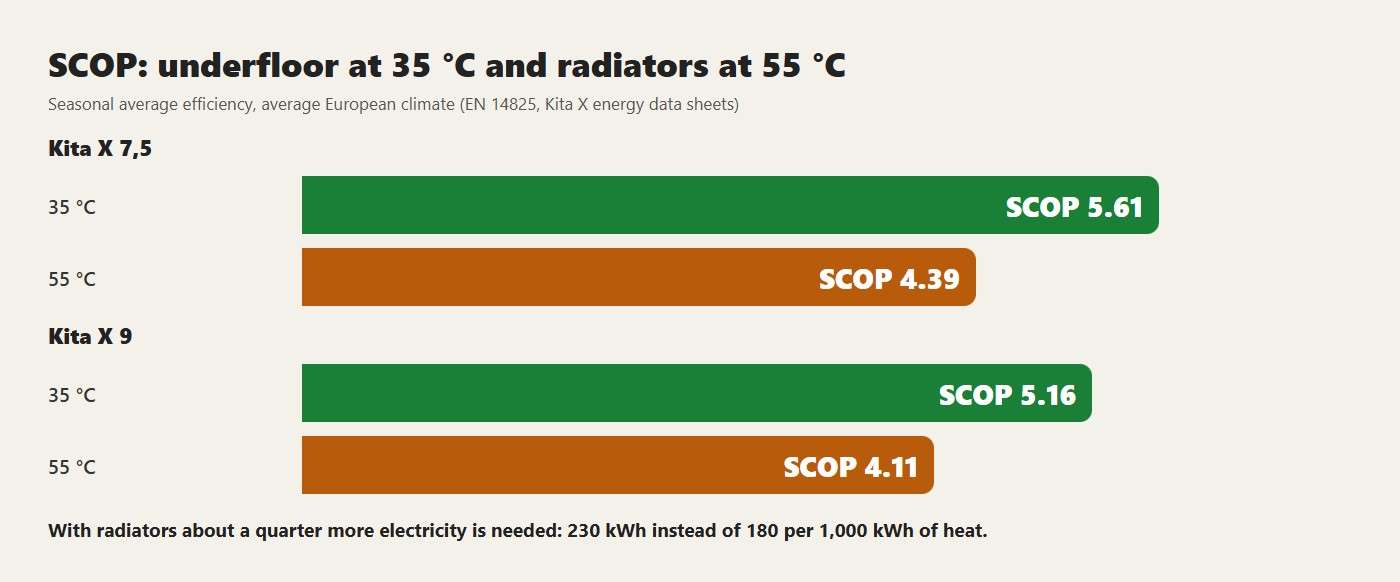
The figure that counts for the whole season is the SCOP, the average efficiency over the winter in the average European climate. The data sheets give it at two flow temperatures: 35 °C, for underfloor heating, and 55 °C, for radiators. The Kita X 7.5 has an SCOP of 5.61 at 35 °C and SCOP 4.39 at 55 °C; the Kita X 9 SCOP 5.16 and SCOP 4.11. In practice: with radiators the heat pump uses about a quarter more than with underfloor heating, but for every kilowatt-hour of electricity it still delivers four of heat. For 1,000 kWh of heat the Kita X 7.5 needs about 230 kWh of electricity with radiators and about 180 with underfloor heating. Capacity changes too: at +2 °C outside the Kita X 7.5 gives 6.6 kW with water at 35 °C and 6.0 kW with water at 55 °C. Not much, because propane copes well with high temperatures.
03
How hot the water gets
All our propane air-to-water units reach a flow temperature of 70 °C. With water at 65 °C and 2 °C outside, a Kita X 9 still gives 7.0 kW and a Kita X 7.5 5.6 kW. The compressor could go higher, up to 80 °C water, as other machines on the market do. We stop at 70 °C for a longer compressor life. To make 80 °C water the compressor has to bring the gas to a pressure far above the one it draws it in at: the compression ratio rises, the compressor works strained and hot, and does not last. We want it to last many years, not five. For radiators 70 °C is more than enough, and for most of the winter the water runs much lower. Propane helps: it condenses at a higher temperature than other refrigerants and is the refrigerant best suited to radiators. How a propane machine is built inside is told in the tip on R290.
04
The test to run this winter, before changing anything
You do not need a calculation: you need the boiler you have. In a cold spell, lower the boiler flow temperature to 55 °C and leave it there for a few days, with the thermostats where you usually keep them. If the house stays warm, the radiators are fine for a heat pump as they are. If the house stays warm at 60-65 °C but not at 55, that is fine too: the machine gets there, it will just use a little more on peak days. If a single room stays cold, the problem is that radiator, not the system.
05
If one room stays cold
- replace that radiator with a bigger one or a model with more columns: same position, same pipes;
- fit a fan coil there: it heats with water at 40-45 °C and cools in summer;
- close the draught: a new window in that room is often worth more than an extra radiator;
- you almost never need to touch the other rooms or redo the pipes.
06
The water temperature is not fixed: the system controls it
With a boiler the flow temperature is almost always the same all winter. With a heat pump it is not: the controller raises it on cold days and lowers it on mild ones, following the outdoor temperature and the room temperatures. 70 °C is reached on a few days a year; the rest of the time the water is cooler and the SCOP goes up. With HCC, even on cold days, 70 °C is rarely reached: instead of raising the water temperature, the system extends the running hours. The radiators stay warm for longer, the house is just as warm and the machine works where it performs best. That is the job of the HCC system controller, which works on the rooms and not on the tank, as explained in the tip on why a heat pump is not a boiler. The energy optimiser goes one step further: it stores heat in the walls when electricity is cheaper or the photovoltaic system is producing, and gives it back later.
07
Which heat pump for a house with radiators
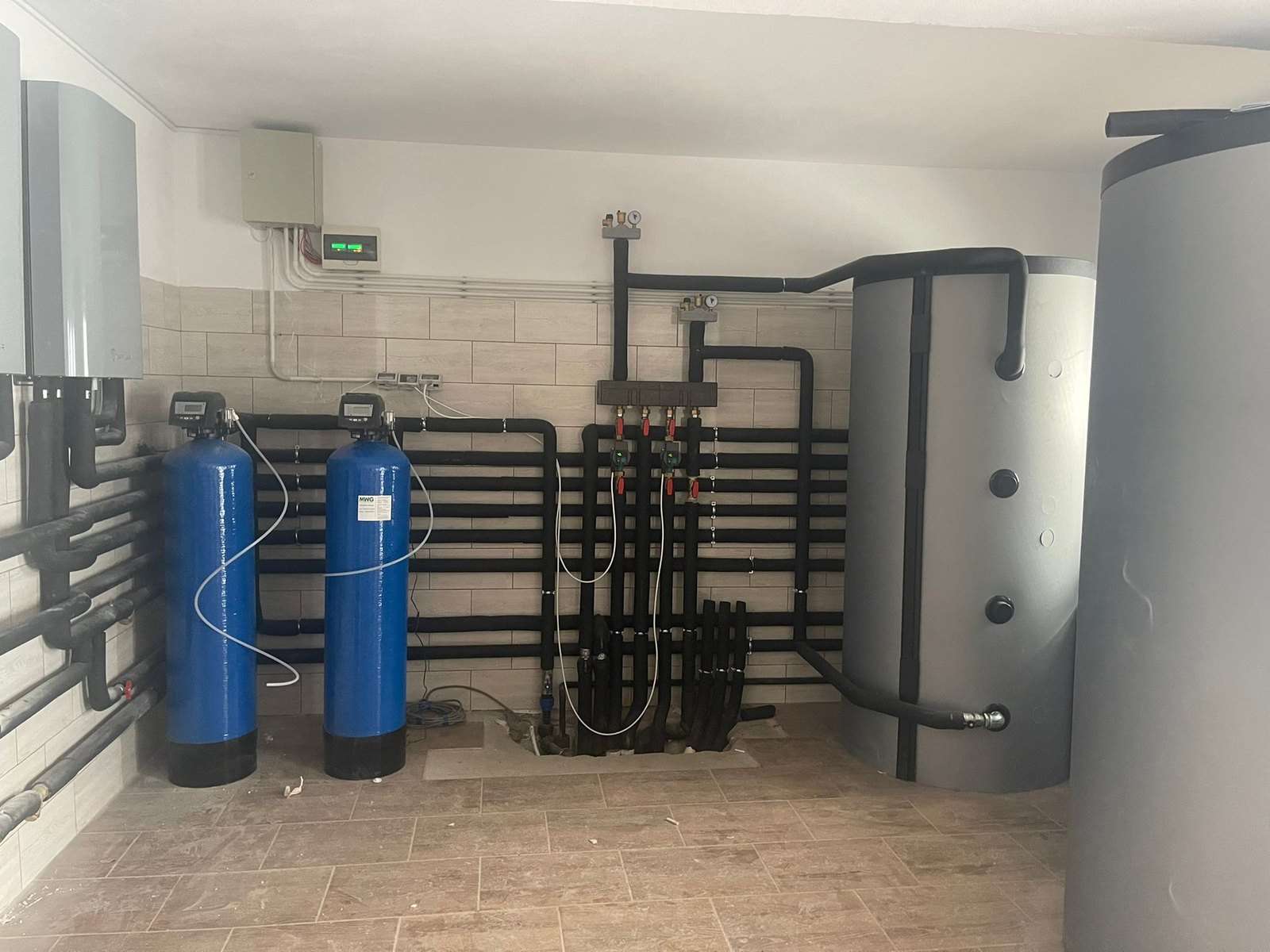
For a house you go up to 20 kW. The Kita X at 7.5 and 9 kW suits flats and small or low-consumption houses; for detached houses, large or old houses and two-family homes there is our new heat pump for homes. They are propane monoblocs and work below -20 °C outside. The size is not copied from the boiler: a 24 kW wall-hung boiler is that big to make instant hot water at the tap, not because the house needs it. A heat pump is chosen on the capacity needed on the coldest day of the area, with the water at radiator temperature: how to do it is explained in the tip on useful capacity, and why it then runs at half capacity in the one on sizing. The full data sheets are on the air-to-water heat pumps page.
08
The other things that change
- Domestic hot water: the same machine also heats the water for the house, up to 70 °C, with a cylinder in place of the boiler.
- Cooling: not with radiators alone; with fan coils or underfloor heating the same heat pump cools in summer.
- Boiler: you do not have to keep it. Those who wish leave it as a back-up, but the house is heated by the heat pump.
- Photovoltaics: the heat pump uses electricity, and during the day part of it comes from the roof. The energy optimiser shifts heating into the sunny hours.
- Incentives: replacing a boiler with a heat pump qualifies for national incentives in most countries. No periodic refrigerant checks: propane is not an F-gas.
- Old radiators: those that leak, are rusty or full of sludge have to be replaced anyway, heat pump or not; a dirt separator is fitted on the system, as we explain in the article on maintenance.
09
What to ask whoever quotes for the job
- The heat loss calculation room by room: it says how much heat each room needs on the coldest day, and so whether the existing radiator is enough.
- A check of the radiators: size, number of sections and at what water temperature they heat the room enough.
- The condition of the pipes and of the circulation: diameters, valves, sludge, pump.
- How the water temperature is controlled: with a weather-compensation curve on the outdoor temperature, not at a fixed value.
- A quote that separates the essential work from the work that is only recommended.
10
Frequently asked questions
Can I fit a heat pump with the radiators I already have?
Yes. It connects to the existing system in place of the boiler. First run the test with the boiler at 55 °C: if the house stays warm, the radiators are fine as they are.
At what temperature does the heat pump run with radiators?
It reaches 70 °C. For most of the winter the controller keeps it lower, between 45 and 55 °C; at 55 °C the SCOP of the Kita X is between 4.1 and 4.4.
How much more does it use than underfloor heating?
About a quarter more: the Kita X 7.5 has an SCOP of 5.61 at 35 °C and SCOP 4.39 at 55 °C. For 1,000 kWh of heat you need about 230 kWh of electricity instead of 180.
Do I have to change the radiators?
Usually not. If one room stays cold in the test, you change that radiator or fit a fan coil in that room.
Does it work when it is very cold?
Yes. The propane air-to-water units work below -20 °C outside and at +2 °C still deliver water at 65 °C.
What capacity does a house need?
It depends on the area and the house: usually between 7.5 and 20 kW. It is chosen on the capacity of the coldest day, not on the boiler’s capacity.
See also: Heat pump controls: thermostats, underfloor cooling and fan coils under one system · How much electricity does a heat pump use: per day, per year and by size, with the data sheet figures · Heat pump and solar panels: how much the roof really covers, month by month, and how to make them work together · Hybrid boiler and hybrid heat pump: what they really are, and why we do not make them · Heat pump maintenance and servicing: what to do, how often, and how long a heat pump lasts · Heat pump heating curve and weather compensation: what it is, why it is set 5 degrees too high, and how to do without it · Heat pump in an old house: it can be done, even with radiators, if you know what it will use · High temperature heat pump: up to 70 °C, how much more it uses and when you really need it · Are heat pumps worth it? The real drawbacks and how to avoid them · How to balance radiators for a heat pump: flow, valves and the right water temperature
All the technical tips are on the series page.


