

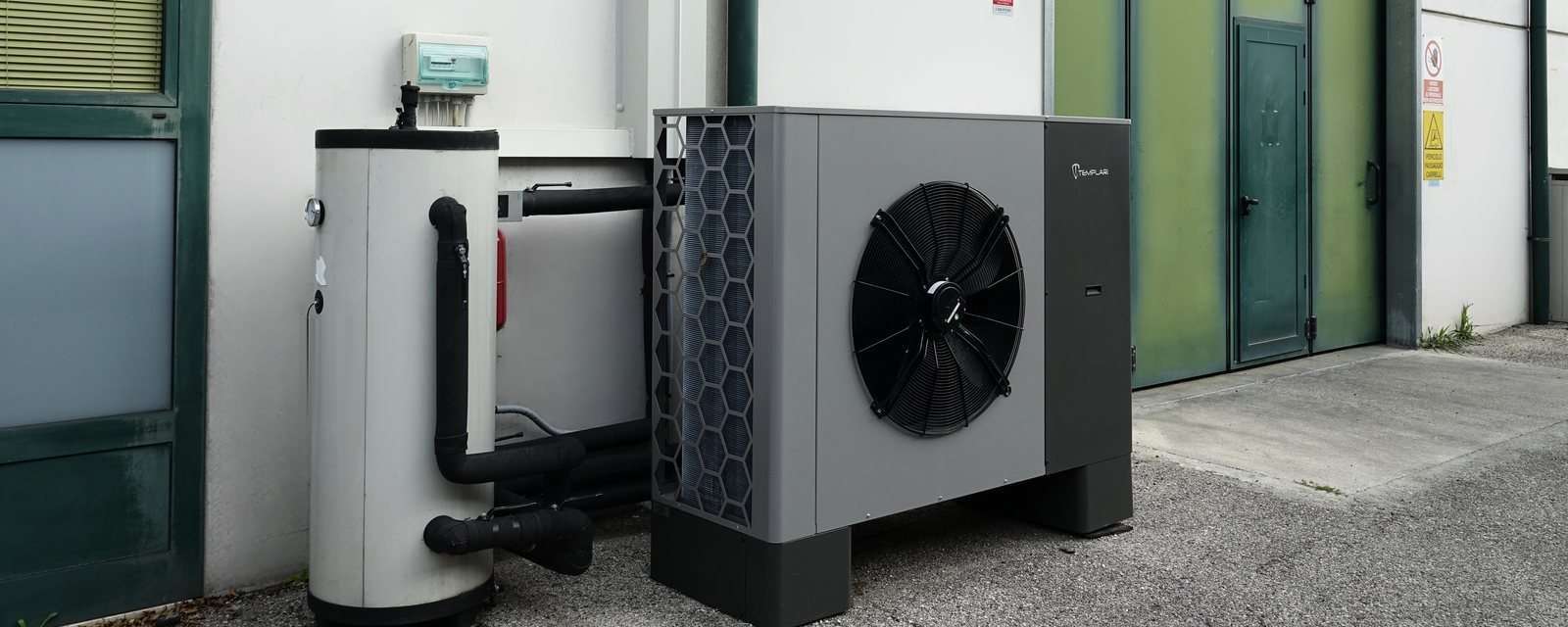
Heat pump buffer tank: is it needed, which type, what size and which to avoid
The buffer tank is the water store of the heating system, and it is the most searched heat pump accessory: 9,900 searches a month in Germany, 5,400 in Poland, 3,600 in Italy. The questions are always the same: is it needed? Which type? How many litres? Here we answer with what we see on real systems and what the standards say, plus two warnings: some tanks work badly with a heat pump, and a hot water cylinder that is too small makes the unit work far more than it should.
01
What a buffer tank is for
The buffer tank holds a store of water between the heat pump and the system, and it does three jobs. It gives the unit a volume of water to work on, so it runs long cycles instead of switching on and off all the time. It gives heat to the system while the unit defrosts, as we explain in the article on defrosting. And it separates the unit’s circuit from the rooms’ circuit, which have different flow rates. In summer, if the unit also cools, the same tank holds chilled water: that is why our buffer tanks are insulated and built for both hot and cold.
02
The buffer tank must not control the unit
This is the most common mistake: many heat pumps switch on and off by looking at the buffer tank sensor. But the tank heats up and cools down quickly, and the unit chases it. Our units with HCC regulate on room temperature, which changes in hours, not minutes: the buffer stays a flywheel, not a thermostat. We explain it in the article on why a heat pump is not a boiler and in the one on the complete system.
03
Plain buffer yes, stratified no
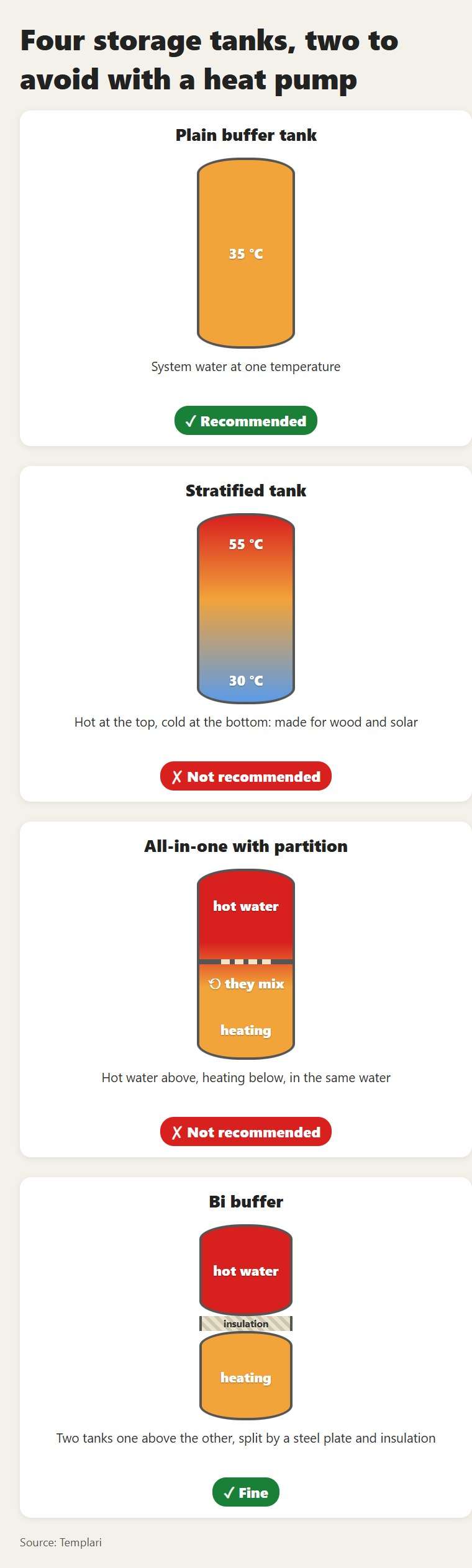
For a heat pump we recommend a plain buffer tank: an insulated tank with the system water at one temperature. A stratified tank is built to keep hot water at the top and cold at the bottom, and it is designed for wood boilers and solar thermal, which work at high temperatures and with 20-30 degree differences. A heat pump works differently: the EN 14511 rating test for underfloor heating uses water entering at 30 °C and leaving at 35 °C, just 5 degrees, with a high flow rate that mixes the layers; and the unit performs better the lower the water temperature. It does not need the hot layer at the top. We advise against it.
04
The all-in-one with a partition: no
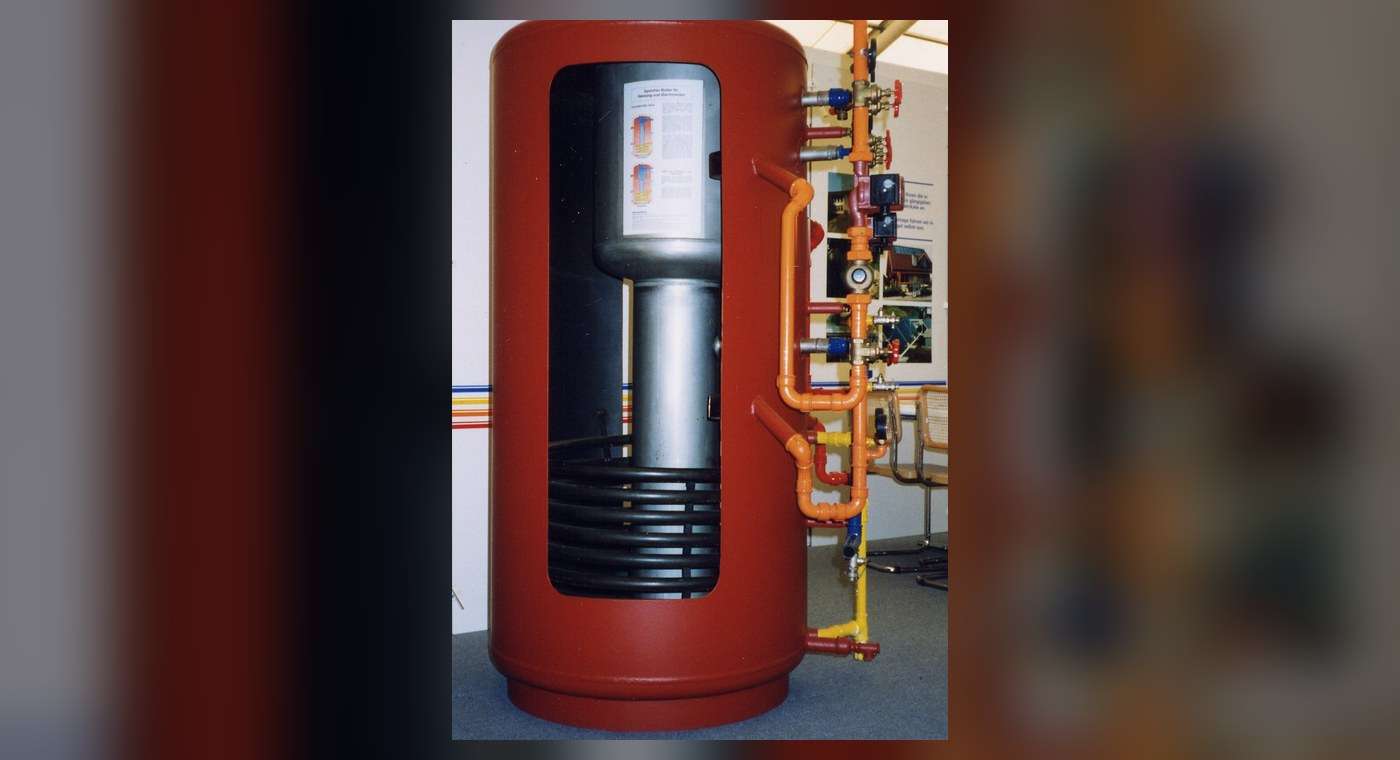
Then there is the all-in-one tank: a single tank with a partition in the middle, closed or perforated, where domestic hot water is drawn from the top and system water from the bottom. We advise against it. Water passes from one side to the other and mixes: the system draws heat from the hot water, the hot water cools and the unit starts making hot water again, and again. That way it uses twice as much and lasts half as long. If the two parts are truly separate, it is fine.
05
The bi buffer: two tanks, one above the other
The bi buffer is something else. It is two tanks one above the other, separated by a steel plate and a layer of insulation: hot water above, heating below, and the two waters never touch. It takes the space of one tank and is handy when space at home is tight. We have it in our catalogue in four sizes.
06
How many litres
On litres, rules of thumb do not agree. German sources give figures from 10 to 50 litres per kW of output: the EN 15450 standard gives 12 to 35 litres per kW, the VDI guidelines about 20. A 10 kW unit would therefore need between 120 and 350 litres. Two things matter more than the rule: the minimum water volume the manufacturer requires for its unit, and the system. Underfloor heating already holds a lot of water in its pipes, fan coils hold little. Our buffer tanks go from 100 to 1,500 litres, and the size is chosen with the heating engineer on the unit and the system. Bigger also means more heat lost, as we see below.
07
A cylinder that is too small is a waste
The same goes for the hot water cylinder. The heat pump heats it by turning a three-way valve: for that time it stops serving the system and brings the water up to hot water temperature. With a 300 or 500 litre cylinder the valve turns three times a day. With a 100 or 150 litre one, chosen because space is short, the unit has to switch to hot water as often as every half hour, in summer too while it is cooling. It is a huge waste of energy; and with underfloor heating the unit keeps going from low to high temperature and wears out much sooner.

08
How much a tank loses
A hot tank loses heat all day, and the EU energy label measures it: the class depends on the watts lost relative to the litres (EU Regulation 812/2013). At the class limits, a 300 litre tank loses 36 W in class A+, 70 W in class B and 98 W in class C: if it stays hot all year that is 319, 614 and 860 kWh. Heat loss grows with the difference between the water and the room: a buffer at 35 °C loses less than a cylinder at 50 °C. That is why insulation matters, and the tank should be the right size, not the biggest possible.

09
A plant room done properly
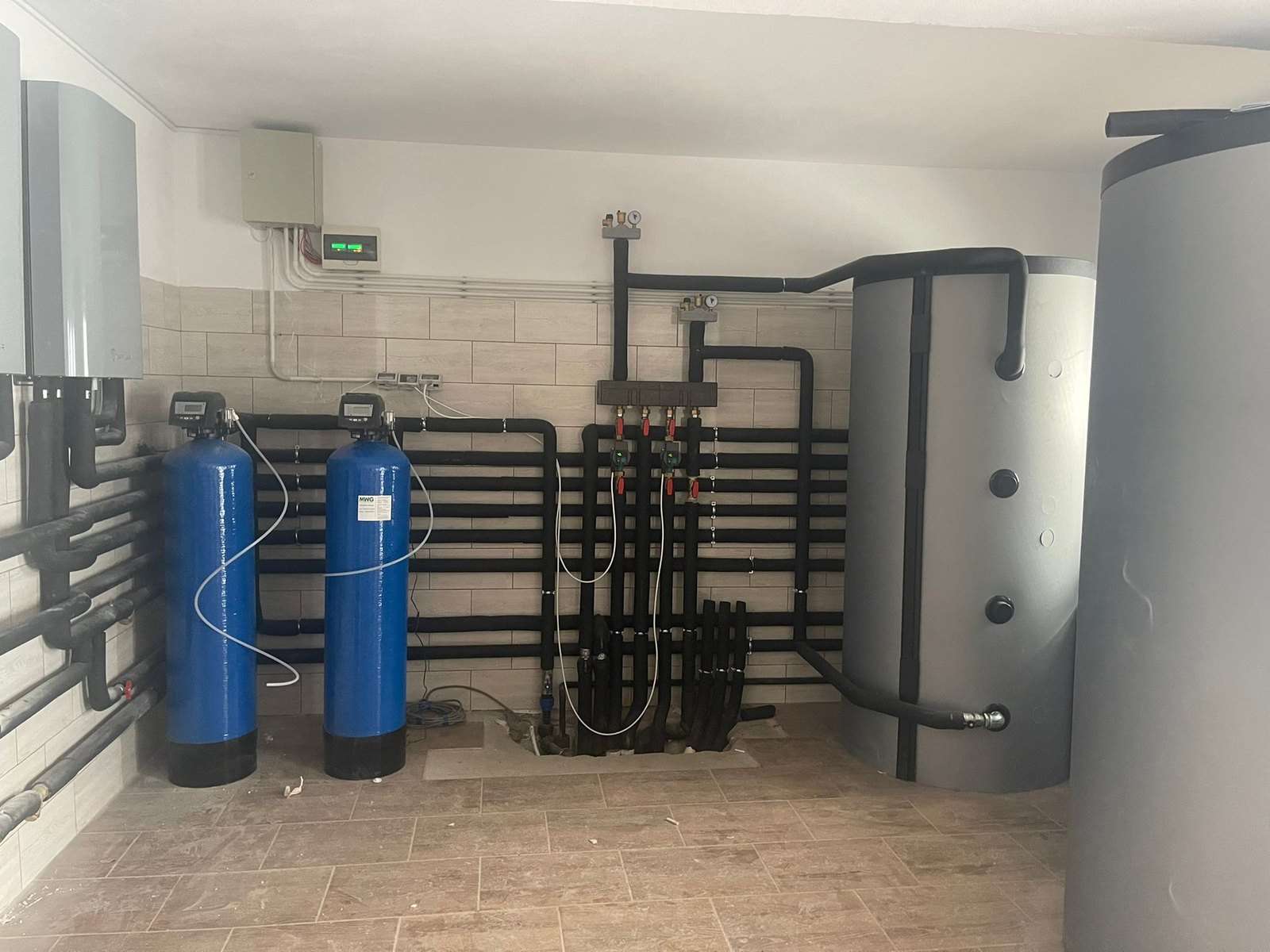
In a tidy plant room the buffer, the cylinder and the water treatment sit close together, with short insulated pipes. In summer the buffer and the chilled water pipes must be insulated with anti-condensation material: below the dew point the room air condenses on them. And the system water must be treated, because dirt that settles in the tank ends up in the heat exchangers. Who checks what and how often is in the article on maintenance.
10
What to ask the installer
Five questions. Which type of buffer: plain, not stratified and not all-in-one. How many litres and why, starting from the unit’s minimum volume and the water already in the system. Which energy class the tank has. How big the hot water cylinder is: with 100-150 litres the unit will switch to hot water too often. And what controls the unit, the buffer sensor or the rooms. If you want an opinion on your system, ask us for information.
11
Frequently asked questions
Does a heat pump need a buffer tank?
In most systems yes: it gives the unit a volume of water for long cycles, gives heat during defrosting and separates the unit’s circuit from the rooms’ circuit. The size depends on the unit and the water already in the system.
Is a stratified buffer tank better?
Not with a heat pump: a stratified tank is designed for wood and solar, which work at high temperatures. A heat pump performs better with the lowest possible water temperature, and its flow rate mixes the layers.
Can an all-in-one tank be used for heating and hot water?
We advise against it if the two parts share the same water, divided only by a closed or perforated partition: the water mixes, the unit keeps remaking hot water, uses twice as much and lasts half as long. It is fine if they are separate, as in the bi buffer.
How many litres should a buffer tank have?
Sources range from 10 to 50 litres per kW; EN 15450 gives 12-35 litres per kW. What counts is the minimum volume the manufacturer requires and the water already in the system.
How big should the hot water cylinder be?
With 300-500 litres the unit switches to hot water three times a day; with 100-150 litres as often as every half hour, wasting energy and adding wear.
How much heat does a buffer tank lose?
It depends on the energy class: at the class limits a 300 litre tank loses 36 W in A+ and 98 W in C, that is 319 to 860 kWh if it stays hot all year.
Should the buffer tank control the heat pump?
Better not: it heats up and cools down quickly and the unit keeps switching on and off. With HCC the unit regulates on room temperature.
See also: Heat pump water heater or the system heat pump: hot water with a heat pump · Cooling with a heat pump: underfloor or fan coils, how efficient it is and what you need
All the technical tips are on the series page.


