

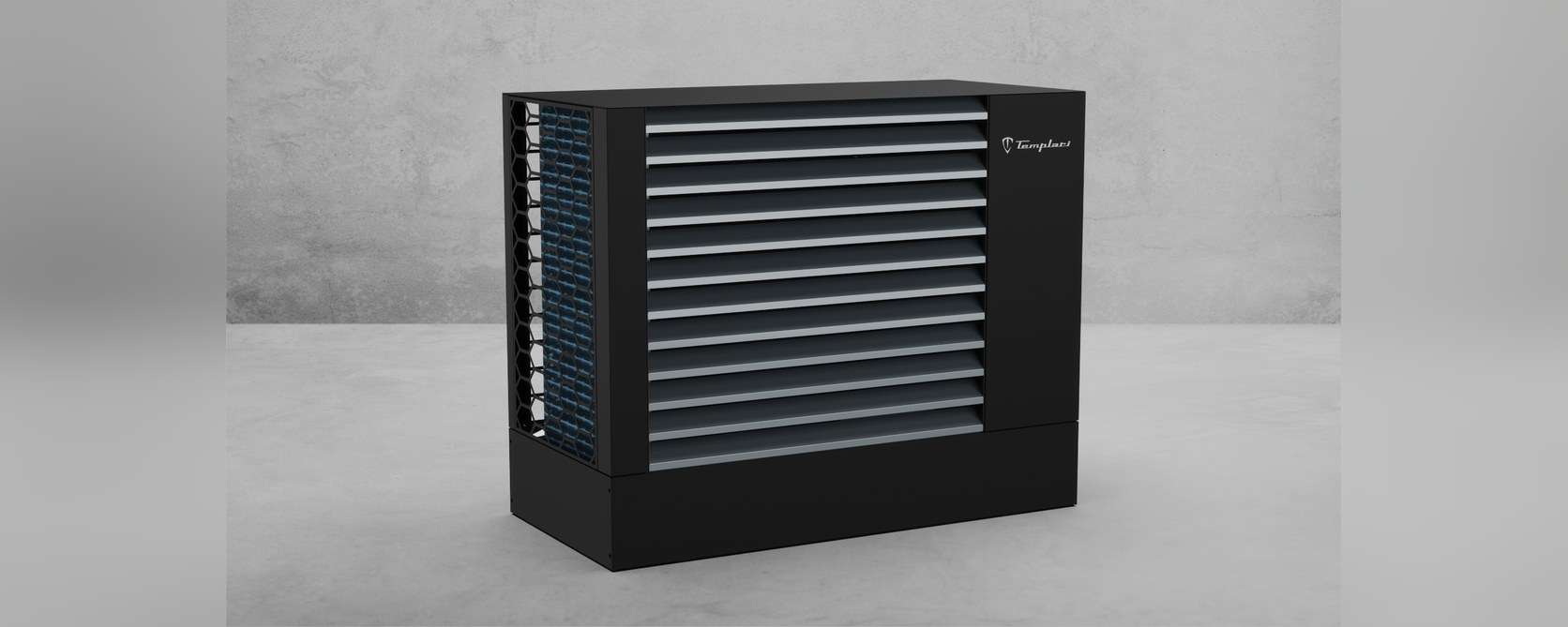
R290 heat pump: what is inside a propane air-to-water unit
Our air-to-water heat pumps run on R290, that is propane. The gas, however, is only the start: what makes the difference is how the machine is built around it. Here we describe ours, piece by piece.
01
A natural gas that stays entirely outside the house
R290 is propane: a natural gas with a GWP of 3, which means an almost zero greenhouse effect. It is flammable, and that is why with R290 only monobloc units are made: the whole gas circuit stays in the machine outdoors, and only the water pipes enter the house.
The propane is not burned here: there is no flame and no combustion. It is not the gas in a cylinder: R290 is refrigerant-grade propane, at least 99.5% pure and dry, while bottled LPG is a mix with butane and an added odorant. It always runs in the same factory-sealed circuit, evaporating in the outdoor coil and turning back into liquid in the condenser, and as long as the circuit is intact it is never used up. The electrical panel sits in a compartment separate from the refrigerant circuit, as required by the safety standard for heat pumps with flammable refrigerants (EN 60335-2-40), and there is a degasser on the water pipes that separates and vents any gas.

F-Gas leak checks: None
Used in: Our monobloc air-to-water units
F-Gas leak checks: Above 7.4 kg (5 t CO₂eq)
Used in: Kita Air, industrial split
F-Gas leak checks: Above 2.4 kg (5 t CO₂eq)
Used in: Previous-generation units
02
The right gas for radiators
With propane the machine heats water well even at the high temperatures radiators need. The compressor discharge stays cooler than with R32, and the vapour injection we use on our R32 machines is not needed here. That is why R290 is the gas that works best when the house has radiators.
03
Subcooling: one more control
In the condenser the refrigerant gives its heat to the water of the system and becomes liquid. It leaves a few degrees below its condensing temperature: those extra degrees are the subcooling. They do two things:
- only liquid reaches the expansion valve, without gas bubbles, and the machine runs steadily;
- every kilo of refrigerant carries more heat, so the machine is more efficient.
Too little is a problem, but so is too much: it means liquid is sitting in the condenser and taking away exchange surface.
On our R290 air-to-water units of the SP, MP, LP and LP PLUS range there is a second electronic valve besides the expansion valve. The controller uses it to keep the subcooling at the right value, one for heating and one for cooling.
04
The rest of the machine
- Large outdoor coil with fins 2.5 mm apart: it builds up less frost and defrosts less often (tip 1).
- Demand defrost: it starts only when the coil is full of frost and heat exchange has dropped, not on a timer (tip 2).
- Inverter compressor: the machine spends most of the winter at half capacity, where it is most efficient (tip 3).
- Electronic expansion valves only, driven by our u-Kita controller.
- HCC controls the system on the room temperature, read by the ROOM sensors, not on the buffer tank (tip 4); with the optimiser it uses the walls of the house as storage (tip 5).
05
What to check before buying
- which gas the machine uses, and whether it is a monobloc with all the gas outside the house;
- with radiators, at what water temperature the machine delivers its capacity;
- whether the expansion valves are electronic and whether the machine also controls the subcooling;
- how large the outdoor coil is and how far apart the fins are.
Our R290 air-to-water units are on the air-to-water heat pumps page.
06
Frequently asked questions
Is the propane in a heat pump burned?
No: there is no flame and no combustion. The propane circulates in a sealed circuit, evaporating and turning back into liquid on every cycle, and as long as the circuit is intact it is never used up.
What is an R290 heat pump?
A heat pump that uses propane as refrigerant: a natural gas with a GWP of 3, meaning an almost zero greenhouse effect. Since it is flammable it is used only in monobloc units, with all the gas outside the house.
Does a propane heat pump work with radiators?
Yes: with R290 the machine heats water well even at the high temperatures radiators need, and the compressor discharge stays cooler than with R32.
What is subcooling?
It is the number of degrees below the condensing temperature at which the refrigerant leaves the condenser: it makes sure only liquid reaches the valve and that every kilo carries more heat. On our SP, MP, LP and LP PLUS a second electronic valve keeps it at the right value.
Why is R290 used only in monobloc units?
Because it is flammable: in a monobloc the whole gas circuit stays in the machine outdoors, and only the water pipes enter the house.
See also: Heat pumps and radiators: does it work? Yes, and better with propane · High temperature heat pump: up to 70 °C, how much more it uses and when you really need it · Heat pump for a flat: can you have one without an outdoor unit? What goes outside and what goes indoors
All the technical tips are on the series page. The next one in two weeks.


