

How much electricity does a heat pump use: per day, per year and by size, with the data sheet figures
The question always comes in the same form: how much does a 10 kW heat pump use? The honest answer is that consumption does not depend on the size of the machine but on how much heat the house asks for, and on how much it costs the machine to produce it. Here are the figures from our data sheets, the sums you can do yourself and the things that push the bill up or down.
01
Consumption is not the power on the nameplate
A 10 kW heat pump delivers 10 kW of heat; it does not use them. The ratio between the heat it gives and the electricity it draws is the COP: a Kita SP 10 at +7 °C outdoors, with water at 35 °C, gives 10 kW of heat and draws 1.84 (COP 5.44). At -7 °C it gives 7.4 kW and draws 2.1 (COP 3.52). It is the opposite of a boiler, where 24 kW on the plate are 24 kW of gas burnt. The first thing to get out of your head is the equation size equals consumption.
02
How much it really draws, size by size
The chart gives the electrical power drawn by each model when it works at full output, at +7 °C and at -7 °C outdoors with water at 35 °C: it is the data sheet heat divided by the data sheet COP. An XS 7.5 draws 1.6 kW; an SP 8 from 1.4 to 1.6 kW; an SP 10 from 1.8 to 2.1; an SP 12 from 2.4 to 3.6; an MP 20 from 4.1 to 5.2 kW. These are ceilings: the machine modulates and for most of the hours it sits far below. Anyone looking for the consumption of a 6, 8, 10 or 12 kW heat pump finds the answer here for our range; for another brand the sum is the same, heat divided by COP, with the figures from its data sheet.

03
How much it uses per day
A day’s consumption is the heat the house asked for that day divided by that day’s COP. The physical maximum is quick to work out: an SP 10 running 24 hours at full output at -7 °C would use 2.1 kW for 24 hours, that is 50 kWh. It almost never happens: the machine is chosen to reach full output only on the coldest day of the year and for the rest of the winter it works at half capacity or less. For normal days there are the figures of the European HP Keymark certification, which tests the machine in an independent laboratory at part load too, as it really runs in winter: at +2 °C outdoors an SP 10 gives 4.8 kW of heat drawing 0.82 (COP 5.84); at +7 °C it gives 4.3 kW drawing 0.57 (COP 7.64); at +12 °C 4.2 kW with 0.40 kW (COP 10.37). A whole day at +2 °C is about 20 kWh of electricity, one at +7 °C about 14. Owners read it straight off the display: our machines count the kWh produced and the kWh used.
04
The certified part-load figures, size by size
The second chart comes from the HP Keymark data sheets (EN 14825, average climate, water at 35 °C): the electrical power each model draws at the test points at -7, +2 and +7 °C, that is at the load the standard sets for that temperature. At +7 °C the whole range from 8 to 20 kW sits between 0.6 and 0.9 kW: that is where most of the winter is spent.

05
How much it uses per year: the sum from your gas bill
The most reliable way to estimate annual consumption is not square metres but the bill you already have. The cubic metres of gas of the last year say how much heat your house really asks for, the way you live in it.
- take the cubic metres of gas of a whole year, heating and hot water together;
- one cubic metre is worth about 10 kWh of energy; an old boiler brings about 85% of it into the house, a condensing one about 95%. With 1,200 cubic metres the house received about 10,000-11,000 kWh of heat;
- divide by the SCOP at your system’s temperature: with radiators our air-to-water units sit between SCOP 3.8 and 4.3 (SP 10: 4.20), with underfloor heating between SCOP 5.1 and 5.75;
- the result is a year’s electricity: for that house about 2,400-2,600 kWh with radiators, about 1,800-1,900 with underfloor heating. For every 1,000 kWh of heat an SP 10 needs 238 kWh of electricity at 55 °C and 174 at 35 °C.
The same certification also gives the annual consumption in the average European climate, for a house whose design load equals the machine’s rated output: an SP 10 uses 2,999 kWh a year with water at 35 °C and 3,881 with water at 55 °C; an MP 18 5,759 and 7,081; an MP 20 7,306 and 8,861. These are the figures to put next to the sum made from the bill.
06
What pushes consumption up
- Water temperature: the biggest item. The same SP 10 at +2 °C outdoors has a COP of 4.72 with water at 35 °C and COP 3.17 with water at 55 °C: 49% more electricity for the same heat. That is why with radiators it pays to keep the flow temperature low, as explained in the tip on radiators.
- Cold outside: the SP 10’s COP goes from COP 5.44 at +7 °C to COP 3.52 at -7 °C and COP 2.86 at -15 °C. But days at -7 are few, and they weigh less on the total than people think.
- Domestic hot water: it is produced at 55-70 °C, where the COP is between 2.2 and 3.2. For normal use 45-50 °C in the cylinder is enough, and the difference shows on the bill.
- Defrosts: every defrost is heat taken away from the house. A machine that defrosts on a fixed schedule uses more than one that defrosts only when the coil is really full of frost.
- The wrong size: a machine that is too big always works at minimum and keeps starting and stopping; every start is a peak in draw and a bit of efficiency lost.
07
How to use less
- Flow temperature as low as possible: the HCC controller works on the rooms and extends the running hours instead of raising the temperature; every degree less of flow is more efficiency. How to test your own system is in the tip on radiators.
- Do not switch off and on: a house that cools down has to be reheated from scratch, at full output and with a worse COP. Better a constant temperature and a machine that modulates.
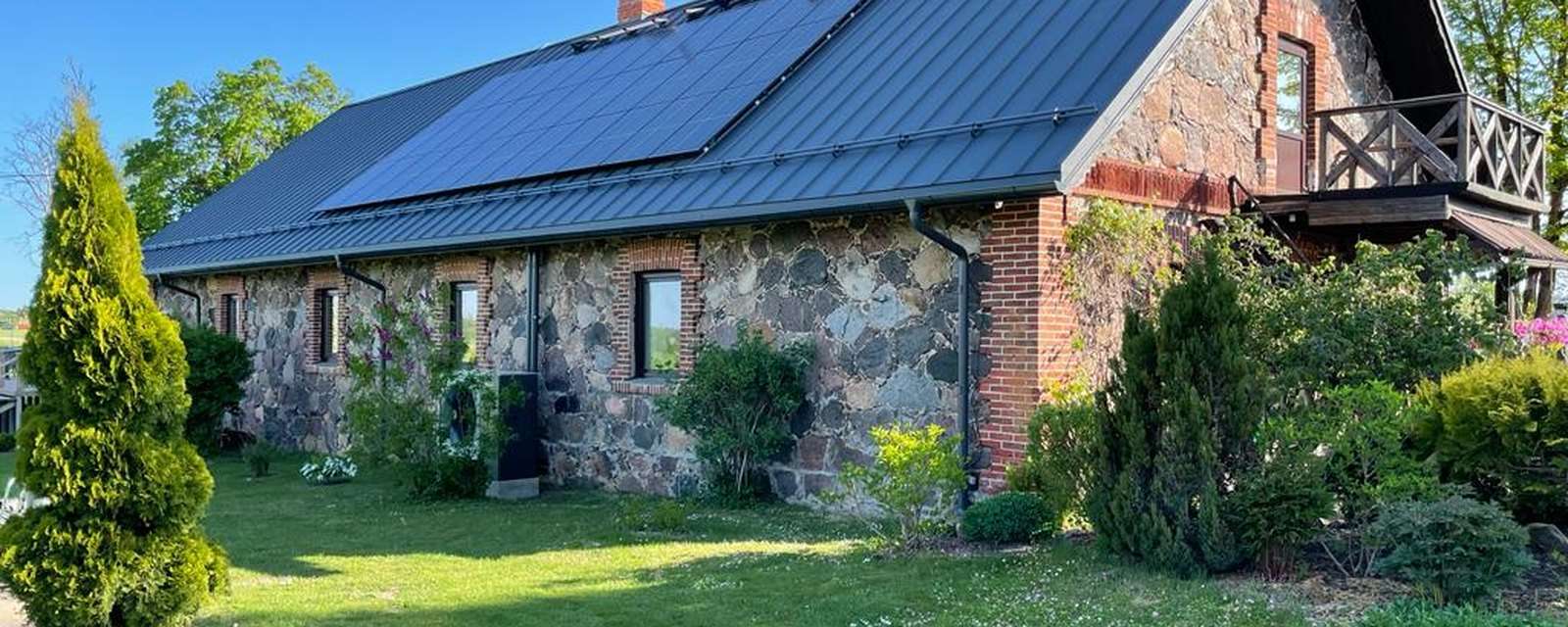
- Use the sun: with photovoltaics the daytime electricity comes from the roof. The energy optimiser shifts heating into the sunny hours and stores heat in the walls.
- Domestic hot water at 45-50 °C when that is enough, higher only for the anti-legionella cycle.
- The right size: chosen on the demand of the coldest day, not on the boiler. Why is in the tip on sizing and in the one on useful capacity.
- A machine that modulates right down and defrosts only on demand: that is the job of the inverter and the on-board electronics, not of the user.
08
Is it cheaper than gas?
The sum is done with your own tariffs, but the rule is simple. With radiators (SCOP 4.2) the heat pump costs less than the boiler as long as a kilowatt-hour of electricity costs less than about half a cubic metre of gas; with underfloor heating (SCOP 5.75) as long as it costs less than about two thirds. With photovoltaics the self-produced share is not paid for, and the comparison shifts further. On top of that the fixed cost of the gas supply and the compulsory boiler servicing disappear.
09
And in summer?
The same machine cools, and in cooling the ratio between cold produced and electricity drawn is called EER. An SP 10 with underfloor or fan coils at 18 °C water has an EER of 5.43; with water at 7 °C 3.62. The same rule applies: the closer the water is to room temperature, the less it uses.
10
And in an industrial building?
For an industrial building consumption is reasoned the same way, but the heat to produce depends on the height and on how it is distributed: how the kW are calculated is in the tip on industrial buildings, and how much capacity changes with the cold in the one on useful capacity.
11
Frequently asked questions
How much does a 10 kW heat pump use?
At full output, with water at 35 °C, a Kita SP 10 draws 1.84 kW at +7 °C outdoors and 2.09 kW at -7 °C. At part load, HP Keymark certified figures: 0.82 kW at +2 °C and 0.57 kW at +7 °C.
How much does a heat pump use per day?
The heat the house asked for that day divided by the COP. An SP 10 can use at most about 50 kWh on a -7 °C day at full output; with the Keymark part-load figures, about 20 kWh on a +2 °C day and about 14 at +7 °C.
How much does it use per year?
Take a year’s cubic metres of gas, multiply by 9 and divide by your system’s SCOP (4.2 with radiators, 5.75 with underfloor heating, for an SP 10). With 1,200 cubic metres: about 2,400-2,600 kWh with radiators.
Does a heat pump use a lot?
It uses electricity instead of gas: for 1,000 kWh of heat you need 174-238 kWh of electricity against about 105-120 cubic metres of gas. The electricity bill goes up, the gas bill disappears.
Does it use less with radiators or with underfloor heating?
With underfloor heating: SCOP 5.75 against 4.20 for an SP 10, about a quarter less. With radiators it pays to keep the flow temperature as low as possible.
How much do photovoltaics matter?
During the day the heat pump’s electricity comes from the roof. With the energy optimiser heating shifts into the sunny hours and the self-produced share grows.
See also: Heat pump and solar panels: how much the roof really covers, month by month, and how to make them work together · Heat pump COP: what it is, how it is measured, and why it is not the same in the fog · Heat pump maintenance and servicing: what to do, how often, and how long a heat pump lasts · Heat pump in an old house: it can be done, even with radiators, if you know what it will use · Heat pump water heater or the system heat pump: hot water with a heat pump · Are heat pumps worth it? The real drawbacks and how to avoid them · Three phase or single phase heat pump: which to choose and what supply you need
All the technical tips are on the series page. The next one in two weeks.


