

High temperature heat pump: up to 70 °C, how much more it uses and when you really need it
The high temperature heat pump is searched above all in Germany, 2,900 times a month, then in Poland (1,000), in Italy and the Netherlands (720), in Spain (590) and in France (480). Whoever searches for it almost always has a house with radiators and a boiler to replace, and wants to know whether a heat pump will deliver hot water like the boiler did. Our propane air-to-water units reach 70 °C. Here we explain what high temperature means, why the refrigerant makes the difference, what each extra degree costs and how many hours a year it is really needed. We cover radiators in the article on heat pumps with radiators.
01
What high temperature means
The EU energy label tests heat pumps at two water temperatures: 35 °C, for underfloor heating, and 55 °C, for radiators (EU Regulation 813/2013). With air at +7 °C, in the 55 °C test the water enters at 47 °C and leaves at 55 °C. A high temperature heat pump goes further: 65-70 °C and more, like a gas boiler. Our propane air-to-water units reach a flow temperature of 70 °C.
02
The refrigerant decides how high the water can go
Every refrigerant has a critical temperature, above which it no longer condenses and the unit stops heating. For R32 it is 78.1 °C, and in practice it is used up to 55-60 °C; for propane, R290, it is 96.7 °C, and it is used even above 75 °C (CIBSE Journal, 2025). Our propane compressor condenses up to 82 °C: we stop the flow at 70 °C so that the compressor lasts. How a propane heat pump is built is explained in the article on R290.

03
Every extra degree costs
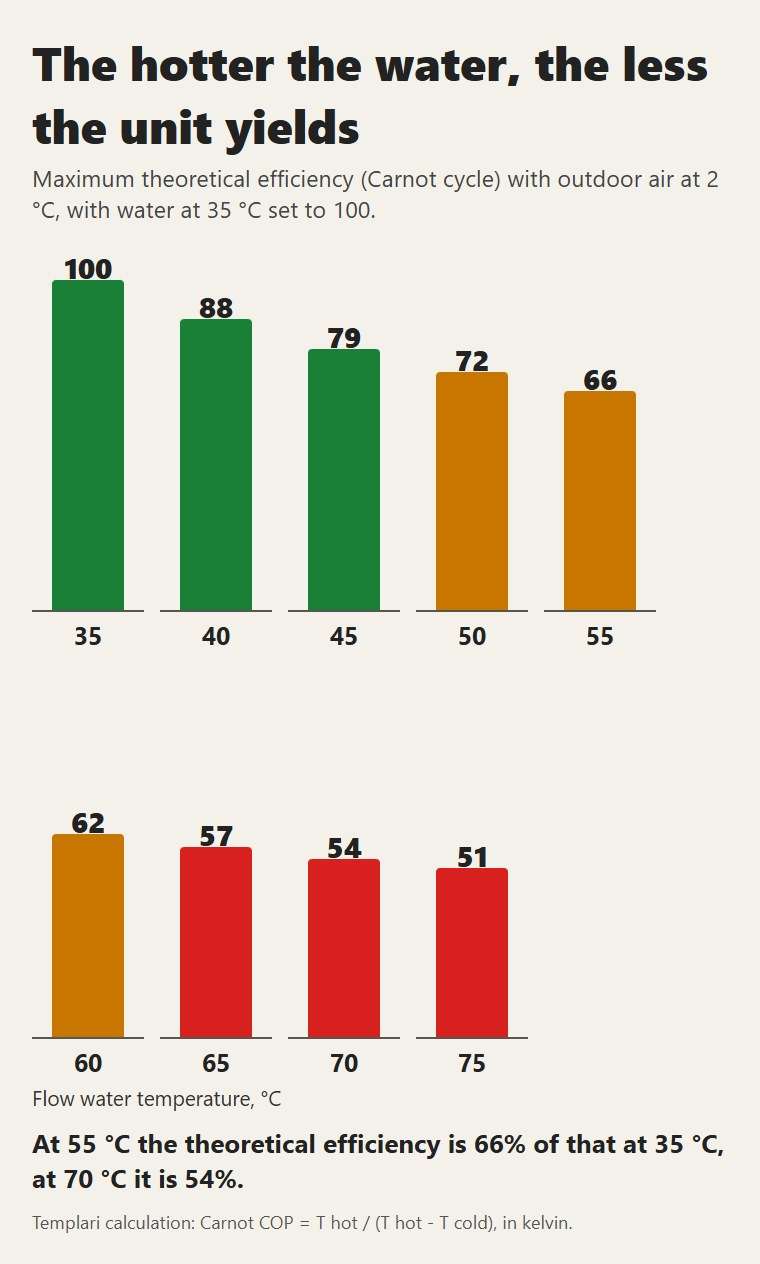
A heat pump yields more the smaller the lift between the outdoor air and the water it has to make. With air at 2 °C, the maximum theoretical efficiency, that of the Carnot cycle, with water at 55 °C is 66% of that with water at 35 °C; at 70 °C it drops to 54%. Real units follow the same path: the rule of thumb is 1.5 to 3% less for every extra degree (CIBSE Journal, 2023). On the Kita X data sheet, the SCOP, the efficiency over the whole winter, goes from 5.61 with water at 35 °C to 4.39 at 55 °C: 22% less. That is why high temperature is a reserve for the coldest days, not the normal way of working.
04
How hot the water really needs to be
Fraunhofer ISE measured 77 heat pumps for four years in existing houses built between 1826 and 2001. The flow water averaged 38.2 °C; the average maximum was 48.6 °C. In houses with radiators only, the average maximum rose to 63.9 °C, but the yearly average stayed at 38.5 °C; the highest value measured was 68.3 °C. At -10 °C outside, most radiator systems stayed below 55 °C. In England a government study of real homes found that, without changing radiators, 55 °C is enough for 53% of homes on an average day of the coldest month, but for only 10% on the peak day. It means very hot water is needed a few hours a year, on the coldest days: that is where a unit that reaches 70 °C counts.

05
The unit only goes up when needed
A well-made heat pump does not keep the water at 70 °C all winter. With a heating curve the water temperature follows the outdoor temperature and rises only when it is cold outside, as we explain in the article on the heating curve. With HCC the unit looks at room temperature and works on time: more hours with low water temperature instead of a few hours with high. That way 65-70 °C is rarely needed. Why a heat pump should not be controlled like a boiler is in the article on HCC.
06
Domestic hot water and legionella
High temperature is also needed for hot water. The Italian legionella guidelines require at least 60 °C in storage tanks, and between the unit’s flow and the water in the cylinder there are about 4 degrees: 60 °C in the cylinder takes a 64 °C flow, which a unit capped at 55 °C cannot give. With 70 °C our heat pump gets there without an electric heater. We cover it on the page on domestic hot water.
07
Before raising the temperature, look at the radiators
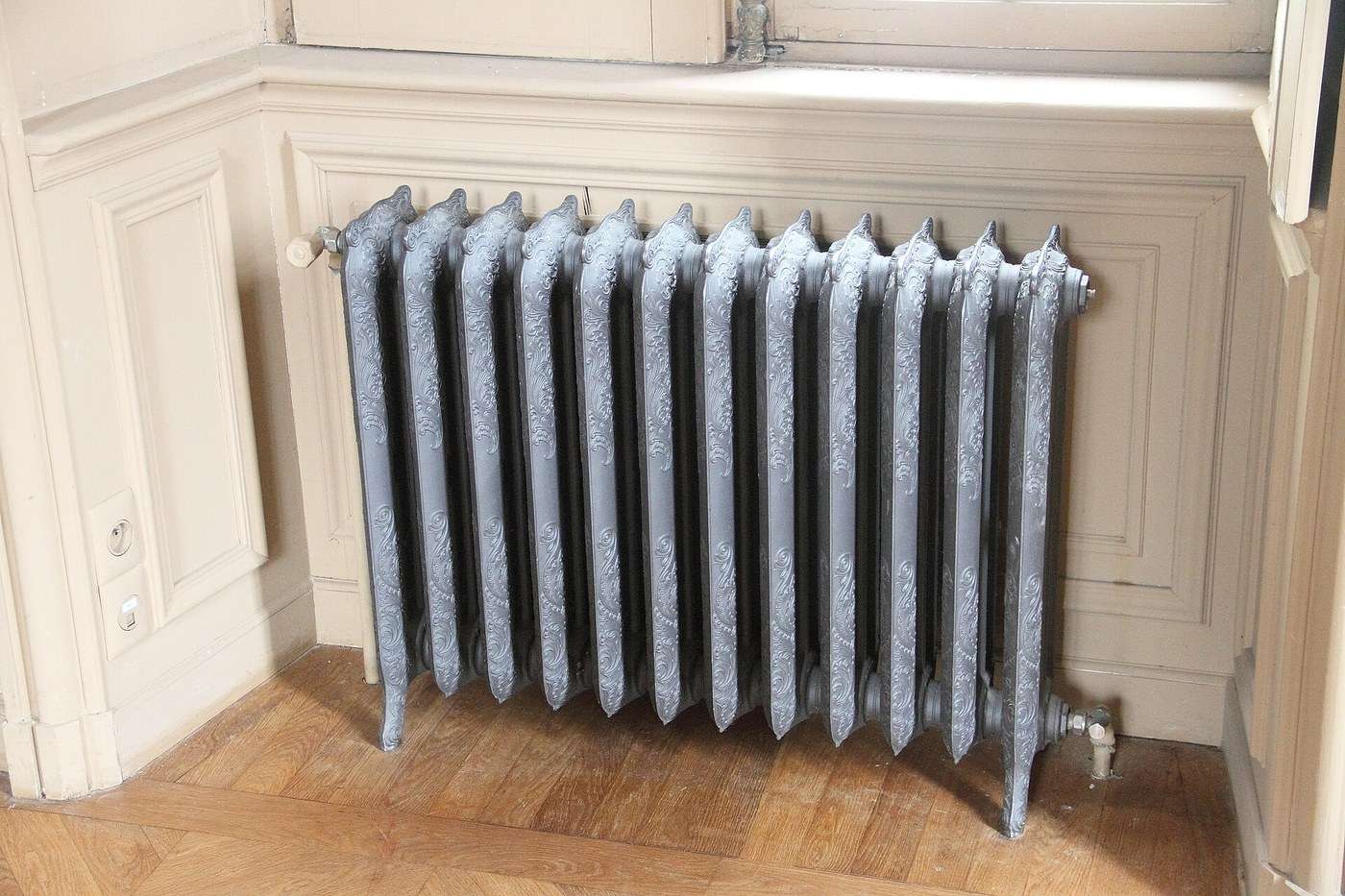
A radiator heats the room with the difference between its water and the air: the bigger it is, the less hot the water needs to be. Old houses often have large radiators, fitted when windows were single-glazed; after replacing the windows or insulating the roof, those same radiators are enough with cooler water. Before deciding how high the unit must go, it is worth a winter test with the boiler at a lower temperature, and replacing only the radiator in the room that stays cold. We explain it in the article on old houses.
08
What to ask the installer
Five questions. What temperature the unit reaches with the compressor alone, without an electric heater. With which refrigerant. What temperature it will run at on normal days and on the coldest ones, that is how the heating curve is set. How it makes hot water at 60 °C. And who checked whether the radiators are big enough. If you want an opinion on your house, ask us for information.
09
Frequently asked questions
What is a high temperature heat pump?
It is a heat pump that heats water above the 55 °C of the EU radiator test, up to 65-70 °C and more, like a boiler. Our propane air-to-water units reach a flow temperature of 70 °C.
How hot can a propane heat pump go?
Propane has a critical temperature of 96.7 °C and is used even above 75 °C. Our compressor condenses up to 82 °C; we limit the flow to 70 °C so that the compressor lasts.
How much more does a heat pump use at 70 °C?
With air at 2 °C the theoretical efficiency at 70 °C is 54% of that at 35 °C. But water that hot is needed only a few hours a year: in the existing homes measured by Fraunhofer ISE the average flow was 38.2 °C.
Do radiators need a high temperature heat pump?
On the coldest days often yes. Fraunhofer ISE measured an average maximum of 63.9 °C in homes with radiators only, with a yearly average of 38.5 °C. That is why it matters that the unit reaches 70 °C, but goes there only when needed.
Is R32 or R290 better for high temperature?
Propane: its critical temperature is 96.7 °C against 78.1 °C for R32, which in practice is used up to 55-60 °C.
Can a heat pump make hot water at 60 °C against legionella?
Yes, if it reaches at least a 64 °C flow, because there are about 4 degrees between flow and cylinder. Our propane units reach 70 °C without an electric heater.
Do I have to replace my radiators for a heat pump?
Not necessarily. First run a winter test with the boiler at a lower temperature: often it is enough to replace the radiator in the room that stays cold.
Sources: Fraunhofer ISE, WP-QS im Bestand · CIBSE Journal, CPD Module 246 · BEIS, Electrification of Heat Demand Side, 2021
See also: Heat pump for a block of flats: communal or one per flat, output, hot water and where it goes · Heat pump or pellet boiler: efficiency, space, fine dust and maintenance compared
All the technical tips are on the series page.


