

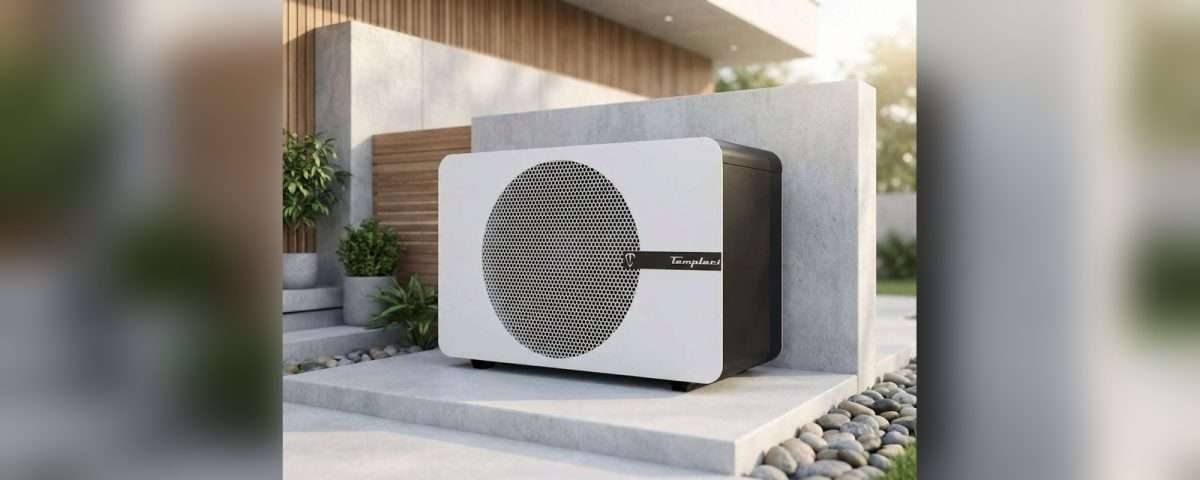
Heat pump in an old house: it can be done, even with radiators, if you know what it will use
A house built before 1990 and never insulated is the case people argue about most: some say a heat pump does not belong there, others say everything must be renovated first. The answer is simpler. On the house, most of the time, nothing can be done: walls are not rebuilt and often not even the windows. The heat pump can go in anyway, radiators included, with a suitable unit and knowing from the start that it will use two or three times the electricity of a class A house. Here we explain why, how much, and what to check first.
01
What the energy class says
Energy classes differ from country to country, but the logic is the same: the house is compared with a reference building of the same shape, in the same climate, built properly. In Italy the scale runs from A4 to G: a class A4 house uses less than 40% of that reference, a class G house more than three and a half times it, under the decree of 26 June 2015. A house from the sixties or seventies that has never been touched almost always sits in the last two classes, F and G: the red band of the scale seen on property listings.

02
What an old house means, in numbers
A class A or B house needs, on the coldest day, 25-40 W per square metre. A renovated house 50-70. A house built before 1990 and never insulated 80-120 W per square metre, sometimes more. The same 100 m² flat therefore needs 3-4 kW in a new house and 8-12 kW in an old one. It is not the heat pump that uses more: it is the house that lets two or three times the heat out. It was the same with the boiler, but gas hid it better.
03
Where the heat escapes
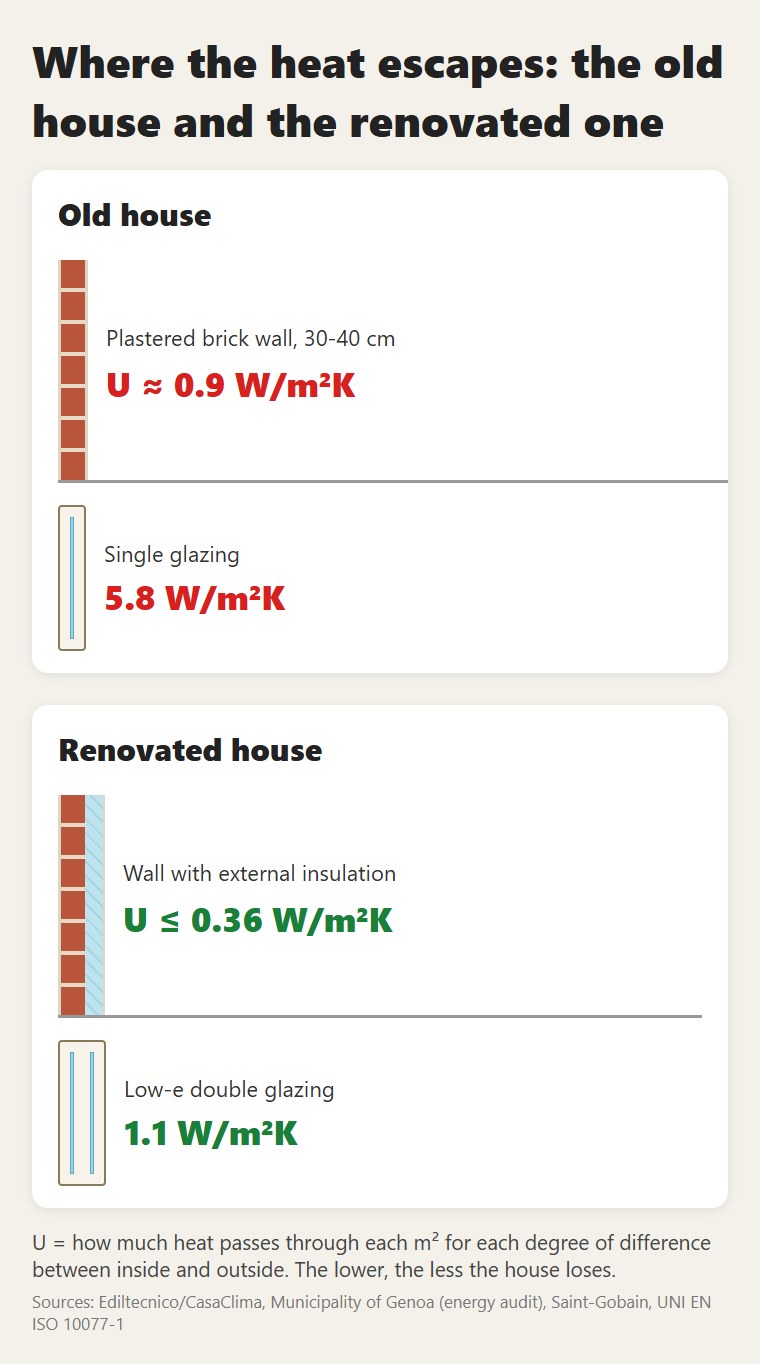
Heat escapes through walls, roof, windows and draughts. How much is told by the U-value: the watts passing through each square metre for each degree of difference between inside and outside. A plastered brick wall of 30-40 cm, typical of the seventies, sits around 0.9 W/m²K; the same wall with external insulation must drop below 0.36 to meet renovation limits. Single glazing lets through 5.8 W/m²K, low-e double glazing 1.1: five times less. That is why in an old house the heat pump works more in the same hours: it is not its fault.
04
Nothing can be done on the house, but on the machine yes
Insulating an old house from the outside costs more than the heat pump and often cannot be done, for planning rules, for neighbours, for money. So you work on the machine. You need a heat pump that reaches radiator temperatures, keeps its output when it is cold outside and regulates on the house instead of on a fixed curve. Our propane air-to-water units, R290, do all three: 70 °C flow temperature, operation below -20 °C, control on room temperature. If one thing can be done on the house, the first is the attic or the top floor slab: it is the part that is insulated with the least work, and every kW of heat loss removed is electricity saved for every winter to come.
05
It works with radiators
The radiator of an old house was chosen for a boiler sending water at 70-80 °C. Rated at 75 °C, at 55 °C it gives about half, as we explain in the article on radiators. That is why with a heat pump that stops at 55 °C an old house often does not get warm. Ours reach 70 °C: on the coldest days the water goes high and the radiators perform as before; on the days in between the room-based control lowers the water and efficiency rises. There is no need to replace the radiators; if you want to replace a few, start with the smallest.
06
It will use two or three times a class A house
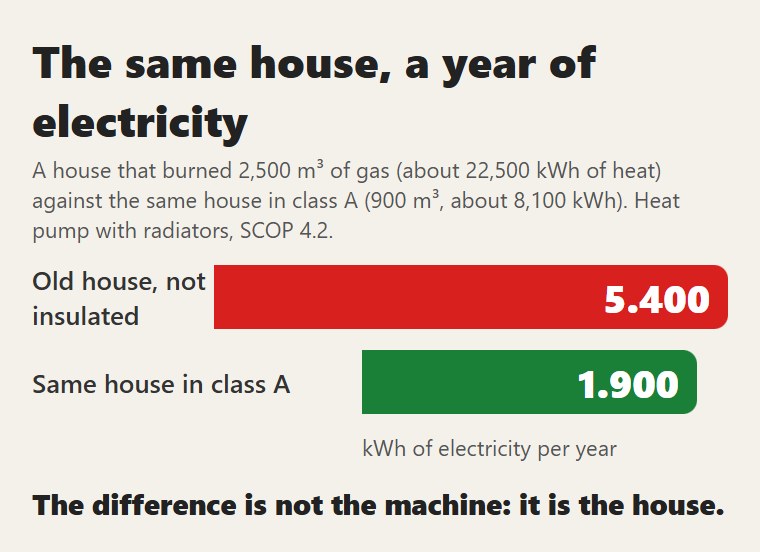
It has to be said plainly. The heat the house asks for is two or three times, so the electricity is too. The calculation starts from the gas bill, as in the article on consumption: the cubic metres of a year times 9, divided by the SCOP of the system. With radiators the certified SCOP of our SP 10 is 4.2 at 55 °C: a house that burned 2,500 cubic metres of gas needs about 5,400 kWh of electricity a year. The same house in class A, with 900 cubic metres, would need about 1,900. The difference is not the machine, it is the house.
07
Propane makes the difference when it is cold
In an old house the moment that counts is the coldest day, when the house asks for the most and the radiators want the hottest water. Propane evaporates down to -30 °C and condenses above 80 °C: the R290 unit holds the two together, cold air outside and hot water inside, without struggling. It will use more on those days, like any heating, but it does not stop and does not need a heater working in its place. How it is built inside is in the article on the R290 unit.
08
Which size
For a house you normally go up to 20 kW; for a large old house up to 30. The size is chosen on the heat loss calculation, not on square metres, and you look at the output the unit gives at -7 °C, not the rated one, as in the article on useful capacity. An old 150 m² house usually needs 12-18 kW: a Kita MP. A 250 m² one can reach 20-30 kW: a Kita LP. Below, for flats, there is the Kita X. A unit that is too big keeps starting and stopping and lasts less; too small, it cannot cope on cold days: we explain it in the article on sizing.
09
Better to keep the boiler alongside?
Keeping the gas boiler next to the heat pump for the cold days is the most frequent idea in an old house. We do not recommend it, and in the article on hybrids we explain why: two systems, two maintenance contracts, the gas contract that stays, and a heat pump chosen small that then works badly. With a propane unit of the right size the boiler is not needed; at most a small electric back-up heater that in practice does not run.
10
What to check before deciding
Three things. The heat loss calculation, done by a heating engineer, which gives the real kW of the house. The gas bills of the last two years, which say how much heat the house really asked for. The radiators, room by room: how many and how big, because that decides the water temperature needed. With these three figures you choose the unit and know in advance what it will use. Without them, you are guessing.
11
The next units
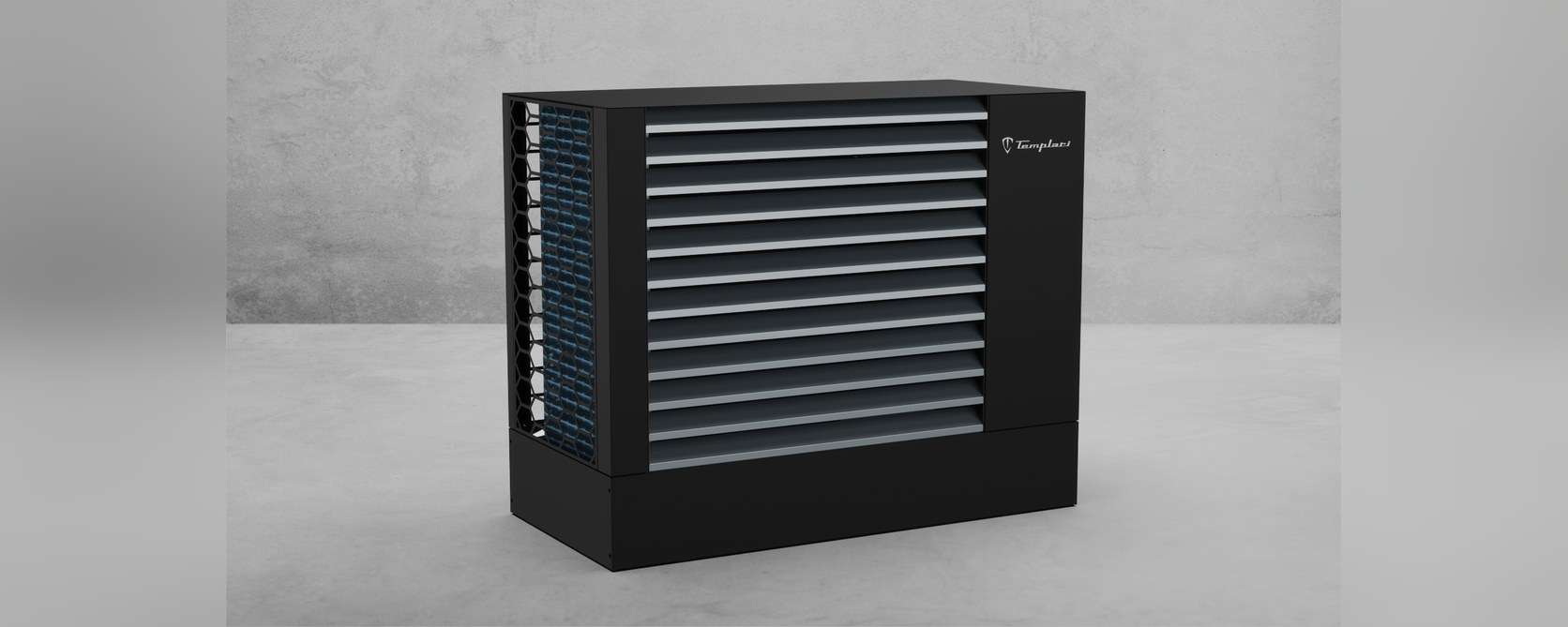
For old houses the unit about to arrive is the new propane air-to-water, with the compressor enclosed in an insulated housing that you can barely hear; for flats the Kita X. Both control on room temperature and reach 70 °C. If you have an old house and want to know whether and with which unit it can be done, ask us for information: with the three figures above we answer with a number, not a maybe.
12
Frequently asked questions
Can a heat pump go into an old, uninsulated house?
Yes, radiators included, with a propane unit that reaches 70 °C and controls on room temperature. It will use two or three times the electricity of a class A house, because the house loses two or three times the heat.
What energy class is an old house?
A house from the sixties or seventies that was never insulated almost always sits in the lowest classes: in Italy F or G, more than two and a half, often more than three and a half times the reference building of the 2015 decree.
Does a heat pump work with old radiators?
Yes, if it reaches the temperature they need. Radiators are rated at 75 °C and give about half at 55 °C: a heat pump that stops at 55 °C is often not enough in an old house. Ours reach 70 °C.
How much does a heat pump use in an old house?
Start from the gas bill: cubic metres of a year times 9, divided by the SCOP. With 2,500 cubic metres and radiators, about 5,400 kWh of electricity a year with an SP 10.
Should the house be insulated first?
If it can be done, it helps: every kW of heat loss removed is electricity saved for good, and the attic is the part insulated with the least work. If it cannot, the heat pump goes in anyway, with the right size.
Should the boiler be kept as back-up?
No, with a propane unit of the right size. Keeping the boiler means two systems, two maintenance contracts and the gas contract that stays.
What size is needed for an old house?
It is decided on the heat loss calculation and the output at -7 °C. As an order of magnitude, 150 m² uninsulated need 12-18 kW, 250 m² can reach 20-30.
See also: Heat pump in cold weather: down to what temperature does it work? Below freezing, at -20 and -25 °C · High temperature heat pump: up to 70 °C, how much more it uses and when you really need it · Heat pump or pellet boiler: efficiency, space, fine dust and maintenance compared
All the technical tips are on the series page.


