Rotary vs scroll compressor: what it tells you about the heat pump in front of you
The compressor is the heart of the heat pump: it is what raises the heat taken from the outdoor air to the temperature needed inside the house. Not all compressors are the same, though, and the type a manufacturer chooses says a lot about the unit it has in mind.
01
The families of refrigeration compressors
The compressor is the same component in a refrigerator, a cold room, an air conditioner and a heat pump: it draws in the refrigerant at low pressure and brings it to the pressure, and therefore the temperature, at which it can give up heat. What changes is the size and the way it compresses. There are five families.
Reciprocating, piston. The oldest and most widespread in refrigeration: from the household refrigerator, where it is a small hermetic unit, to cold rooms and supermarket display cases, where it is semi-hermetic and reaches tens of kilowatts. Sturdy and able to withstand high compression ratios, but it pulses, vibrates and has many moving parts.
Rotary, vane or eccentric rotor. The type found in air conditioners and small heat pumps: light, inexpensive, quiet at small sizes. A single rotor in the small ones, two out of phase in the medium ones, the twin rotary.
Scroll, spiral. From home heat pumps to water chillers and units of 50-100 kW for industrial buildings: continuous compression, few moving parts, tolerates a little liquid, does not vibrate at large displacements.
Screw. Two meshing helical rotors: hundreds of kilowatts, large water chillers, industrial cold rooms, low-temperature plants. High efficiency at full load, with the cost and maintenance of an industrial plant.
Centrifugal. An impeller that accelerates the gas: thousands of kilowatts, the refrigeration plants of hospitals, airports and large offices. Outside our field.
Besides the principle, the construction also differs. Hermetic: motor and compressor welded in a shell, it cannot be opened, it is replaced; this is the type in refrigerators, air conditioners and heat pumps, ours included. Semi-hermetic: the shell is bolted and can be opened for maintenance; this is the type in commercial refrigeration. Open: the motor is outside, connected by a shaft with a seal; this is the type in refrigerated trucks and large industrial plants.
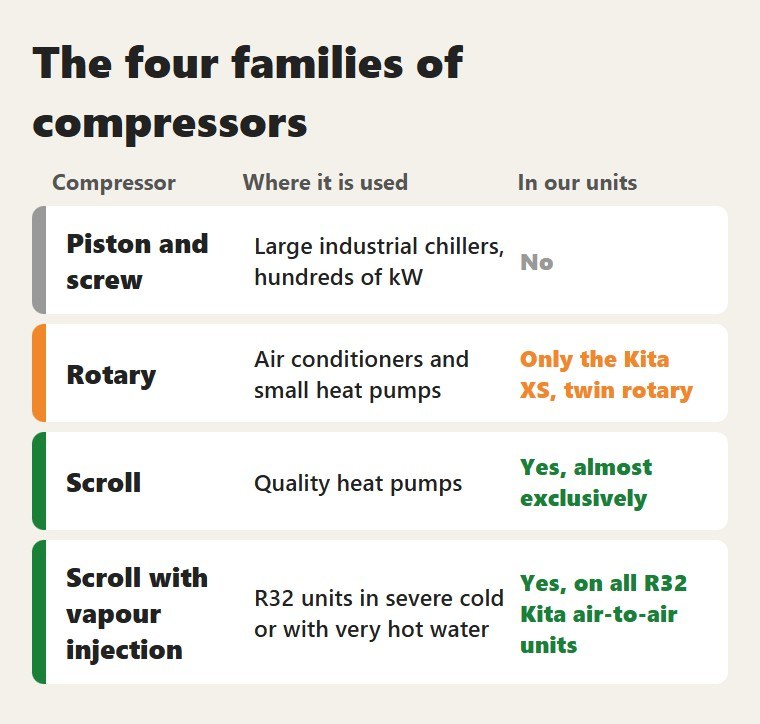
In heat pumps, from the home to the industrial building, the real choice is between two: rotary and scroll. The rest of this tip explains why we choose the scroll.
02
The rotary: the one in air conditioners
The rotary is the compressor found in almost every air conditioner. Inside a cylinder an eccentric rotor turns: in the smallest air conditioners there is a single rotor, in larger ones there are two, offset to balance each other, and that is the twin rotary. It is light, small, inexpensive, and for a home it is fine: at small sizes a good rotary performs as well as a scroll. It has two limits, though. It is sensitive to liquid: a compressor should only draw in gas, and the rotary needs a tank on the suction side, the accumulator, which evaporates the droplets before they reach the cylinder. And as displacement grows, as industrial-building units require, it starts to vibrate: the bigger the eccentric rotor, the more it unbalances the machine.

03
The scroll: two spirals chasing each other
The scroll is made of two spirals, one fixed and one that orbits inside it without rotating on itself. The gas enters from the outside, is trapped in ever smaller pockets and leaves compressed from the centre. The movement is continuous, without knocks, and there are few moving parts. Three advantages follow. It is robust: the spirals tolerate a little liquid better, which the rotary suffers from. It does not vibrate even at the large displacements of industrial units. And it performs well across the whole operating range, which is what counts in a heat pump that goes from winter to summer.

04
Vapour injection
There is a fourth advantage, which on R32 units weighs more than the others: the scroll can have vapour injection. R32 is a refrigerant that leaves the compressor very hot. When it is very cold outside, or when very hot water is needed inside, the compressor has to raise the pressure a lot: the compression ratio grows and with R32 the discharge temperature climbs too high, which damages the oil and shortens the life of the unit. Injection sends part of the refrigerant, already cool, into the spirals halfway through compression: the discharge temperature drops, the output available in the cold rises, and the compressor always works within its limits. With propane, R290, the problem does not exist: the discharge temperature stays low and injection is not needed.
05
What we use
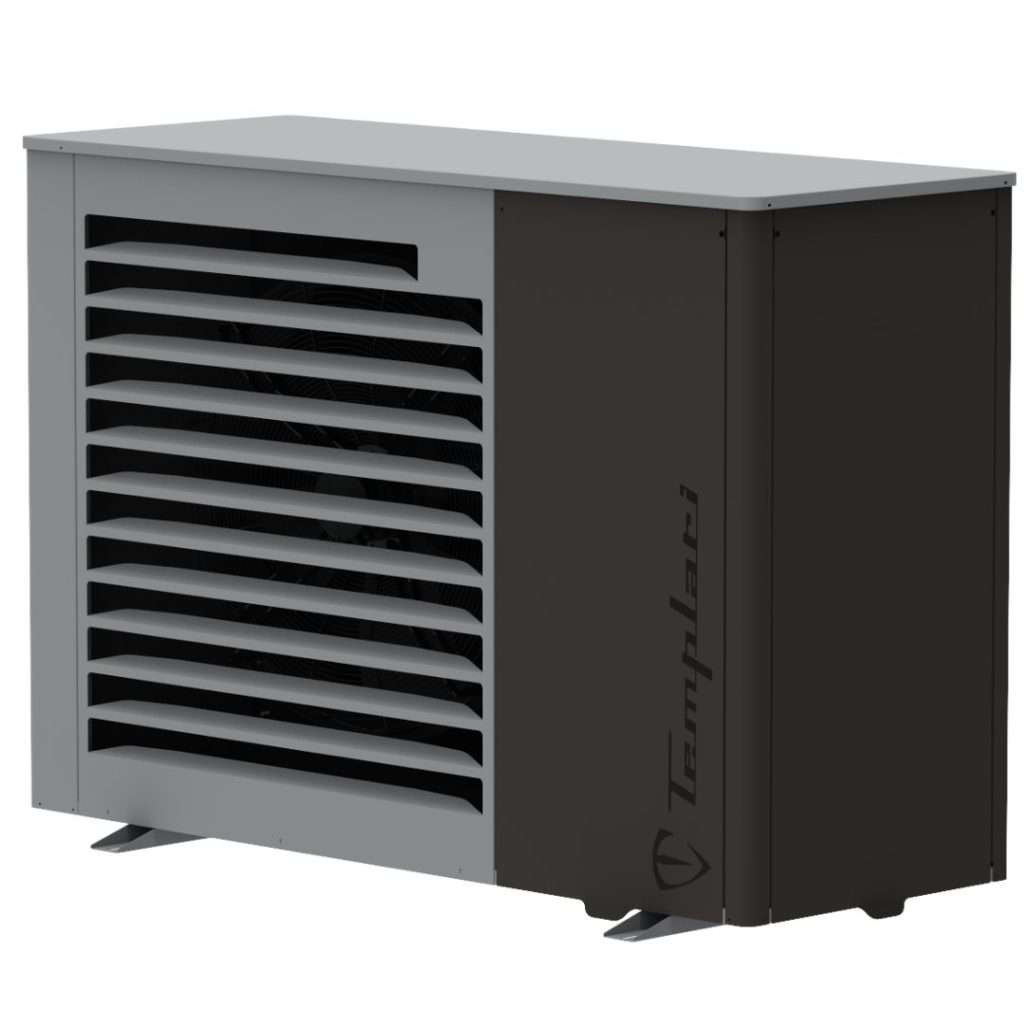
In our units we use almost exclusively scroll compressors, for their robustness and their efficiency. All our Kita air-to-air units on R32 have a scroll with vapour injection: it is one of the reasons why they heat well even on the coldest nights, and why units installed years ago still work as on day one. Our air-to-water units run on R290 and do not have injection, because with propane it is not needed.
06
How to check, before you buy
- ask which compressor the unit has: rotary or scroll, and what brand;
- if the unit runs on R32, ask whether the compressor has vapour injection, especially if it will work with low outdoor temperatures or high-temperature hot water; with R290 it is not needed;
- for an industrial or large building, ask the compressor’s displacement and how it is mounted: at those sizes a rotary vibrates.
07
Frequently asked questions
Scroll or rotary compressor: which is better?
For a small house a good rotary performs as well as a scroll. At large displacements the scroll is sturdier, does not vibrate, tolerates some liquid better and can have vapour injection. In our machines we use scroll compressors almost exclusively.
What is vapour injection?
It sends part of the already cold refrigerant into the scroll spirals halfway through compression: the discharge temperature drops and the output available in cold weather rises. It is needed with R32; with propane, R290, it is not.
What compressor do Templari heat pumps use?
Scroll. The Kita air-to-air units with R32 have a scroll with vapour injection; the air-to-water units use R290 and have no injection, because propane does not need it.
Why does a large rotary compressor vibrate?
The rotor is eccentric: the larger the displacement, the more it unbalances the machine. For an industrial building, ask for the compressor displacement and how it is mounted.
What compressor does a refrigerator have?
A hermetic reciprocating one of a few watts. In cold rooms and display cases it becomes semi-hermetic, which can be opened for maintenance. Heat pumps use rotary and scroll compressors instead, which are hermetic.
What is the difference between a hermetic and a semi-hermetic compressor?
The hermetic one is welded in a shell and cannot be opened: if it fails, it is replaced. The semi-hermetic one is bolted and can be repaired. Heat pumps and air conditioners use hermetic ones; commercial refrigeration uses semi-hermetic ones.
See also: R290 heat pump: what is inside a propane air-to-water unit · Hybrid boiler and hybrid heat pump: what they really are, and why we do not make them · How long do heat pumps last: years of service, what wears out and what makes them last longer
All the technical tips are on the series page. The next one in two weeks.