

Heat pump installation: where to put it, what you need and how it is done, step by step
Installation is the most searched topic after the unit itself: in France “installation pompe à chaleur” 5,400 times a month, in Poland “montaż pompy ciepła” 1,900, in Germany, the Netherlands and Spain 1,600, in the UK “heat pump installation” 2,900. Here we follow an air-to-water monobloc heat pump like ours from the survey to the first start-up, with the things that decide whether the system works well for twenty years. We do not give prices: they depend on the house.
01
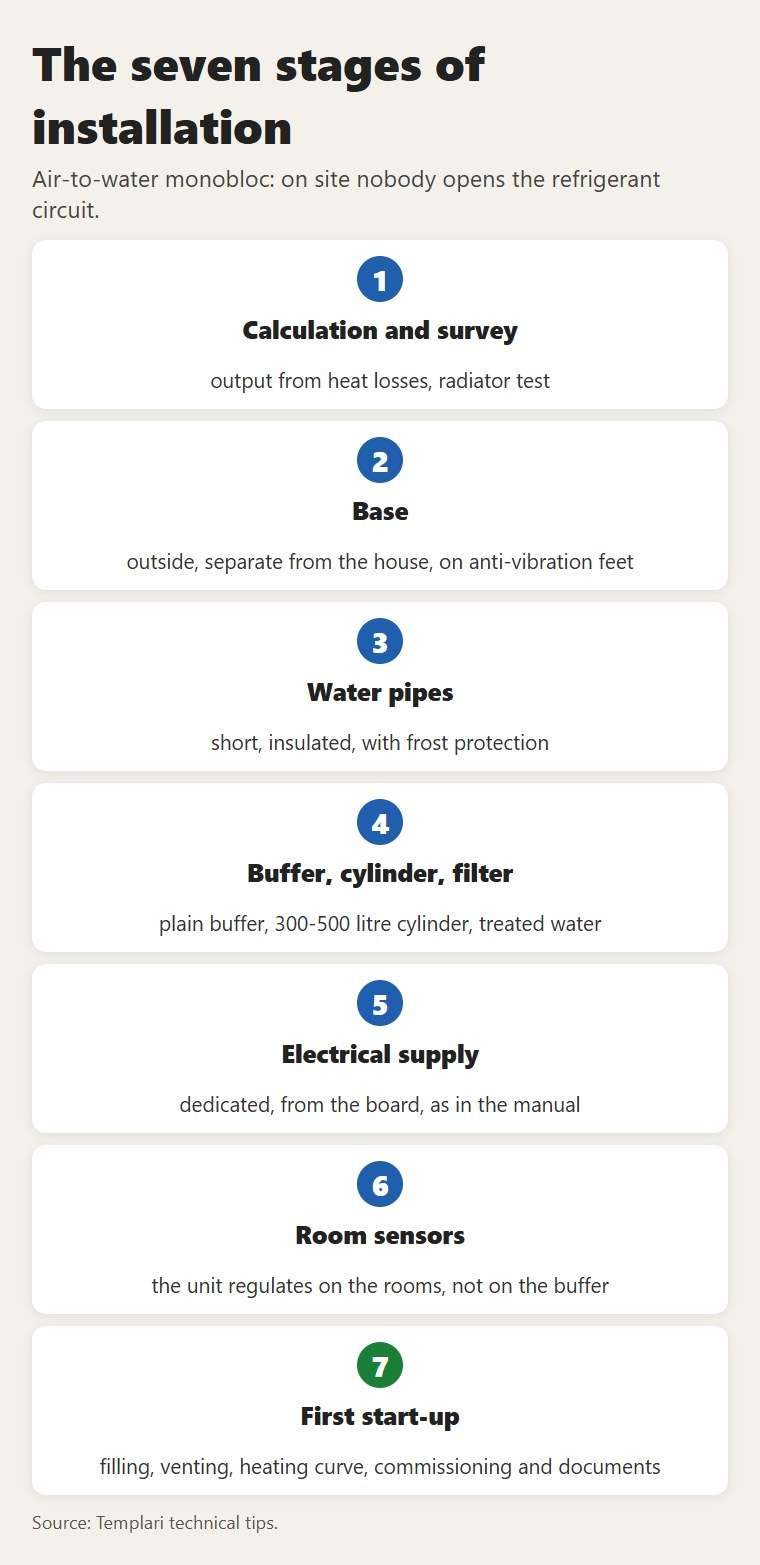
First: the calculation and the survey
The output is not copied from the old boiler: it is calculated from the house’s heat losses on the coldest day of the area, as we explain in the article on sizing. At the survey the existing system is checked: with radiators it is worth first running the winter test with the boiler at 55 °C, described in the article on heat pumps with radiators. And it is decided where the unit, the buffer tank and the cylinder go.
02
Where the unit goes outside
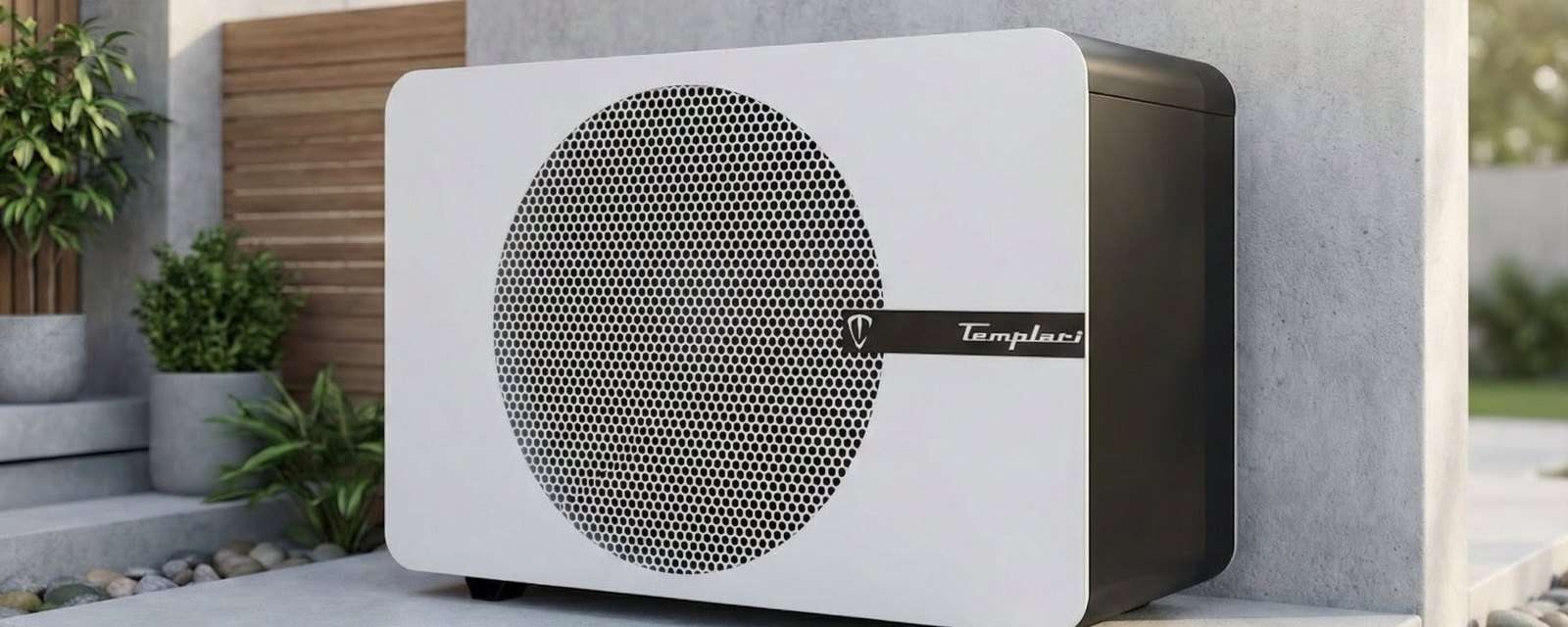
A monobloc stands outdoors, on a stable base separate from the house and on anti-vibration feet, with free space in front of the fan and behind the coil so the air can circulate. Away from corners and bedroom windows, with the air outlet facing the garden: distances from the neighbours are explained in the article on noise. With propane there is one more rule. Propane is about one and a half times heavier than air (PubChem): if it ever leaked, it would sink. That is why there is a safety zone around the unit, given in the manual according to EN 378, inside which there must be no windows, doors, light wells, drains, gullies or electrical sockets.

03
The defrost water
In winter the unit melts the frost on the coil and discharges water, sometimes several times a day, as we explain in the article on defrosting. That water must go onto a gravel bed or into a frost-protected drain, never onto a path or steps, where it would turn to ice.
04
Only two water pipes come into the house
In a monobloc the refrigerant circuit is sealed and tested at the factory: nobody opens it on site, and only the water flow and return come into the house. The outdoor section must be short and insulated, with frost protection: anti-freeze valves that drain the water below a certain temperature, or glycol in the circuit, as we explain on the page on the monobloc. Inside go the buffer tank, plain and not stratified, the hot water cylinder, ideally 300-500 litres, and a dirt filter: the system water must be treated, because whatever settles ends up in the heat exchangers. The reasons are in the article on the buffer tank.
05
Electrics and sensors
The unit needs its own electrical line from the board, with the protection and cable size given in the manual. Then the controls: with HCC each room gets a temperature and humidity sensor, and the unit regulates on the rooms, not on the buffer tank sensor. Why, we explain in the article on why a heat pump is not a boiler and in the one on the complete system.
06
First start-up and commissioning
The system is filled, the air is vented, pressure and flow are checked and the heating curve is set, that is the water temperature according to the cold outside, as we explain in the article on the heating curve. At the end the installer hands over the documents; in Italy this includes the declaration of conformity of the system (Ministerial Decree 37/2008). From then on the checks are those in the article on maintenance.
07
What to ask the installer
Six questions. What calculation the output is based on. Where the unit will go and whether the safety zone in the manual has been checked. Where the defrost water goes. How the outdoor pipes are protected from frost. Which buffer tank and cylinder are fitted. And what controls the unit: the rooms or the buffer tank sensor. If you want an opinion on your house, ask us for information.
08
Frequently asked questions
Where is an air-to-water heat pump installed?
Outdoors, on a base separate from the house, with free space for the air, away from corners and bedroom windows. With propane, the safety zone must be free of windows, doors, light wells, drains and sockets.
Do you need a refrigeration engineer to install a monobloc heat pump?
No: the refrigerant circuit is sealed and tested at the factory. On site only the water and electrical connections are made.
Can a heat pump go near a window?
Not inside the safety zone given in the manual, because propane is heavier than air. And for noise, better away from bedroom windows: for a free-standing Kita X the German LAI guide gives at least 4.6 metres from the neighbour’s window at night.
Where does the water coming out of a heat pump in winter go?
It is defrost water: it must go onto a gravel bed or into a frost-protected drain, never onto a path or steps.
What is needed indoors for a monobloc heat pump?
Two water pipes, a plain buffer tank, a hot water cylinder, ideally 300-500 litres, a filter, a dedicated electrical line and the room sensors.
Who can install a heat pump?
A qualified installer. In Italy they issue the declaration of conformity required by Ministerial Decree 37/2008.
Sources: PubChem, Propane · EN 378 · DM 37/2008
See also: Heat pump for a block of flats: communal or one per flat, output, hot water and where it goes · Heat pump for a flat: can you have one without an outdoor unit? What goes outside and what goes indoors · Three phase or single phase heat pump: which to choose and what supply you need
All the technical tips are on the series page.


