

Heat pump for a block of flats: communal or one per flat, output, hot water and where it goes
Heat pumps are not only for houses. In apartment buildings they are searched for more and more: in Germany “Wärmepumpe Mehrfamilienhaus” 2,900 times a month, in Italy “pompa di calore condominio” and similar about 800, in France the collective heat pump about 1,900 across all variants. Here we explain the two routes, communal or one per flat, how much output is needed, what changes for hot water and radiators, where the unit goes and how costs are shared.
Communal or one per flat
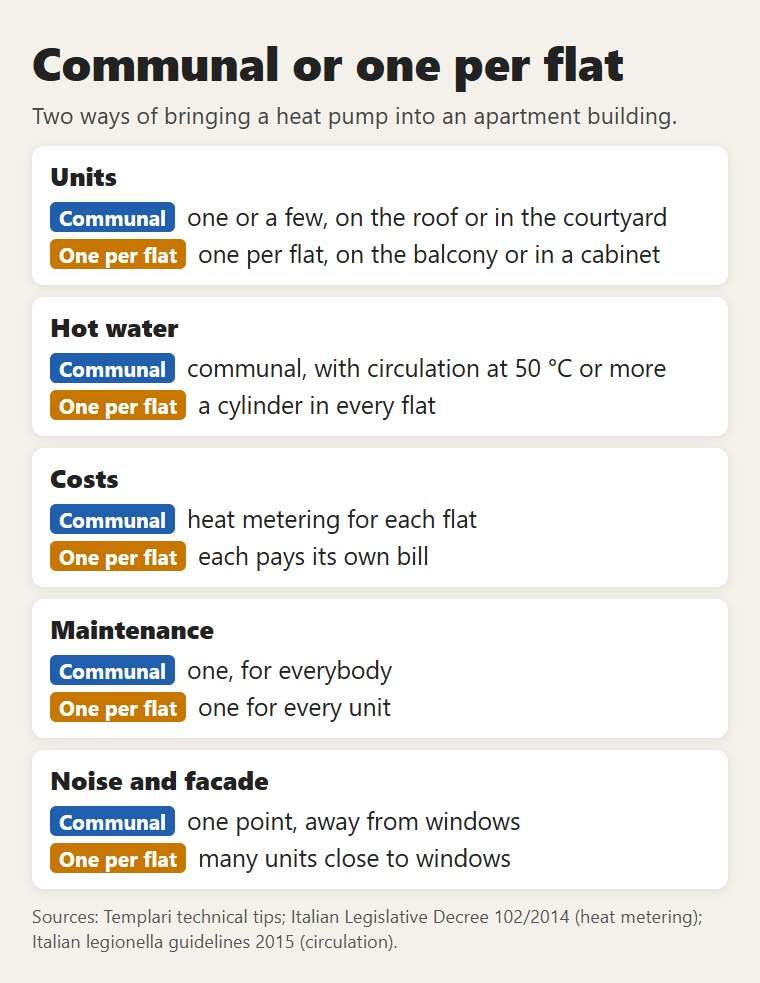
There are two routes. Communal: one unit, or a few, on the roof or in the courtyard, replacing the shared boiler, with hot water for everyone. One per flat: each home has its own small heat pump, on the balcony or in a cabinet, and its own cylinder. The communal option needs a single maintenance and keeps the noise in one spot away from windows; the individual option leaves everyone free, but puts many units on the facade and near windows.
How much output: start from the calculation
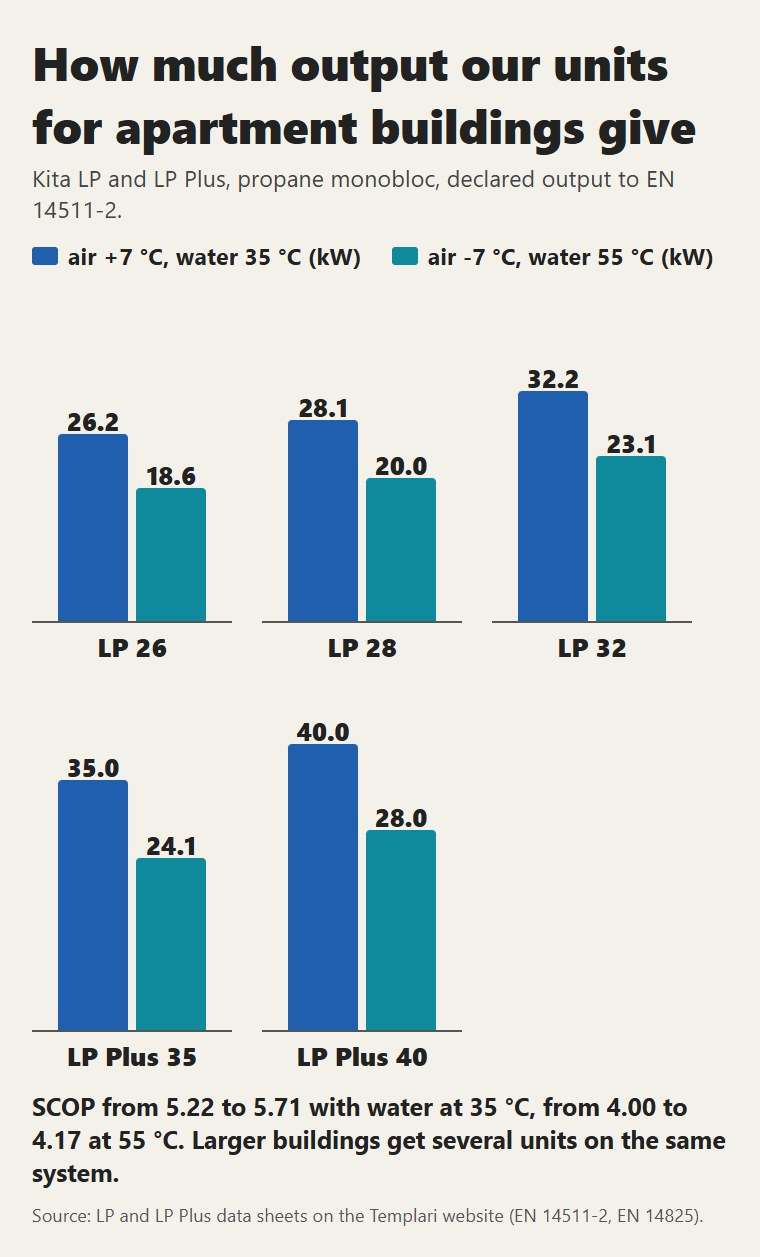
The output is calculated from the building’s heat losses on the coldest day of the area, just as for a house: we explain it in the article on sizing. For apartment buildings we have the Kita LP and LP Plus, propane monoblocs: with air at +7 °C and water at 35 °C they give from 26.2 kW (LP 26) to 40 kW (LP Plus 40); with -7 °C outside and water at 55 °C from 18.6 to 28 kW. The SCOP ranges from 5.22 to 5.71 with water at 35 °C and from 4.00 to 4.17 at 55 °C. For larger buildings there is Multi Kita: several units work in cascade and add up their output, and if one is being serviced the others keep heating.

Hot water for everyone and legionella
With communal hot water, legionella is the sensitive point: the Italian guidelines require at least 60 °C in storage tanks and at least 50 °C at the return of the circulation loop. A unit that stops at 55 °C is not enough; our propane air-to-water units reach 70 °C. We cover it on the page on domestic hot water and in the article on high temperature.
Radiators in old buildings
Many apartment buildings have radiators designed for a boiler at 70-80 °C. Lower temperatures are often enough, especially after replacing the windows: in the homes measured by Fraunhofer ISE with radiators only, the water averaged 38.5 °C and reached 64 °C only on the coldest days. First run the test with the boiler at a lower temperature, as we explain in the article on heat pumps with radiators.
Where the plant goes
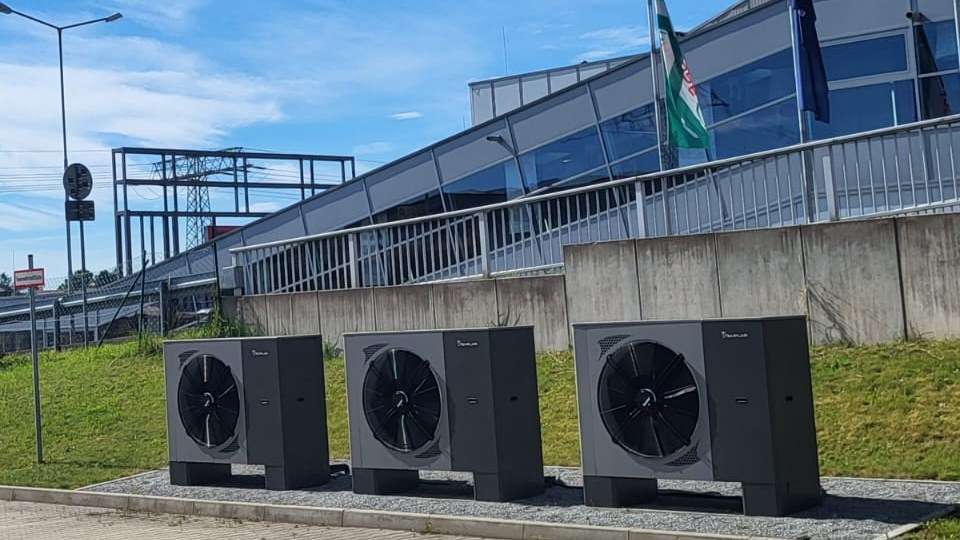
A large unit goes on a flat roof or in a courtyard, away from windows. It is heavy: 280 kg for an LP, 320 kg for an LP Plus, and the roof must carry it. It is louder than a small one: the LP has a sound power of 56.4-59.3 dB(A) against 53 for the Kita X, and the German LAI guide for a residential area at night asks for about 7-9.5 metres from windows instead of 4.6. The propane safety zone and the rules in the article on installation also apply.

Photovoltaics on the block and a central heat pump
Today the solar panels on the roof of a block of flats only power the common areas: stair lighting, lift, gate. They use little, and almost all the output goes to the grid. With a central heat pump the building has a large consumer of its own: the plant room.
A 20 kWp roof in Padua produces about 27,400 kWh a year (PVGIS data, European Commission): 43 kWh on an average December day, 99 in July. Domestic hot water is brought up to temperature in the storage tanks in the middle of the day, when the sun is out and the air is warmer, and the machine is more efficient. How to do the month-by-month sum is explained in the article on heat pumps and photovoltaics.
One, two or three Kita LP or LP Plus propane units on the same system are enough for a block of flats: 26.2 to 40 kW each, with 7 °C outside and water at 35 °C.
How costs are shared
With a communal system each flat pays for what it uses. In Italy it is mandatory: communal systems need individual temperature control and heat metering for each unit (Legislative Decree 102/2014, art. 9). The switch to a heat pump is decided at the owners’ meeting; majorities and rules vary from country to country.
One per flat: the Kita X
If the building stays without a communal system, each home can have its own Kita X, running on propane, at 7.5 or 9 kW, even inside a technical cabinet on the balcony. It is the unit we suggest to flat owners thinking of a hybrid: we present it in the article on hybrids.
What to ask the designer
Six questions. Communal or individual, and why. What calculation the output is based on and how many units are needed. How hot water at 60 °C is made with circulation. Whether the radiators are enough with cooler water. Where the units go, how heavy they are and how far from windows. And how each flat’s heat is metered. If you want an opinion on your building, ask us for information.
Frequently asked questions
Can a heat pump be used in a block of flats?
Yes, in two ways: communal, with one or a few units on the roof or in the courtyard instead of the boiler, or one per flat, with a small unit on the balcony or in a technical cabinet.
How much output does an apartment building need?
It is calculated from the building’s heat losses. Our Kita LP and LP Plus give 26.2 to 40 kW each with air at +7 °C; larger buildings get several units on the same system.
Can a communal heat pump make hot water safe from legionella?
Yes, if it goes high enough: at least 60 °C in storage and 50 °C in the circulation loop are needed. Our propane air-to-water units reach 70 °C.
Where does a heat pump go in an apartment building?
On a flat roof or in a courtyard, away from windows. An LP weighs 280 kg, and for noise, at night in a residential area, the German LAI guide gives about 7-9.5 metres from windows.
How are costs shared with a communal heat pump?
Each flat pays for what it uses. In Italy, communal systems must have individual temperature control and heat metering (Legislative Decree 102/2014).
Can a heat pump be fitted in just one flat?
Yes: the Kita X, at 7.5 or 9 kW, also fits in a technical cabinet on the balcony. Check the building’s rules on the facade.
Sources: D.Lgs. 102/2014 (Regione Piemonte) · LAI 2013 · UNI EN 14511-2
All the technical tips are on the series page.


