

Heat pump water heater or the system heat pump: hot water with a heat pump
Domestic hot water can be made with a heat pump in two ways: with a heat pump water heater, a separate appliance with its own tank, or with the air-to-water heat pump of the heating system, the same one that heats and cools the house. Here we explain when each one makes sense, what temperature to keep the water at, how big the cylinder should be and how much it uses.
Two ways
- Heat pump water heater: makes hot water only. It suits homes where gas heating stays, or where an electric water heater is to be replaced.
- The system’s air-to-water heat pump: heats, cools and makes hot water with a single outdoor unit and a cylinder. It is the choice when the boiler goes.
The heat pump water heater
It is a tank with a small heat pump on top: it takes heat from the air of the room it stands in, a cellar, a garage, a utility room, and puts it into the water. Ours, using propane R290, come in 200 and 300 litres, class A+, heat water up to 75 °C and work with room air between -7 and 43 °C. According to EN 16147 the 300 litre model reaches COP 3.25 with air at 7 °C and COP 4.03 with air at 20 °C, and gives 330 litres of water at 40 °C. Inside there is also a 2 kW heater for the days it is needed. It moves 350 m³ of air an hour and cools the room a little: that is why it goes in an unoccupied space.
The system heat pump: up to 70 °C
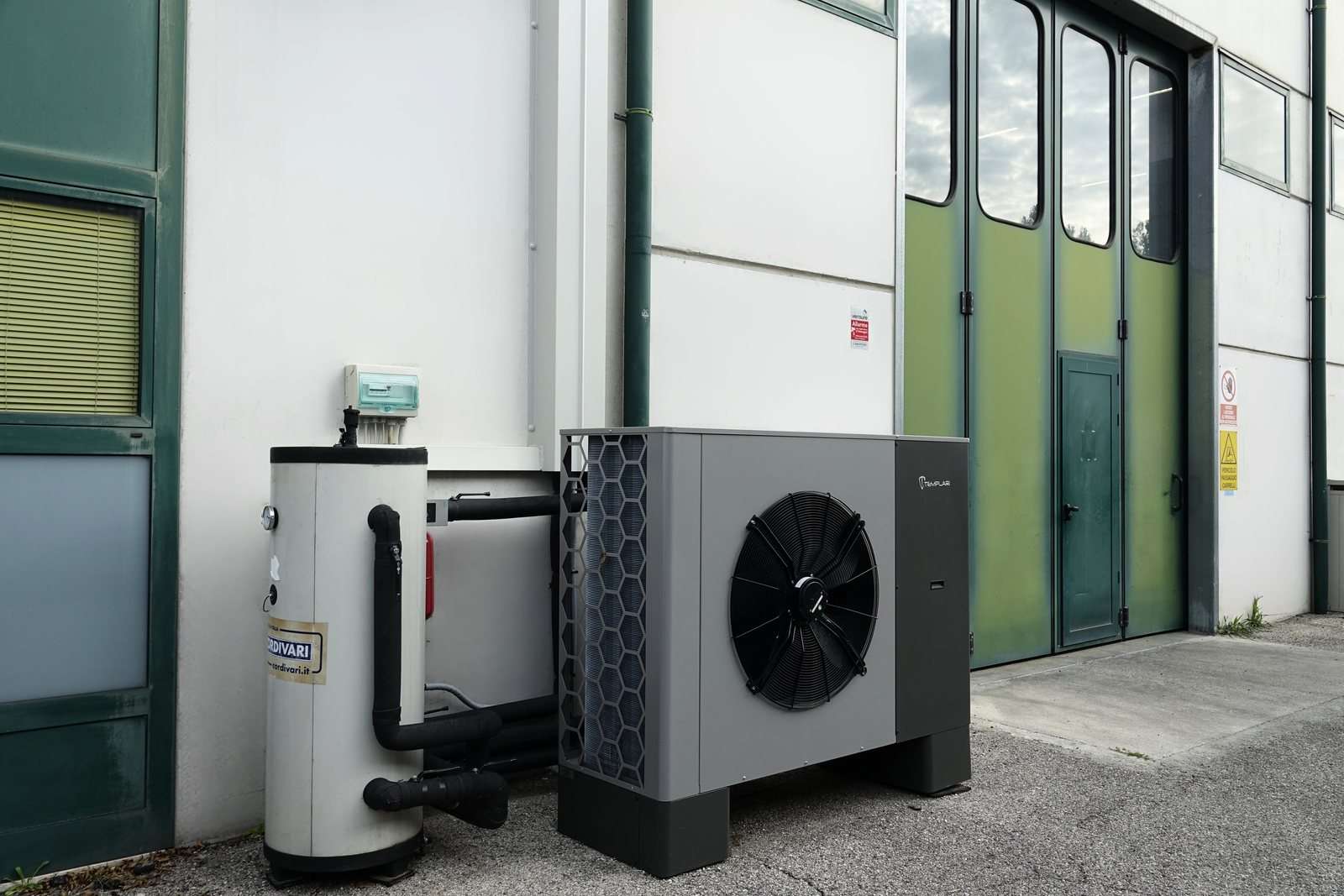
If the boiler goes, it makes sense for the same air-to-water heat pump to make hot water too: one outdoor unit, a cylinder indoors and a three-way valve that sends the unit’s water to the cylinder when needed. Propane, R290, could condense up to 82 °C; we limit our units to 70 °C so the compressor lasts longer. Those 70 °C are needed: there are about 4 degrees between the water leaving the unit and the water in the cylinder, on one of our systems 48.0 °C flow and 44.2 °C in the cylinder. To have 60 °C in the tank the unit must send at least 64 °C, and a heat pump that stops at 55 °C cannot get there. How a propane unit is built is in the article on R290.
What temperature to keep the water at
The Italian guidelines on legionella, from 2015, place the risk with water between 20 and 50 °C. In systems with recirculation they require at least 60 °C in the tanks and at least 50 °C at the base of the recirculation risers; at the tap a thermostatic mixing valve brings the water to 42-44 °C to avoid scalding. Thermal disinfection is done at 70-80 °C. In a home, 45-50 °C is enough for everyday use and costs less, and now and then the cylinder must be taken high for hygiene: our control does it by itself.

How big the cylinder should be
A small cylinder costs dearly. With 300 or 500 litres the three-way valve turns three times a day; with 100 or 150 litres the unit has to switch to hot water as often as every half hour, in summer too while cooling, wasting energy and wearing out sooner. If space is short, a bi buffer is better, two tanks one above the other in the space of one: see the article on buffer tanks.

How much it uses
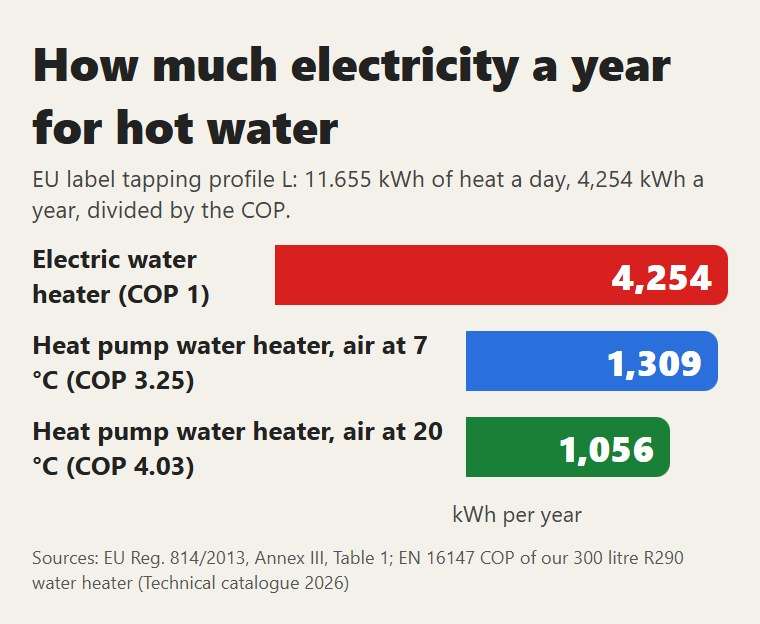
For comparison, the EU label’s tapping profile L is used: 11.655 kWh of heat a day, 4,254 kWh a year (EU Regulation 814/2013). An electric water heater takes all of it from electricity: 4,254 kWh. A heat pump water heater with COP 3.25 takes about 1,300, with COP 4.03 about 1,050: a third to a quarter. The system heat pump is in the same range: at 55 °C our SP 10 reaches COP 3.53 with air at +7 °C. The full calculation for the house is in the article on consumption.
With solar panels
Hot water is the simplest way to use the electricity from the panels: the cylinder is a water battery. Without batteries it is best heated in sunny hours; with batteries any time is fine. See the article on heat pumps and solar panels.
What to choose
Gas heating that stays, or an electric water heater to replace: the heat pump water heater. A boiler to remove: one air-to-water heat pump for heating, cooling and hot water, with a cylinder of 300 litres or more. For a house you normally go up to 20 kW.

Frequently asked questions
Can a heat pump also make domestic hot water?
Yes. The air-to-water heat pump heats a cylinder through a three-way valve; our R290 units reach 70 °C flow temperature.
Heat pump water heater or the system heat pump?
If gas heating stays, the water heater is enough. If the boiler goes, one air-to-water heat pump for heating, cooling and hot water is the better choice.
How much does a heat pump water heater use?
With the EU label profile L, 4,254 kWh of heat a year, about 1,050-1,300 kWh of electricity at COP 4.03-3.25, against 4,254 for an electric water heater.
What temperature should hot water be kept at?
45-50 °C is enough for use. The legionella guidelines require at least 60 °C in tanks of systems with recirculation; at home the cylinder should be taken high now and then.
How big should the cylinder be with a heat pump?
300-500 litres: the unit switches to hot water three times a day. With 100-150 litres as often as every half hour, wasting energy and adding wear.
Where does a heat pump water heater go?
In an unoccupied room such as a cellar, garage or utility room: it takes heat from the room air, works between -7 and 43 °C and cools it a little.
Read also
- Heat pump buffer tank: which to choose
- Heat pump and solar panels
- How much electricity a heat pump uses
- Heat pump with radiators: does it work?
- How an R290 heat pump is built
- Templari air-to-water heat pumps
- All the technical tips
- High temperature heat pump: up to 70 °C, how much more it uses and when you really need it
- Heat pump backup heater: when it switches on, how much it uses and when it is a warning sign


