

How does a heat pump work: heat is not produced, it is moved
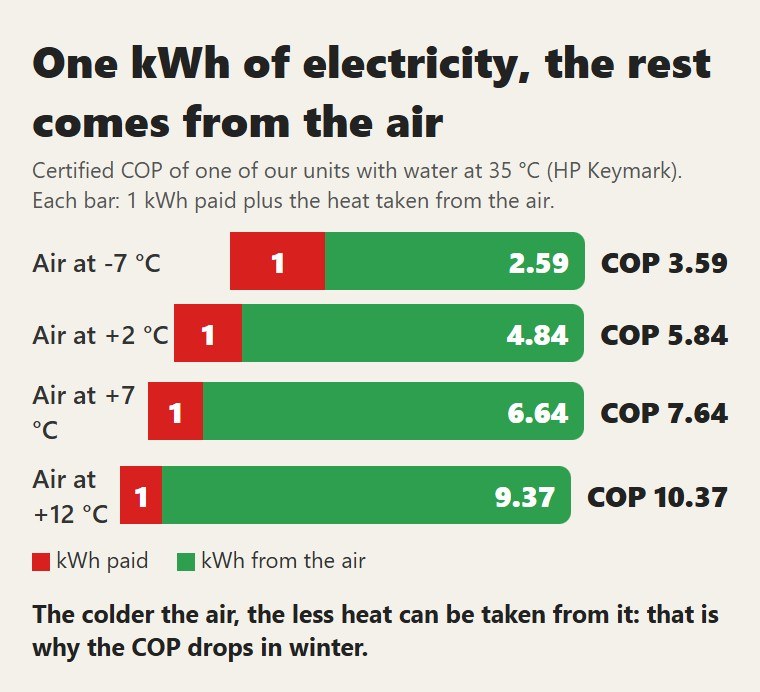
A boiler burns gas to produce heat. A heat pump does not produce heat: it takes it from the outside air, even in winter, and brings it indoors. Electricity is only needed to move it, which is why the machine delivers more heat energy than the electrical energy it uses. How much more is shown by the COP, which on our machines can be read on the display.
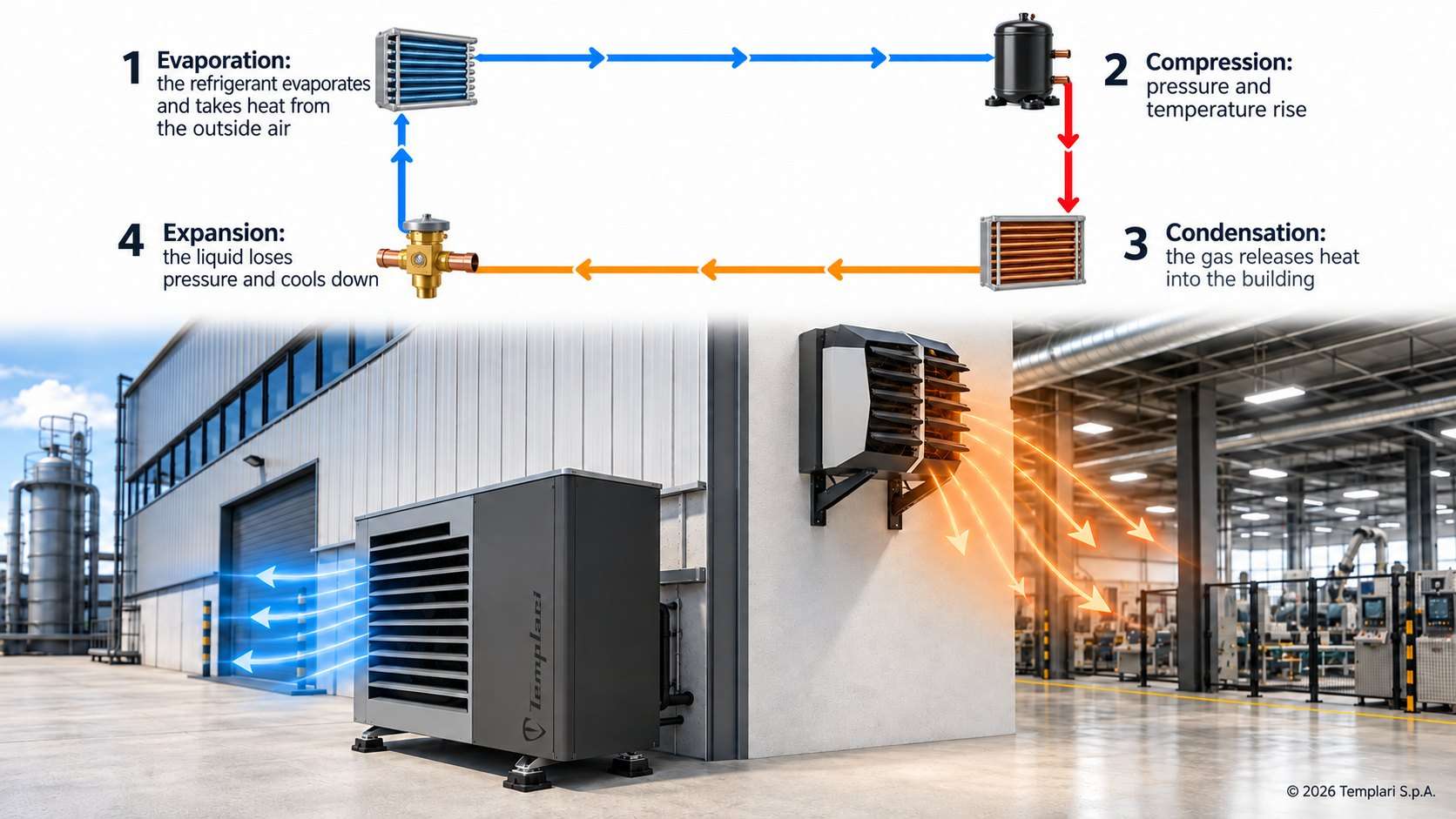
The transport is done by a refrigerant that circulates in a closed circuit and goes through four stages. We explain them with a Kita Air heating an industrial building.
01
The four stages of the refrigerant
1. Evaporation. The refrigerant enters the finned coil of the outdoor unit colder than the air. It evaporates, like boiling water, and while evaporating it absorbs heat from the air that the fan pushes through the coil. It works below zero too: the refrigerant only has to be colder than the air.
2. Compression. The compressor draws in the gas and compresses it: pressure and temperature rise until it is much warmer than the air in the building.
3. Condensation. The hot gas reaches the indoor unit and gives its heat to the air that the fan blows downwards, where people work. As it gives off heat, it turns back into liquid.
4. Expansion. The liquid returns to the outdoor unit and passes through the expansion valve: it loses pressure, cools down and is ready to evaporate again. On our machines the valve is always electronic. It is driven by the on-board controller, which reads the sensors and lets into the coil exactly the amount of refrigerant that can evaporate, moment by moment. A mechanical valve cannot follow changes in temperature and load with the same precision.
In the diagram the compressor is drawn at the top for clarity. In the machine it sits in the outdoor unit, together with the coil and the valve.
02
In summer the cycle reverses
The same machine cools. The two coils swap jobs: the indoor one takes heat from the building, the outdoor one throws it out. Why an air conditioner that also heats in winter is not a heat pump we explained in the tip on air conditioners.
03
Why it delivers less when it gets colder
The compressor works harder the bigger the gap between the temperature at which the refrigerant evaporates outside and the one at which it condenses inside. With air at -7 °C the gap is bigger than at +7 °C, and the COP drops. It is the law Carnot wrote two centuries ago: no real machine reaches its limit, but the trend is the same.
That is why a heat pump is not judged by its rated COP, but by what it does in winter. The coil and the compressor matter:
- a large coil, which makes the refrigerant evaporate close to the air temperature, as explained in the tip on fins;
- a compressor built for large lifts, as explained in the tip on scroll compressors.
04
Defrosting: only when needed
In winter the outdoor coil works below zero and the moisture in the air settles on it as frost. As long as there is little frost, the machine heats normally. When the coil fills up, air no longer passes and the machine has to melt the ice, taking heat from the building.
Many heat pumps defrost on a timer, every so many minutes, or as soon as the coil drops below a certain temperature. So they also defrost when the coil is almost clean, and every unnecessary defrost is heat taken away from the building and time in which the machine does not heat.
Ours defrost only when it is really needed: when the coil is full of frost and the heat exchange with the air has fallen below a certain threshold. It is measured by the on-board controller, not by a clock. It is our patented defrost system. More space between the fins also means more frost before that threshold is reached, and therefore fewer defrosts, as explained in the tip on defrosting.
05
Frequently asked questions
How does a heat pump work, in simple terms?
It does not produce heat: it takes it from the outdoor air and brings it inside with a refrigerant that evaporates, is compressed, condenses and expands in a closed circuit. The electricity only makes it move.
Does a heat pump work below zero?
Yes: the refrigerant in the outdoor coil only has to be colder than the air. When it gets colder the temperature lift grows and the COP falls.
Why does a heat pump perform worse in cold weather?
The compressor works harder the bigger the gap between the temperature at which the refrigerant evaporates outside and the one at which it condenses inside: with air at -7 °C the gap is bigger than at +7 °C.
Can the same heat pump cool in summer?
Yes: the cycle reverses and the two coils swap jobs. The indoor one takes heat from the rooms and the outdoor one throws it out.
See also: Heat pumps and radiators: does it work? Yes, and better with propane · How much electricity does a heat pump use: per day, per year and by size, with the data sheet figures · Heat pump COP: what it is, how it is measured, and why it is not the same in the fog · Best air source heat pump: the 10 things to check before you buy · Cooling with a heat pump: underfloor or fan coils, how efficient it is and what you need · Ground source vs air source heat pump: running costs, lifetime and system cost compared
All the technical tips are on the series page. The next one in two weeks.


