

Ground source vs air source heat pump: running costs, lifetime and system cost compared
“Ground source heat pump” is searched 5,400 times a month in the UK, “air source vs ground source heat pump” 390; in Germany “Erdwärmepumpe” 9,900, in Poland “pompa ciepła gruntowa” 6,600. We only make air-to-water heat pumps: here we compare them with ground source units on certified data sheets under the same standard, and for cost with figures from the Danish Energy Agency.
01
Same machine, different source
A ground source and an air source heat pump work the same way, as we explain in the article on how it works. What changes is where they take the heat from: the ground source unit from the ground, through deep boreholes or pipes buried in the garden; the air source unit from the outdoor air, through its coil and fan. Horizontal pipes need a large garden: according to the Danish Energy Agency their length is about twice the floor area of the house.
02
How much electricity they use
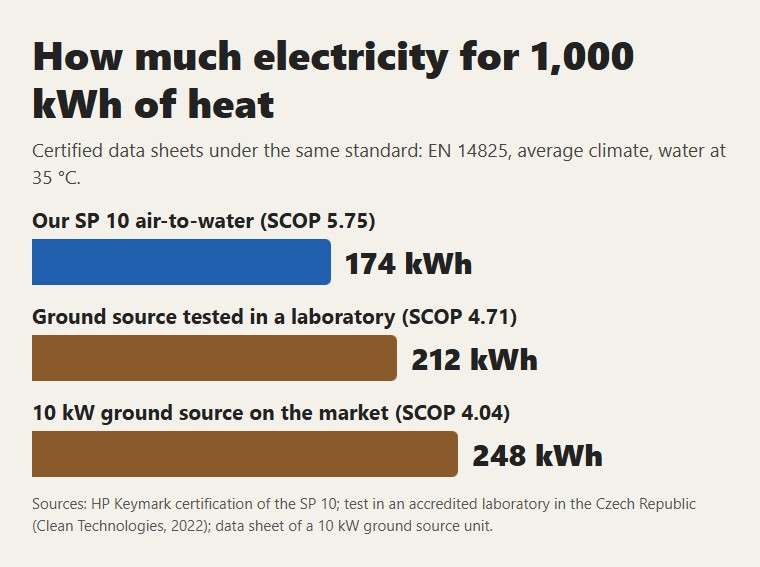
The ground stays above zero in winter and the air does not, which is why people think a ground source unit uses less. But consumption is decided by the machine: compressor, heat exchangers, controls. Under the same standard (EN 14825, average climate, water at 35 °C), for 1,000 kWh of heat our SP 10 uses 174 kWh of electricity (SCOP 5.75, HP Keymark certification); a 10 kW ground source unit on the market uses 248 (SCOP 4.04), one tested in an accredited laboratory in the Czech Republic 212 (SCOP 4.71).
03
How long they last and what they cost
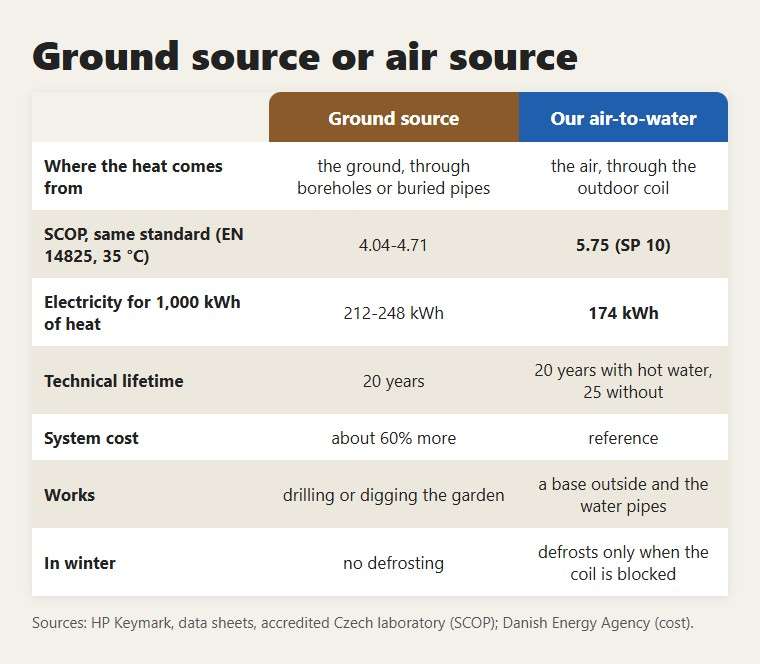
They last the same: one of our air-to-water units lasts 20 years like a ground source one if it also makes domestic hot water, and 25 if it only heats, with no three-way valve for hot water and with HCC controlling on the rooms: that way it defrosts very rarely and starts few times. We explain it in the article on lifetime. In the Danish Energy Agency catalogue the system cost is about 60% higher for ground source, because of drilling or digging; drilling usually needs a permit too. Prices change from country to country and we do not give them.
04
The weak point of air source: defrosting
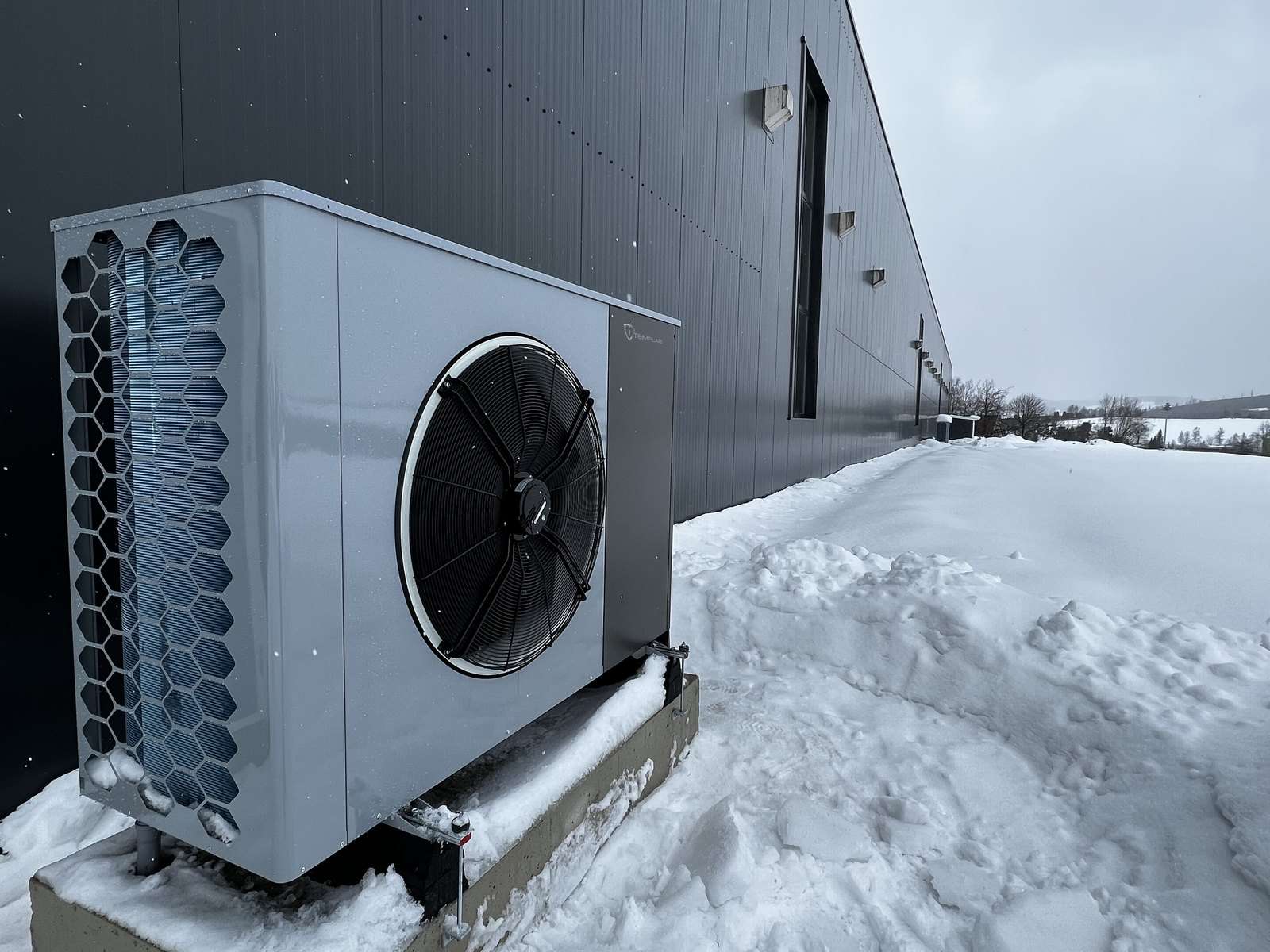
A ground source unit never defrosts; an air source unit does: with humid air around zero the coil frosts up, and melting it costs heat. An air source unit performs well if it defrosts little and only when needed. Our air source units have fins 2.5 millimetres apart and a patented defrost that starts only when the coil is blocked: see the article on fins, the one on defrosting and the one on ice and steam.
05
Water temperature matters more than the source
With underfloor heating the water goes at 35 °C, with radiators at 55, and under the same standard every unit performs less: our SP 10 goes from SCOP 5.75 to 4.20, the 10 kW ground source unit on the market from 4.04 to 3.07. Sending the water as cool as possible counts for more than the choice of source; see the article on weather compensation and the one on radiators.
06
When to choose which
A ground source heat pump does not pay: it costs about 60% more, needs drilling or digging and often a permit, and a well-built air-to-water unit performs better. It remains a choice for those who want it anyway and can drill without problems. Air source can be installed wherever there is a place outside, even in an existing home without touching the garden; in real cold it keeps working, as we explain in the article on sub-zero temperatures. The real limits of air source are on the page on pros and cons. For an opinion on your home, ask us for information.
07
Frequently asked questions
Is a ground source or an air source heat pump better?
For us, air-to-water. A ground source system costs about 60% more and needs drilling or digging; and under the same standard (EN 14825, average climate, 35 °C) our SP 10 has SCOP 5.75 against 4.04-4.71 for the ground source units we compared. In an existing home, the water temperature also matters more than the choice of source.
How much electricity does a ground source heat pump use?
Under the same standard (EN 14825, average climate, water at 35 °C) a ground source unit uses 212-248 kWh of electricity for 1,000 kWh of heat (SCOP 4.71 and 4.04); our SP 10 air-to-water 174 (SCOP 5.75).
How long does a ground source heat pump last?
20 years, like one of our air-to-water units that also makes hot water; ours reaches 25 if it only heats, with HCC controlling on the rooms.
The ground is warmer than the air: why doesn’t a ground source unit perform better?
Because SCOP is decided by the machine: compressor, heat exchangers, controls and, for air source, a defrost that starts only when needed. Under the same standard our SP 10 has SCOP 5.75, the ground source units we compared 4.04-4.71.
Does ground source work with radiators?
Yes, but like air source it performs worse with hot water: with radiators both use more than with underfloor heating.
Does Templari make ground source heat pumps?
No, we make air-to-water and air-to-air heat pumps. For cost we give figures from a public source; for SCOP we compare certified data sheets under the same standard.
All the technical tips are on the series page.


