

Are heat pumps worth it? The real drawbacks and how to avoid them
“Are heat pumps worth it” is searched 1,900 times a month in the UK, “heat pump vs boiler” 720, “heat pump pros and cons” 590; in Germany “lohnt sich eine Wärmepumpe” 1,300. Anyone about to replace a boiler wants to know what can go wrong. The drawbacks are real, and we list them one by one: for each, how much it weighs and what to do to avoid it.
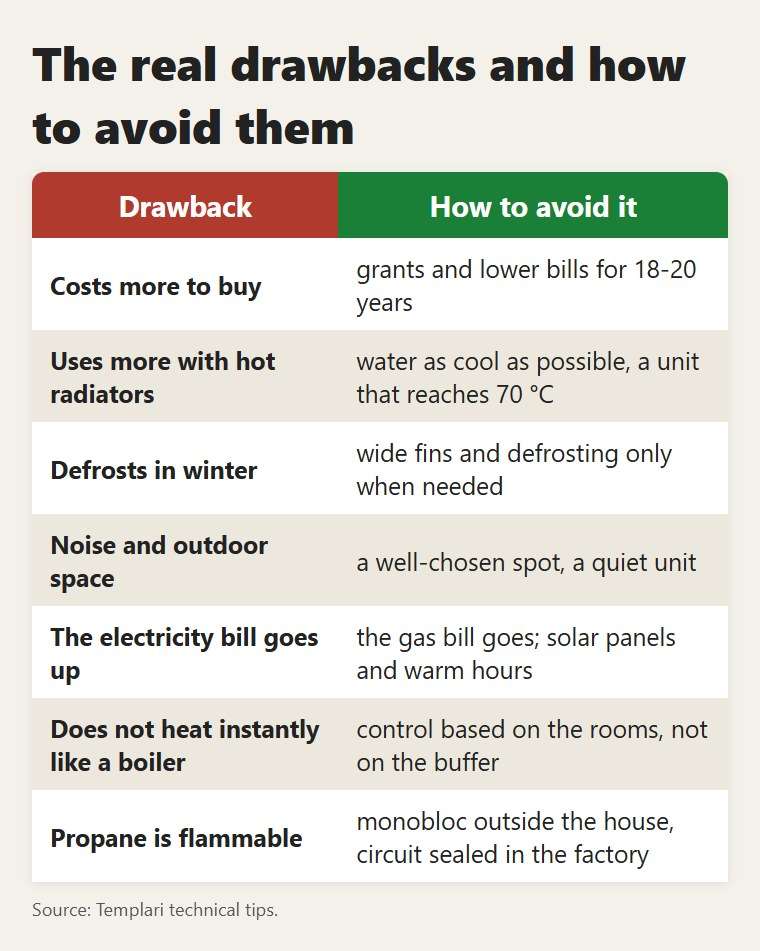
It costs more to buy
The unit and its installation cost more than a gas boiler. This is the most concrete drawback, and it is recovered in two ways: with grants where they exist, and with lower bills for all the years the unit runs, which are about twenty, as we explain in the article on how long heat pumps last.
It uses more with hot radiators
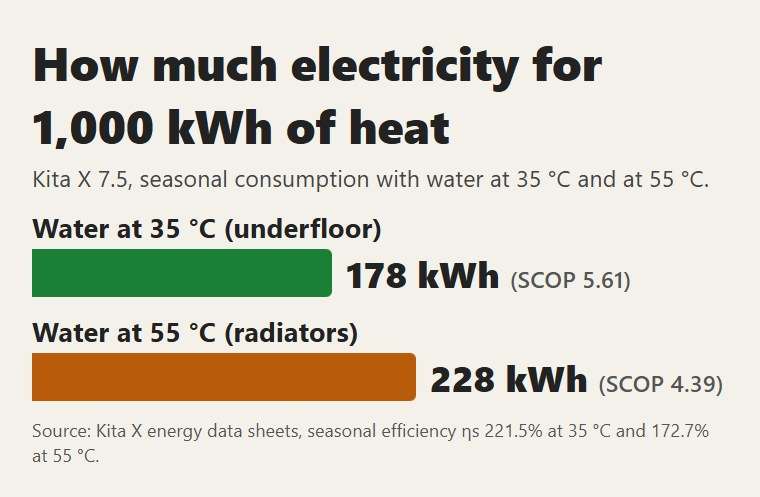
The hotter the water, the more the unit uses. Our Kita X, to deliver 1,000 kWh of heat over a season, uses 178 kWh of electricity with water at 35 °C and 228 kWh with water at 55 °C. Our units reach 70 °C, but the trick is not to need it: with the HCC controller the unit runs more hours with the water as cool as possible, instead of a few hours with very hot water. How to tell whether your radiators are fine is in the article on radiators and the one on weather compensation.
It defrosts in winter
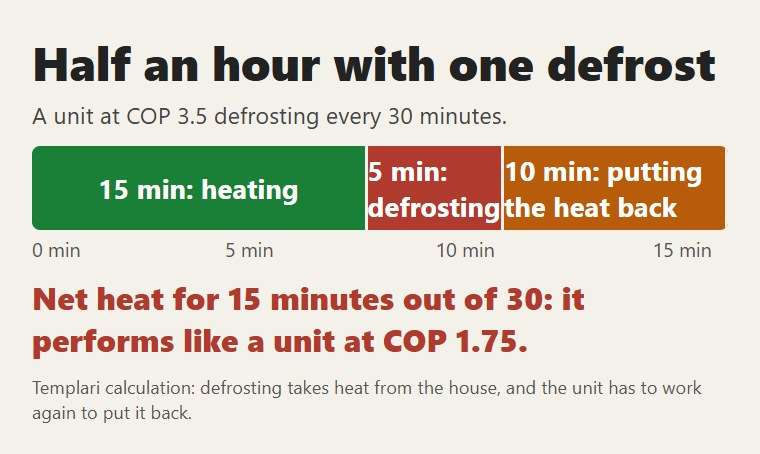
With humid air around zero the outdoor coil frosts up, and the unit has to melt the frost. Defrosting costs more than the meter shows: for five minutes the unit takes heat from the house, then it needs another ten to put it back. A unit at COP 3.5 that defrosts every half hour really heats for only 15 minutes out of 30, and performs like one at COP 1.75. That is why ours have fins 2.5 millimetres apart and a patented defrost that starts only when the coil is blocked: see the article on fins, the one on defrosting and the one on ice and steam.
It makes noise and needs a place outside
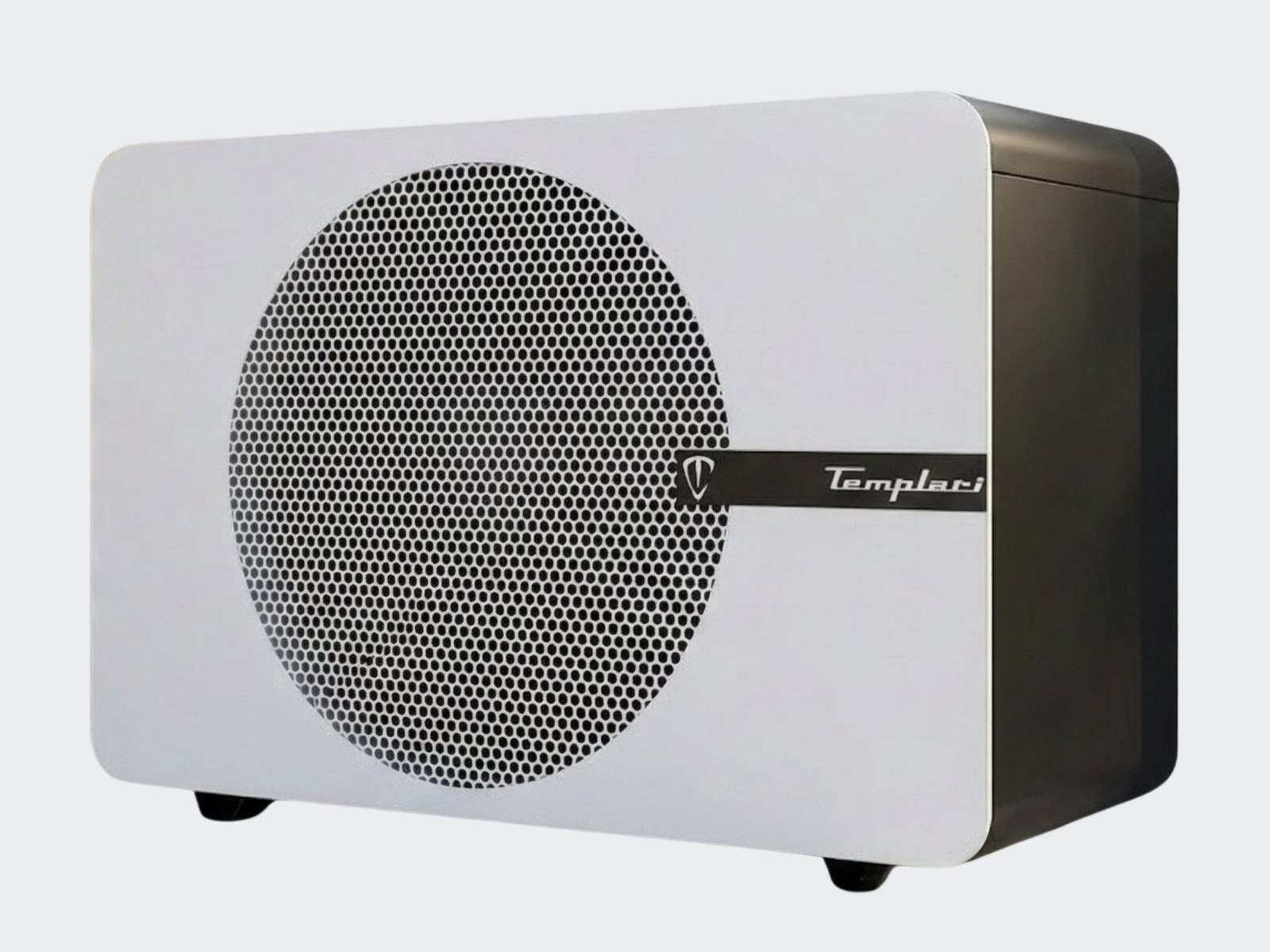
An air-to-water heat pump stands outside, and you can hear the fan. The Kita X has a sound power of 53 dB(A). The spot is chosen with the installer: away from the neighbours’ windows, with free air in front and behind. Distances and rules are in the article on noise and the one on installation.
The electricity bill goes up
The gas bill disappears, with its standing charge, and the electricity bill goes up. The sum has to be done on the total, as we explain in the article on running costs. With solar panels you produce part of the electricity yourself, and our energy optimiser moves the work to the warmest and sunniest hours, using half a degree more in the rooms to load the walls with heat: see the article on solar panels and the one on the optimiser.
It does not heat instantly like a boiler
A boiler fires up and sends hot water within a minute. A heat pump reaches steady running in 5-10 minutes, and works best when it runs long and gently. Switching it on and off like a boiler is the most common mistake. Our units are controlled by the room temperature, not by the buffer tank: a small buffer makes the unit start and stop all the time. We explain it in the article on why it is not a boiler and the one on system control.
Propane is flammable
Our units use propane R290, a natural gas outside the phase-down of fluorinated gases. It is flammable: that is why they are all monobloc, with the circuit sealed in the factory and all the gas outside the house, installed according to EN 378. Only water comes indoors. See the article on propane and the page on monobloc units.
The real drawback: the wrong unit
Many drawbacks told online come from badly chosen units. An oversized heat pump starts and stops all the time, uses more and lasts less; an undersized one often switches on the electric heater. The output is calculated for the house, and with an inverter the unit follows the demand, as we explain in the article on sizing.
When it is not worth it
If there is no place outside for the unit, or if the house loses so much heat that the radiators are not enough even at 70 °C, insulation comes first. For an opinion on your house, ask us for information.
Frequently asked questions
Are heat pumps worth it?
In most homes yes, if the unit is chosen and set up well. It costs more to buy, but it runs for about twenty years with lower bills, and the drawbacks below can mostly be avoided.
What are the disadvantages of a heat pump?
It costs more to buy, uses more with very hot radiators, defrosts in winter, makes some noise and needs a place outside, and raises the electricity bill while the gas bill disappears.
Does a heat pump use a lot of electricity?
It depends on the water temperature: the Kita X uses 178 kWh of electricity for 1,000 kWh of heat with water at 35 °C, and 228 kWh with water at 55 °C.
Heat pump or gas boiler?
The boiler costs less to buy; the heat pump uses three to five times less energy for the same heat and needs no gas. With radiators, first test whether the house stays warm with the boiler at 55 °C.
Why does a heat pump perform worse in winter?
Because it defrosts: every defrost takes heat from the house. With wide fins and a defrost that starts only when needed, there are few defrosts.
Is a propane heat pump dangerous?
Propane R290 is flammable, which is why our units are monobloc: all the gas stays outside the house in a factory-sealed circuit, and only water comes indoors.
All the technical tips are on the series page.


