

How to heat your home without gas: electric, heat pump, and which costs less
“Is electric heating cheaper than gas” is searched 590 times a month in the UK, “electric boiler vs gas boiler” 880 times. The short answer, with today’s prices: direct electric heating costs three times what gas costs; a heat pump costs less than gas as soon as its seasonal COP is above 3. Here are the numbers, and what each way of heating without gas means for the house.
01
What a kWh of heat costs today
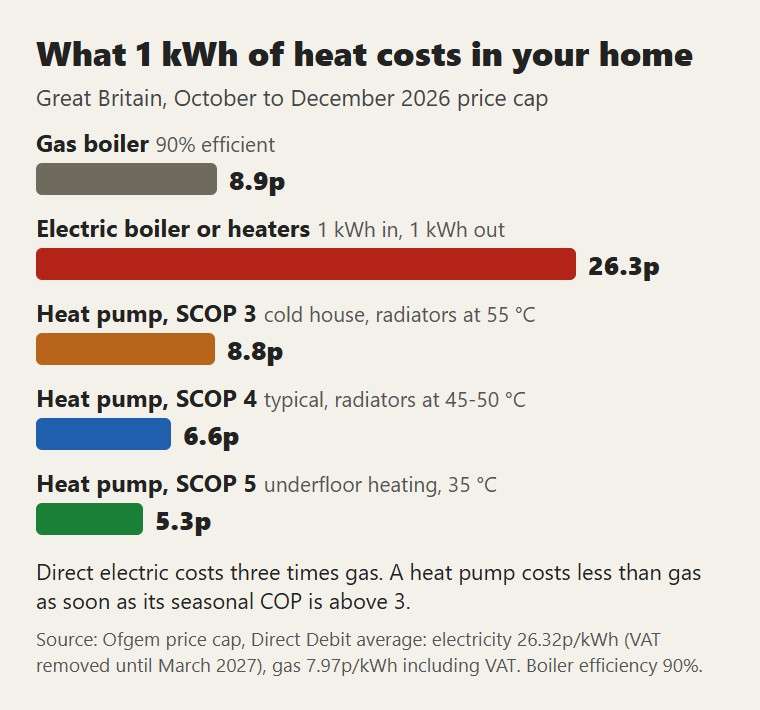
The price cap for October to December 2026 puts electricity at 26.32p per kWh and gas at 7.97p per kWh (Ofgem, Direct Debit average for Great Britain; VAT has been removed from electricity until March 2027, gas includes 5%). Gas is cheaper per unit, but a boiler does not turn all of it into heat: an A-rated condensing boiler delivers about 90%, so a kWh of heat from gas costs about 8.9p. An electric boiler, a panel heater or an infrared panel turn one kWh of electricity into one kWh of heat: 26.3p, three times as much. A heat pump turns one kWh of electricity into three, four or five kWh of heat, depending on its seasonal COP (SCOP): 8.8p at SCOP 3, 6.6p at SCOP 4, 5.3p at SCOP 5. The break-even point is a SCOP of about 3: below it, gas is cheaper; above it, the heat pump wins. What the COP is and how it is measured is in the article on COP and SCOP.
02
Electric boiler or electric heaters: when they make sense
An electric boiler is the easiest swap: same radiators, same pipes, no flue. It is also the most expensive way to heat a house, because every kWh of heat is a kWh of electricity. For a small flat that is rarely heated, or a holiday home used a few weeks a year, the low purchase price can still win over the running cost. For a family home heated every day it does not: the bill triples. Panel heaters, oil-filled radiators and infrared panels obey the same rule; infrared feels warm faster because it heats the people and the walls rather than the air, but it still uses one kWh of electricity for every kWh of heat. Disconnecting the gas does save the gas standing charge, 29.68p a day, about £108 a year, but that does not close a gap of three to one.
03
Storage heaters and off-peak tariffs
Storage heaters charge at night on a cheaper rate and give the heat back during the day. The electricity is still one kWh in, one kWh out; what changes is the price of the kWh. Whether it pays depends on the tariff and on how much of the heat arrives when you want it: with bricks charged at 2 am the house is warm at 7 am and cool in the evening. A heat pump also runs well on an off-peak tariff, with the difference that it gets three or four kWh of heat from each cheap kWh; the energy optimiser does exactly this, storing heat in the walls of the house when electricity is cheap.
04
Pellets, oil and LPG: still a boiler
Oil and LPG are the usual answers off the gas grid. They keep the radiators and the hot water cylinder, and they keep the tank, the deliveries, the flue and the annual service. A pellet boiler needs a store, a feed and regular ash removal, and it produces fine dust; how it compares with a heat pump is in the article on pellet boilers. None of the three takes the house off combustion: they move it from one fuel to another.
05
The heat pump: the one that costs less than gas
A heat pump does not produce heat, it moves it: it takes it from the outside air and brings it into the house at a higher temperature (how a heat pump works). That is why one kWh of electricity becomes three, four or five kWh of heat. Our 7.5 kW propane air-to-water unit has a SCOP of 5.51 with water at 35 °C and 4.31 with water at 55 °C (data sheet, average climate); with the price cap above that is 4.8p and 6.1p per kWh of heat. It delivers 7.5 kW at +7 °C outdoors, 5.3 kW at -7 °C and 4.2 kW at -15 °C, keeps working below -20 °C and runs at 53 dB(A) with the silence kit. The refrigerant is R290, propane: it is what lets the water reach 70 °C and what keeps the efficiency up when it is cold (what is inside a propane unit).
06
Can the radiators stay?
Yes. Our propane units deliver water up to 70 °C, so the radiators that worked with the boiler keep working with the heat pump. What changes is the bill: the hotter the water, the lower the COP. Our 12 kW unit at -7 °C with water at 55 °C delivers 10.09 kW at COP 2.06 (EN 14511 data sheet): on the coldest days with radiators the heat pump costs about the same as gas; on the milder days, which are most of the winter, it costs less. Larger radiators, or the same radiators at 45 °C after balancing, bring the average back up: see heat pumps and radiators and how to balance radiators. For an old house with high heat loss the numbers are in the article on old houses.
07
A year of bills, worked out
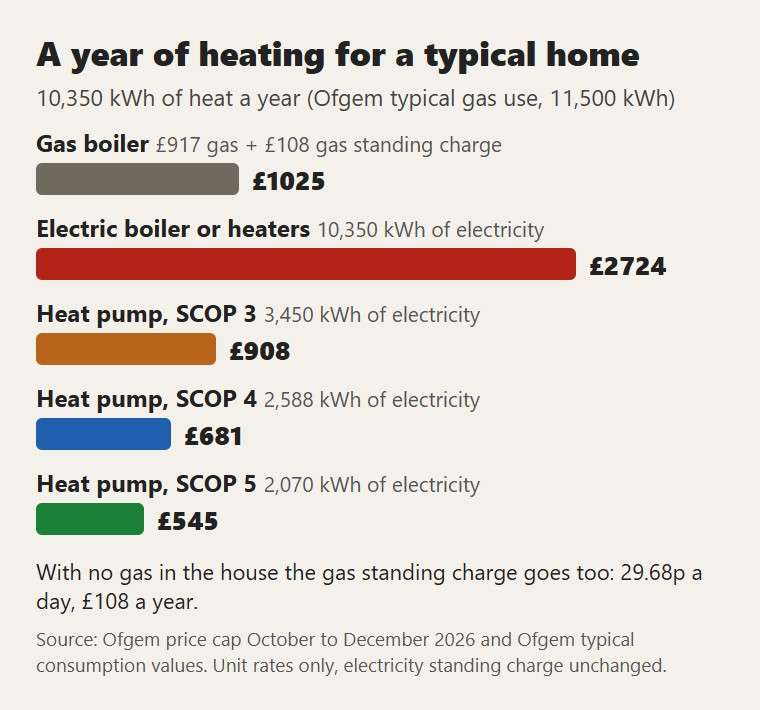
Ofgem’s typical household uses 11,500 kWh of gas a year; at 90% that is 10,350 kWh of heat. With the gas boiler the year costs £917 of gas plus £108 of standing charge, £1,025. With an electric boiler or electric heaters, 10,350 kWh of electricity: £2,724. With a heat pump at SCOP 3, 3,450 kWh of electricity: £908; at SCOP 4, 2,588 kWh: £681; at SCOP 5, 2,070 kWh: £545. The electricity standing charge is there in all cases and is left out. How much a heat pump uses per day and per size, with the data sheet figures, is in the article on running costs; how much of it the roof can cover is in the article on solar panels.
08
What changes in the house
An outdoor unit, on the ground or on a wall, with two pipes into the house (where it goes and how it is installed). A hot water cylinder, because a heat pump does not produce hot water on demand like a combi boiler (hot water with a heat pump). An electrical supply able to feed it: a small unit fits a normal single-phase supply, larger units are better on three phase (single phase or three phase). A noise check for the neighbours (how loud a heat pump is). The gas meter can go, with its standing charge. In England and Wales the Boiler Upgrade Scheme contributes to the cost: see heat pump grants in the UK.
09
Keep the boiler as a backup?
We do not recommend it. A hybrid is a boiler and a heat pump that is too small for the house, with two systems to service and a gas contract that stays (what a hybrid really is). A heat pump sized on the real heat loss of the house heats it on its own down to the design temperature, and below that a small electric backup heater covers the few hours a year it is needed (when the backup heater switches on). Sizing is the whole point: an inverter heat pump is chosen to run at half capacity most of the time (how a heat pump is sized). Which model for which house is in the guide to choosing a heat pump system; for the house you have in mind, ask us.
10
Frequently asked questions
Is electric heating cheaper than gas?
Not direct electric heating: with the October to December 2026 price cap a kWh of heat costs about 8.9p from a gas boiler and 26.3p from an electric boiler or heaters. A heat pump is the exception: 6.6p at SCOP 4.
Electric boiler or gas boiler?
Per kWh of heat the electric boiler costs three times the gas boiler. It makes sense only where the house is rarely heated. For a home heated every day, the way to heat without gas and pay less is a heat pump.
Is a heat pump cheaper than gas?
Yes, as soon as its seasonal COP is above 3. Our 7.5 kW propane unit has a SCOP of 5.51 with water at 35 °C and 4.31 at 55 °C: 4.8p and 6.1p per kWh of heat against 8.9p for gas.
Can I heat my home without gas and keep the radiators?
Yes. Our propane units deliver water up to 70 °C, so the existing radiators work. Lower water temperatures mean a higher COP: balancing the radiators and running at 45-50 °C is where most of the saving is.
What does a typical home spend in a year?
For Ofgem’s typical 11,500 kWh of gas, 10,350 kWh of heat: £1,025 with the gas boiler including the standing charge, £2,724 with electric heaters, £681 with a heat pump at SCOP 4.
Should I keep the gas boiler as a backup?
No. A correctly sized heat pump heats the house on its own; a small electric backup heater covers the few coldest hours. Keeping the boiler means two systems to service and a gas contract that stays.
All the technical tips are on the series page.


