

Hybrid boiler and hybrid heat pump: what they really are, and why we do not make them
“Hybrid boiler”, “hybrid heat pump”, “hybrid system”: three names for the same thing, a gas boiler with an electric outdoor unit next to it and a controller that decides which of the two to switch on. It is sold as the cautious middle way: keep the gas, add a bit of heat pump, and the system chooses by itself. We do not make it. Not out of prejudice: because, taken apart piece by piece, a hybrid is a boiler plus an air conditioner, and an air conditioner is not a heat pump built to heat a house in winter. In this tip we explain how it is made, when it switches to gas, what it costs to keep two systems, and why a propane heat pump that sends water out at 70 °C makes it pointless.
01
How a hybrid system is made
Three pieces. A condensing boiler, often the one already there or a new one of the same brand. An outdoor unit with compressor and coil, connected to an exchanger that heats the system water. And a controller that, according to the outdoor temperature or the price of gas and electricity, decides which one works. In the “compact” version the indoor pieces sit in a single box hung on the wall, with the outdoor unit outside. The name suggests a new machine; in reality it is a boiler with an air conditioner attached.
02
The outdoor unit: in most cases it is an air conditioner
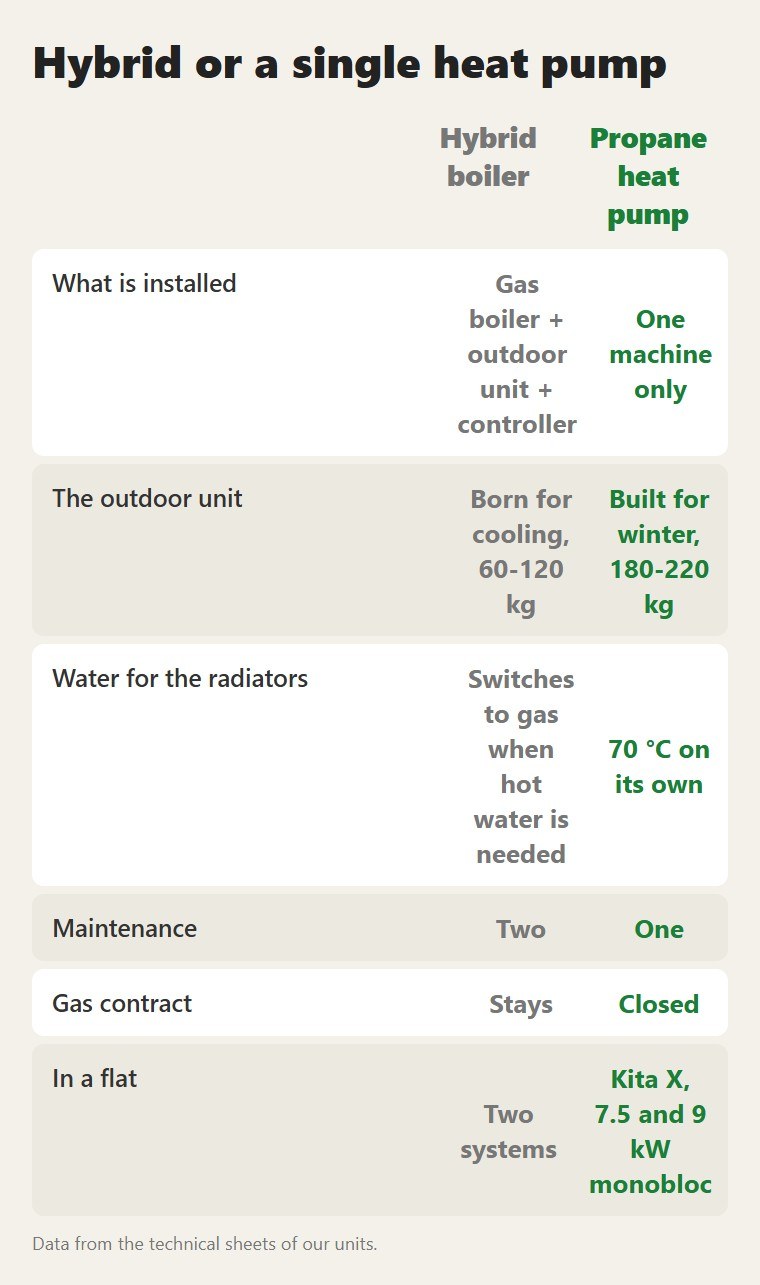
The outdoor unit of almost every hybrid is a condensing unit born for cooling, mass-produced for air conditioners and adapted to heat water. You can tell by the weight: an 8-12 kW split unit weighs between 60 and 120 kg, a 7.5 kW heat pump built for winter weighs 155, as we explain in the tip on air conditioners and heat pumps. The missing kilos are missing where it shows in winter. In the coil: the fins are close together, because in summer frost does not exist; in winter, with humid air between 0 and 7 °C, they clog with frost in a few tens of minutes and the machine spends part of its time defrosting instead of heating (fin spacing and defrosting are explained in our first two tips). And in the compressor: chosen for cooling, without vapour injection, it loses capacity as it gets colder outside and with hot water it stops well before the 70 °C that radiators ask for on the worst days (tip on compressors). It is not a manufacturing defect: it is a machine doing a different job.
03
The point where it switches to gas is the wrong point
The controller has a threshold: below a certain outdoor temperature, or when the efficiency of the electric unit drops below a value, it fires the boiler. The threshold is set where the condensing unit stops paying off, that is on cold days. It is exactly the opposite of what is needed: on cold days, when the house asks for more heat, the boiler works; in the mid seasons, when the demand is a fraction, the electric unit works. The gas saving is concentrated in the months when little gas was burnt anyway. Anyone with a hybrid sees it on the meter: in January the gas runs almost as before.
04
Two systems, two services, a gas contract that never closes
With a hybrid all the fixed costs of gas remain: the contract with its standing charge even at zero consumption, the flue, the flue-gas check and the logbook, the annual boiler service. To these you add the heat pump service. Two machines, two technicians, two things that can break down, and a controller that has to make them agree. The price, which is the most frequent search after the name itself, should be read like this: you buy two generators to do the work of one, and the second one works when it suits it.
05
Why the hybrid was born, and why it is no longer needed
The hybrid was born to cover three limits of the heat pumps of ten years ago: water no hotter than 50-55 °C, capacity collapsing below zero, old radiators asking for 70 °C. With propane these limits are gone. Our R290 air-to-water units send water out at 70 °C, for radiators and for domestic hot water, and keep their capacity when it is cold outside: the Kita X 7.5 gives 7.5 kW at +7 °C, 5.4 kW at -7 and 4.3 kW at -15, and it is sized on the design cold of the area, not on the mild day (tip on sizing). The certified SCOP is 5.61 with underfloor heating and SCOP 4.39 with radiators at 55 °C. A machine like this does not need someone to replace it when it gets cold.
06
What is really needed: one heat pump, and at most a small heater
A propane heat pump sized on the house: the Kita X of 7.5 or 9 kW for flats and small houses (our air-to-water range). The cylinder for hot water. The radiators already there, if the house does not leak heat like a sieve. With photovoltaics on the roof, the house makes a good part of the electricity itself. And, if the designer wants it, a small electric safety heater in the buffer: a few kW that stay off all winter and only serve if the machine is stopped by a fault. This is not a hybrid: it is an electric system with a spare, like the spare wheel in the boot. Gas is not needed, the contract is closed, the flue stays empty.
07
In flats and where there is no garden
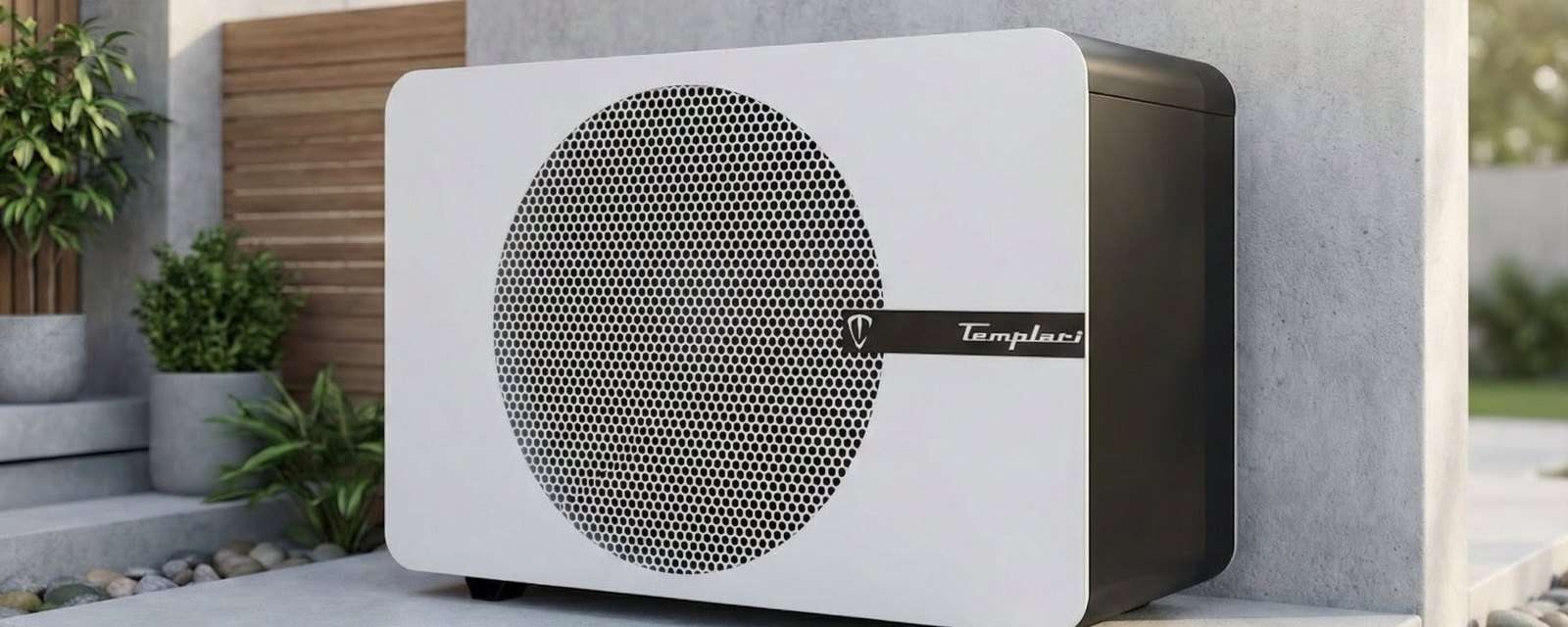
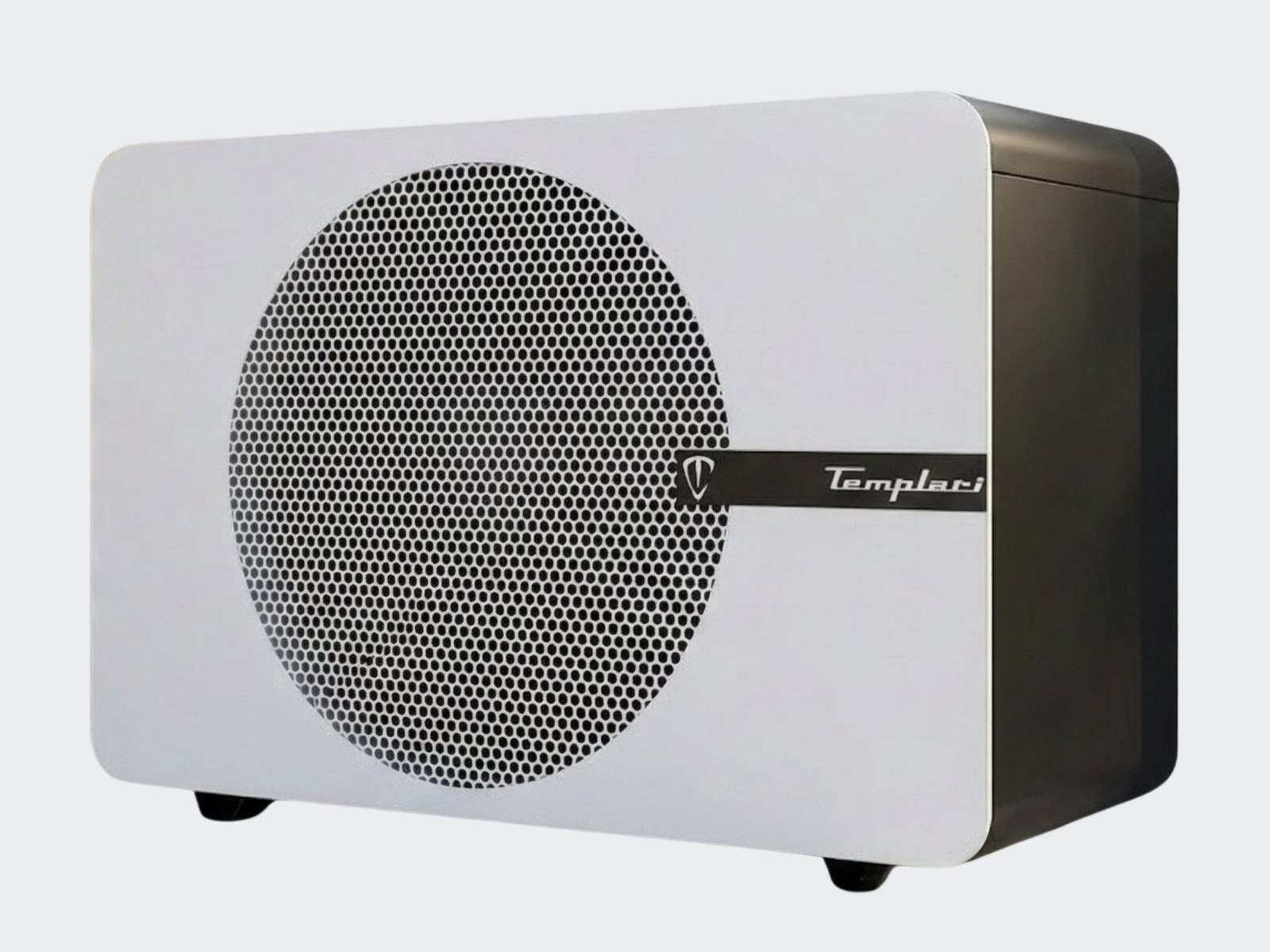
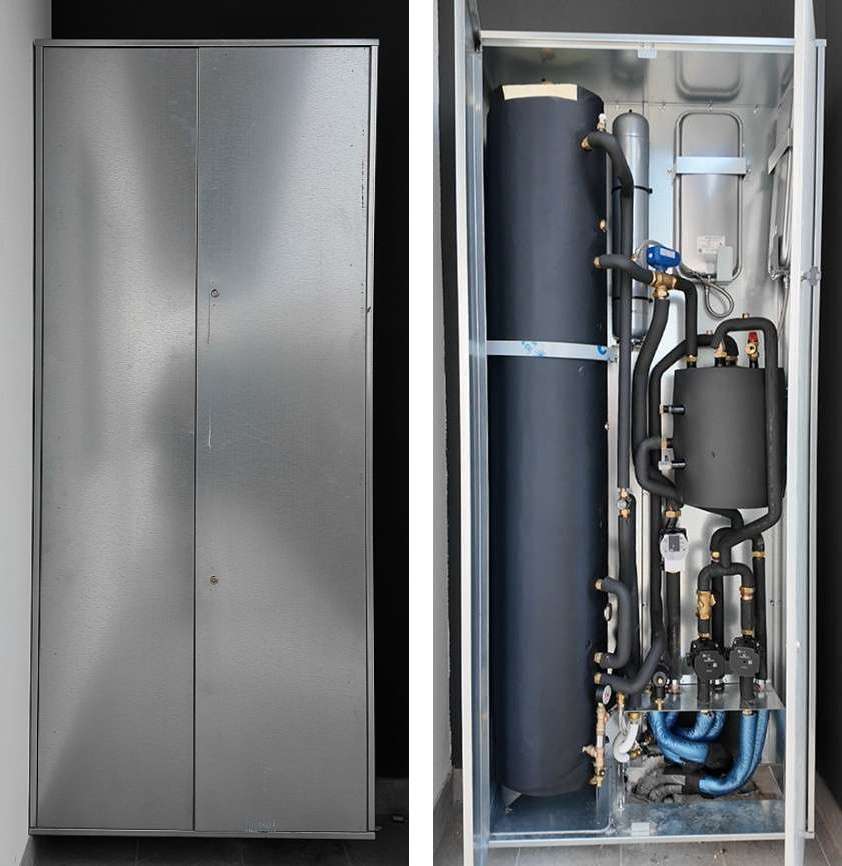
The classic objection to leaving gas is space: in a flat or a terraced house the heat pump does not fit. To anyone looking for a hybrid we propose the Kita X: a serious propane heat pump, built for winter, a compact 7.5 or 9 kW monobloc with a certified sound power of 53 dB(A). It goes outside, next to the house, and brings neither gas nor refrigerant indoors. On the system side, the technical cabinet, recessed or free-standing, gathers cylinder, pumps and control panel in the space of a wall cupboard: the plant room sits where the boiler was.
08
What to ask whoever proposes a hybrid
- What machine the outdoor unit is: born to heat water in winter, or an adapted air-conditioning condensing unit? The weight says a lot.
- What the fin spacing of the coil is and how it handles defrosting.
- Which compressor it has, and what water temperature it reaches without the boiler.
- At what outdoor temperature the controller switches to gas, and how many hours of winter in your area sit below that threshold.
- What the gas contract, the flue-gas check and two services cost every year.
- Whether, with a single heat pump at 70 °C flow temperature sized on the house, the boiler would still be needed.
09
Frequently asked questions
What is a hybrid boiler?
A gas boiler with an electric outdoor unit next to it and a controller that chooses which one to switch on. In most cases the outdoor unit is an air conditioner adapted to heat water.
How does a hybrid heat pump work?
Above a certain outdoor temperature the electric unit works, below it the boiler works. The threshold is set by the controller, according to temperature or energy price.
Is a hybrid boiler worth it?
Compared with a boiler alone it saves gas in the mid seasons. Compared with a propane heat pump built for winter it costs two machines, two services and a gas contract that stays, and on cold days it burns gas as before.
A hybrid heat pump with radiators?
The hybrid is proposed precisely because the outdoor unit does not reach radiator temperature. A propane heat pump at 70 °C gets there by itself: we talk about it in the tip on radiators.
Hybrid boilers, pros and cons?
Pros: you keep the boiler you have and the initial outlay can be lower. Cons: two systems, gas stays, the outdoor unit only works in mild weather, and when the boiler fails you are back where you started.
Can you remove gas completely?
Yes: a heat pump sized on the house, a cylinder, at most a small safety heater. The gas contract is closed and the flue stays empty.
See also: Heat pump in an old house: it can be done, even with radiators, if you know what it will use · Heat pump noise: how many decibels, how far from the neighbours and why it is louder in winter · Heat pump or pellet boiler: efficiency, space, fine dust and maintenance compared · Heat pump for a flat: can you have one without an outdoor unit? What goes outside and what goes indoors · Heat pump backup heater: when it switches on, how much it uses and when it is a warning sign
All the technical tips are on the series page. The next one in two weeks.


