

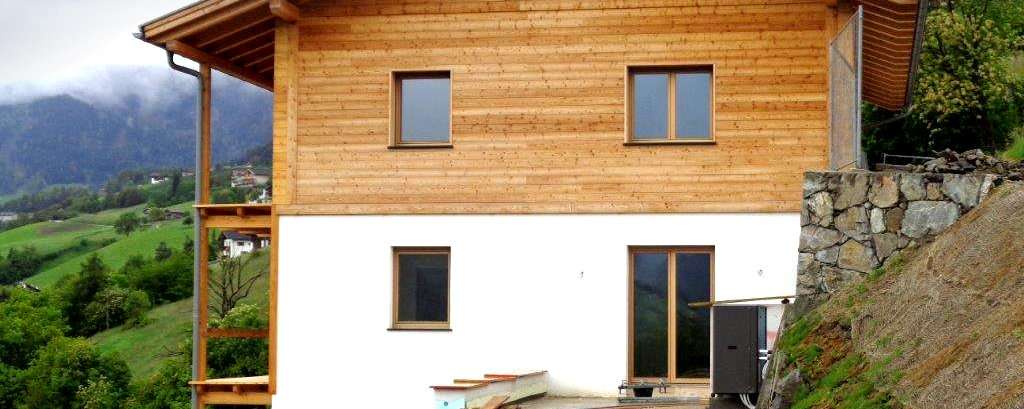
The energy optimiser: the walls of the house as a battery
In the previous tip we saw that a heat pump has to run continuously and that HCC controls it on the room temperature. Inside HCC there is a function that goes one step further: it uses the walls of the house as a battery. We called it the energy optimiser.
01
What it reads
The optimiser measures the outdoor temperature continuously and follows its trend: when it rises, when it falls, where the maximum of the day is and where the minimum. It does not look at the clock: it looks at the real climate, that day, in that place. Inside the house it reads the room temperatures from the room sensors, the same ones HCC uses to control the unit.
02
What it does
Whoever lives in the house decides how much deviation they accept from the set temperature: for example up to three tenths of a degree more when it is warm outside, two tenths less when it is cold outside. Half a degree in all, which nobody feels. With an algorithm we developed ourselves, the heat pump uses that half degree: in the best hours of the day, when the outdoor air is warmer and the unit performs better, it heats a little beyond the set point, and the extra heat ends up in the walls. In the worst hours, at night and at dawn, it lets the walls give it back, and works less.

03
Why the walls
A house weighs tens of tonnes, between walls, floors and screeds. Heating all that mass by half a degree means storing a lot of energy, with no extra tank and no cost. The buffer tank of a system holds a few hundred litres of water; the walls are worth many times that. It is thermal storage: it does the same job as electrical storage, with a different medium.
04
With photovoltaics
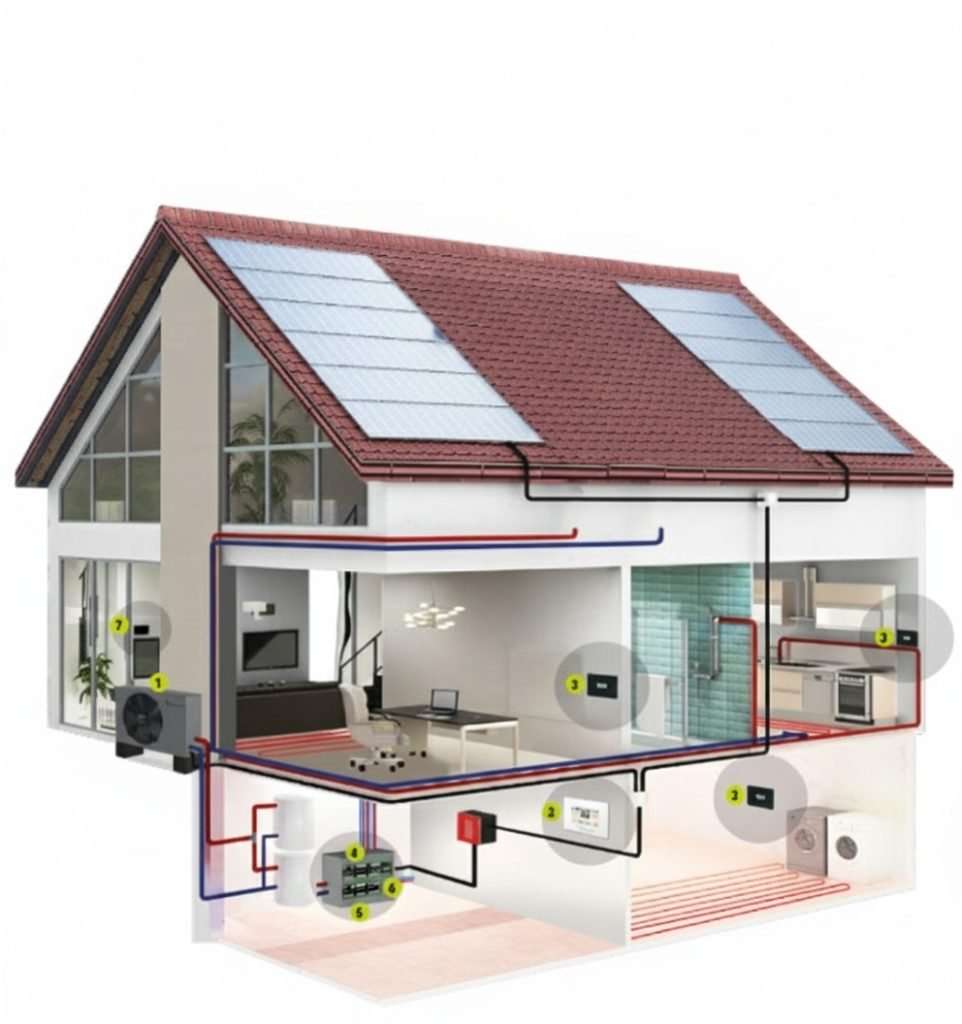
The case where it pays most is the house with panels on the roof. Photovoltaics produce in the middle of the day, when the outdoor air is warmer and the heat pump has its best efficiency: the optimiser makes the unit work exactly then, with the power from the roof, and puts the heat into the walls for the evening. An electrical battery to go with the panels costs from ten to twenty thousand euros. With the optimiser you get part of that result without buying it: the storage is already there, it is the house.
05
The result: one or two COP points
Working this way the seasonal efficiency rises by one or two COP points. That is a great deal, and the reason is simple: the unit couples itself to the house’s system. A heat pump performs better the lower the water temperature it has to produce. The heating engineer, to be on the safe side, usually sets the system at 35 degrees and it stays there all winter. HCC instead looks every day for the lowest temperature at which the rooms are fine, whether the system is underfloor, fan coils or radiators, without anyone having to intervene. In the house of the person writing these tips, with underfloor heating, the water starts in the morning at 23 degrees and reaches 27-28 in the evening, never 35. At the end of the winter that is several hundred euros less on the bill.

06
How to check, before you buy
- ask whether the unit can shift its work into the hours when the outdoor air is warmer, or whether it only follows the thermostat;
- ask whether it reads the room temperature with sensors in the house, not only the water temperature;
- ask what the unit does when the photovoltaics produce: if nothing changes, the power from the roof goes to the grid for a few cents;
- ask at what temperature it will send water into the system: if the answer is a fixed number, 35 degrees all winter, the unit does not adapt to the house.
The energy optimiser is part of HCC, standard on all our heat pumps: it is activated from the panel and set in tenths of a degree.
07
Frequently asked questions
What is thermal storage with a heat pump?
Using the mass of the house, walls, floors and screeds, as a heat store: in the best hours the machine heats slightly above the set point, and in the evening the walls give the heat back.
How does the energy optimiser work?
It follows the outdoor temperature and uses a band chosen by the occupants, for example three tenths of a degree above and two below: it makes the machine work when the air is warmer and it performs best.
Do you need a battery with solar panels and a heat pump?
Not necessarily: with the optimiser the heat pump works when the roof produces and stores the heat in the walls for the evening. You get part of what a battery would give, without buying one.
How much does the optimiser save?
The seasonal efficiency rises by one or two points of COP, because the machine works with the lowest possible water temperature and in the warmest hours. It is part of HCC, standard on all our heat pumps.
See also: Heat pump controls: thermostats, underfloor cooling and fan coils under one system · Heat pump and solar panels: how much the roof really covers, month by month, and how to make them work together · How much electricity does a heat pump use: per day, per year and by size, with the data sheet figures · Heat pump heating curve and weather compensation: what it is, why it is set 5 degrees too high, and how to do without it
All the technical tips are on the series page. Next: rotary or scroll, the compressor that makes the difference, read it here.


