Heat pump flow temperature: what underfloor heating, fan coils and radiators need, and who sets it
The heat pump flow temperature is the temperature of the water leaving the heat pump for the heating system. It is the number that, more than any other, decides how much a heat pump consumes: with the same house, the same cold outside and the same machine, sending water at 45 °C instead of 35 costs a quarter more electricity. Here we explain which flow temperature each type of system needs, why it is usually set higher than necessary, and how our machines find it by themselves, system by system, even on an old system.
01
What is the heat pump flow temperature, and how it differs from the return
The flow is the hot water leaving the machine; the return is the same water coming back after giving up heat to the floor, fan coils or radiators. The difference between the two, generally 5-7 degrees with a heat pump, is the heat delivered to the house. On data sheets the flow temperature appears as “outlet water temperature”: it is the condition at which output and COP are measured, for example 35 °C for underfloor heating and 55 °C for radiators.
02
Which flow temperature each system needs
Each emitter gives off heat in a different way and needs water at a different temperature.
- Underfloor heating: in a standard system the water runs at 28-35 °C, with the higher value on the coldest days. Our machines go lower: in a house with underfloor heating controlled by HCC the water sits at 23 °C in the morning and rises to 27-28 °C in the evening on the coldest days. The surface is large, barely warm water is enough, and this is where a heat pump performs best.
- Fan coils: 40-45 °C. A fan blows air over the coil, so the heat exchange surface is small but crossed by a lot of air. We wrote about it in the tip on fan coils.
- Radiators: it depends on how large they are compared with the room. A system designed for a boiler at 70 °C works, with a heat pump, between 45 and 55 °C on the coldest days, and much lower in the mid-seasons. See the tip on radiators.
- Domestic hot water: it is not a heating flow temperature, but the machine must reach 55-60 °C in the cylinder. Ours reach 70 °C when needed.
These are the values for the coldest days. For most of the winter a system needs 5-10 degrees less, and that is where consumption is decided.
03
What each extra degree costs
With a heat pump heat is not produced, it is moved: the higher the temperature it has to be brought to, the harder the compressor works. In the tip on COP we showed the certified data of one of our machines: going from 35 to 55 °C of flow temperature costs about a third of the COP, at any outdoor temperature. Spread over the 20 degrees of difference, that is about 1.5-2% of consumption for every extra degree of flow temperature. Ten extra degrees, kept all winter to be safe, are 15-20% of the heating bill.
04
Why the flow temperature is set higher than necessary
Whoever commissions the system sets the flow temperature, or the heating curve that governs it, with the coldest day of the year in mind and a house full of cold people calling. To be safe, they add a margin: 5 degrees, sometimes 10. The margin stays all season, even on mild days, which are the majority. It is not the installer’s mistake: with a boiler that margin cost almost nothing, because a boiler’s efficiency changes little with water temperature. With a heat pump it is the most expensive item.
05
The limit of the heating curve
Most heat pumps control the flow temperature with the heating curve: each outdoor temperature corresponds to a water temperature. It is a method that looks outside and not inside: it does not know whether the house is at 19 or 22 degrees, whether the sun is shining on the windows, whether the floor has already stored heat. We wrote about it in the tip on the heating curve. The result is that the curve has to be adjusted by hand, and whoever adjusts it keeps it high.
06
How HCC finds the lowest flow temperature, on any system
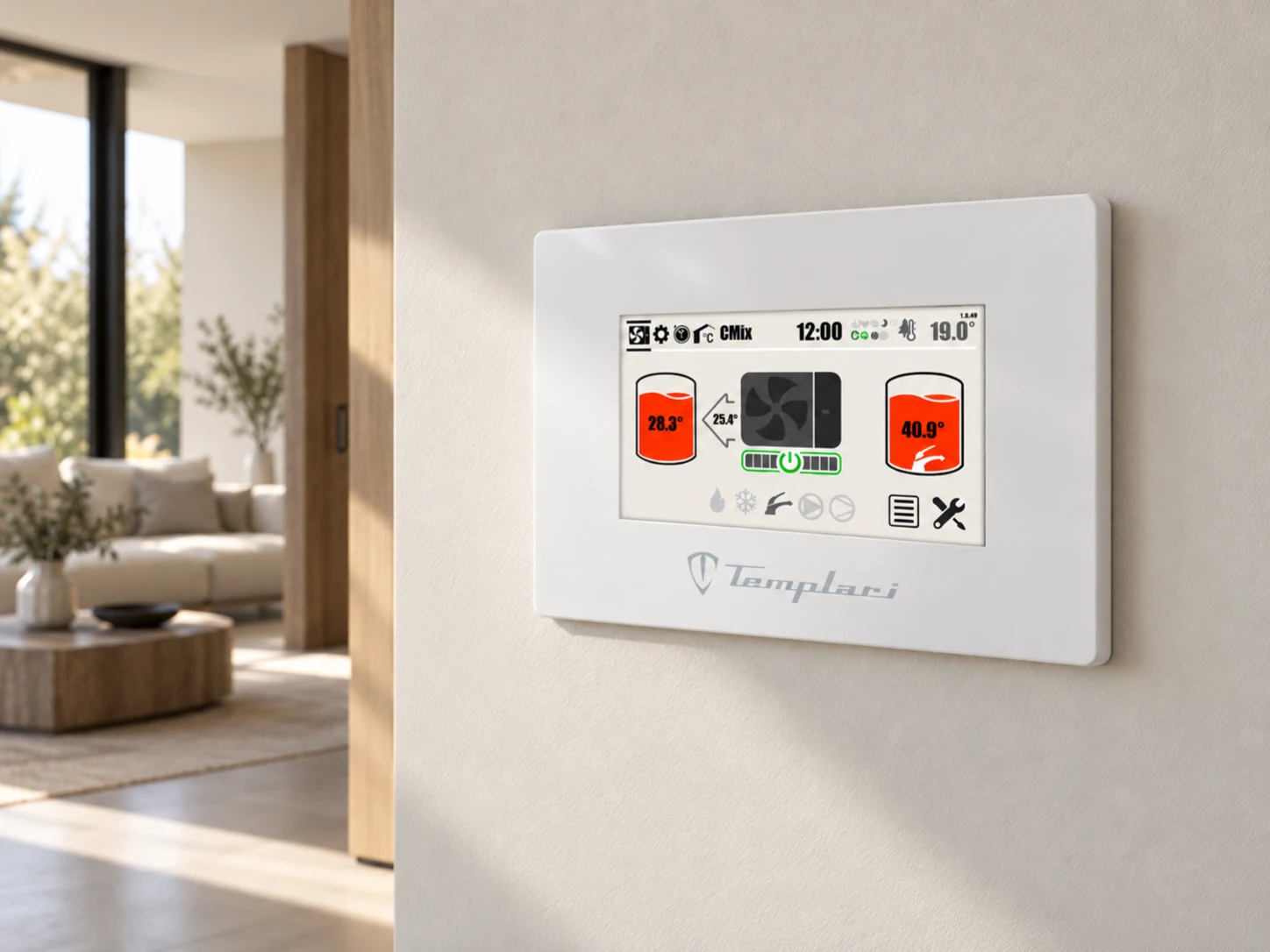
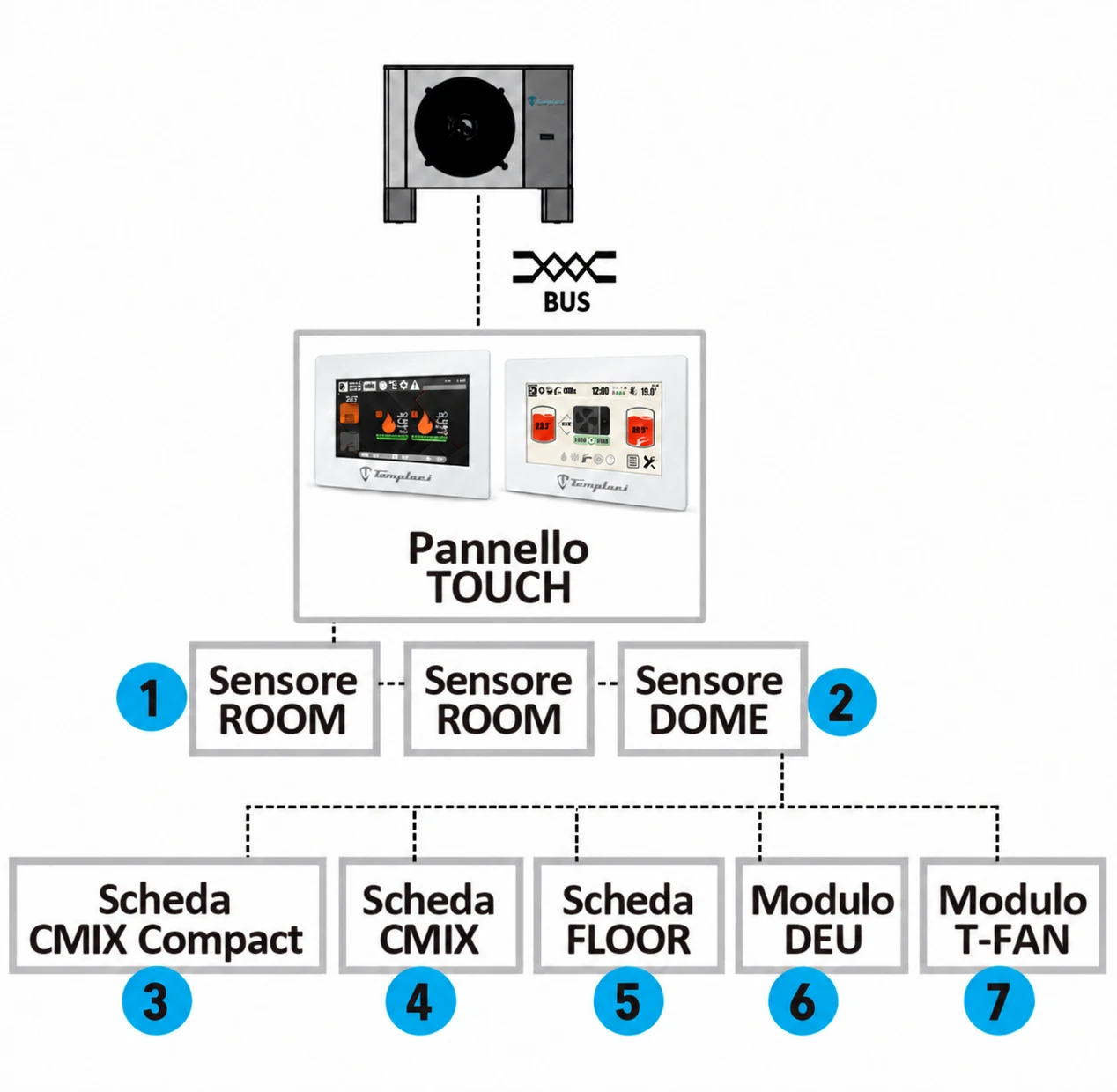
Templari heat pumps come with HCC as standard, the control system that reads the sensors in the rooms and runs the system. With HCC active nobody chooses the flow temperature in advance: the machine starts low and raises the water only as much as needed to keep the rooms at the requested temperature. If at 32 °C the rooms stay at 20, it stays at 32; if the house starts to cool down, it goes up. The system temperature entered on the panel, for example 45 °C, is the maximum that can be reached, not the target.
This holds for whatever system is already in the house: underfloor heating, fan coils, large or small radiators, mixed systems with several zones. The machine does not need to know how the system is built: it measures it from the result. A system of oversized radiators finds by itself that 42 °C is enough; an underfloor system finds that 23-28 °C is enough, where a standard system sits at 28-35. The installer does not have to guess the right curve, and the safety margin no longer exists because the machine corrects course every time the house asks. The result, on the systems we follow, is a flow temperature on average 5 degrees lower than the same house would have with the heating curve: with the 1.5-2% per degree seen above, that is 7-10% less electricity for the whole winter, before even counting the hours when the machine runs much lower.
With several zones HCC reasons zone by zone: the underfloor zone receives water mixed to its own temperature, the radiator zone the one it needs, and the machine produces only the highest of the current demands.
07
What changes on the bill
In the tip on the energy optimiser we described a house with underfloor heating where the flow temperature runs at 23 °C in the morning and at 27-28 °C in the evening, where an installer would have written a fixed 35 °C. The seasonal efficiency rises by one or two COP points, because the machine almost always works below the rated flow temperature value. With radiators the gain comes from time: more hours with low water, instead of a few hours with high water. The 65-70 °C our machines are capable of, described in the tip on high temperature, are rarely needed, and HCC uses them only when the house really asks for them.
08
Old system: what to check
Whoever puts a heat pump on an existing system is often told that “the radiators run at 70 degrees”. In most houses this is not so: the radiators were chosen generously, and the design day at -5 °C comes only a few days a year. Three checks before replacing the radiators: the hydraulic balancing, because a radiator that receives little water calls for a high flow temperature for everyone; the thermostatic valves, which must let the water through when the flow temperature is low; and a winter test with the boiler lowered to 50 °C, which tells you straight away whether the house heats up anyway. The tip on the old house has the complete path.
09
What to ask before buying
- At what flow temperature the COP is declared: 35 °C is underfloor heating, 55 is radiators; the two numbers must be compared at the same flow temperature.
- Is the flow temperature fixed, does it follow a heating curve or does it adapt to the rooms? A fixed number is a margin paid all winter.
- How high the machine goes on the coldest days, without an electric heater.
- With several zones, whether each zone receives its own temperature or all receive the highest.
If you are choosing a heat pump for a system that already exists, ask us for information: we will tell you at what flow temperature it would work in your home.
10
Frequently asked questions
What is the right flow temperature for underfloor heating?
In a standard system 28-35 °C. With the room-based control of our machines the water stays between 23 and 28 °C for almost the whole winter: the floor is barely warm, and this is where the heat pump performs best.
What flow temperature do radiators need with a heat pump?
Between 45 and 55 °C on the coldest days if the system was designed for a boiler at 70 °C, and much less for the rest of the winter. With HCC active the machine finds the value that is enough by itself.
How much more do I consume for every degree of flow temperature?
About 1.5-2%: from the certified data of one of our machines, going from 35 to 55 °C costs about a third of the COP.
Can I set a fixed low flow temperature to save money?
On cold days the house does not heat up, and on mild days you waste just the same. Better a control that adapts to the rooms: it starts low and rises only when needed.
By how much does HCC lower the flow temperature?
On average by 5 degrees compared with the heating curve of the same house, that is 7-10% less electricity; on underfloor heating even more, because the water drops to 23-28 °C where a standard system sits at 28-35.
Do I need an installer to set the flow temperature on a Templari heat pump?
No: with HCC active the machine finds the flow temperature, on any system. On the panel you only enter the maximum the system can accept.
See also: Heat pump heating curve · Heat pump COP · Heat pump with radiators · High-temperature heat pump
All the technical tips are on the series page.