

Warehouse heating has to warm a lot of air: high ceilings, large floor areas, doors that open all day. Many new warehouses are built with underfloor heating. Templari offers two ways to do it with a heat pump: a propane heat pump for underfloor heating, and the Kita Air air-to-air heat pump with a floor-standing unit for buildings without underfloor heating, which also cools in summer.

Warehouse heating: the short answer
- You size on volume, not floor area. A warehouse 7 metres high holds more than twice the air of a house with the same footprint.
- With underfloor heating: a propane air-to-water heat pump supplying water at 35 °C. The Kita L and L+ deliver 26 and 29 kW at -7 °C; a new 70 kW machine at -7 °C is coming soon.
- The economical solution: the Kita Air with a floor-standing unit. It keeps the heat down low, like underfloor heating, and cools in summer.
- Water-based heating is expensive and does not cool. Air-to-air costs much less and works in summer too. The floor stays free: machines can be anchored wherever you need.
Warehouse heating systems: gas, electric, infrared or heat pump
Most people look at industrial gas heaters, electric fan heaters or infrared panels. Each has its place, but not all of them heat a whole warehouse cheaply:
| System | How it heats | Running cost | Cools in summer |
|---|---|---|---|
| Industrial gas heaters | radiant tubes from the ceiling or warm air blowers | medium to high, tied to the gas price | no |
| Oil or diesel heaters | burns fuel and blows warm air | high: fuel, tank, flue | no |
| Infrared heater panels | warms people and surfaces, not the air | high: 1 kWh of power gives 1 kWh of heat | no |
| Electric fan heaters | heating element and fan | high: 1 kWh of power gives 1 kWh of heat | no |
| Heat pump with underfloor heating | water at 35 °C in the screed | low: COP 3.04 at -7 °C, COP 4.72 at +7 °C | no |
| Air-to-air heat pump (Kita Air) | warm air, kept at floor level by the floor unit | low: SCOP 5.17 (Kita Air Plus) | yes, same machine |
Infrared is the right choice for a fixed workstation or a building with doors that stay open. Gas and oil heaters are cheap to buy, but you pay the fuel price for their whole life and they do not cool.
Underfloor heating for warehouses: the propane heat pump
Underfloor heating needs water at a low temperature, usually around 35 °C, and that is exactly where a heat pump works best. For this Templari builds the Kita L and L+ air-to-water heat pumps with propane (R290), as monoblock units: the refrigerant circuit stays sealed in the outdoor unit and only water goes into the building.
| Model | Output at -7 °C | COP at -7 °C | Output at +7 °C | COP at +7 °C |
|---|---|---|---|---|
| Kita L (LP 35) | 26.27 kW | 3.09 | 35.00 kW | 4.65 |
| Kita L+ (LP Plus 40) | 29.34 kW | 3.04 | 40.00 kW | 4.72 |
Values to EN 14511, water at 35 °C. For larger buildings a new 70 kW propane heat pump at -7 °C is coming soon. All models and data: Templari air-to-water heat pumps.
Underfloor heating gives even warmth at floor level, but it is the expensive option: it has to be planned when the building goes up, with pipes in the screed, and it does not cool in summer. And you cannot drill into a floor with heating pipes in it: machine tools, racking and equipment can no longer be anchored freely.
The economical solution: Kita Air with the floor unit
For existing buildings, and for anyone who also wants cooling, there is the Kita Air air-to-air heat pump. The outdoor unit stands outside, the indoor unit inside, with only refrigerant lines in between. No water, no screed, no gas.
The floor-standing unit stands upright on the warehouse floor. It draws air in at the bottom, filters it and sends it back out through motorised adjustable louvres that form an air curtain: the heat stays down where people work, as with underfloor heating. In summer the same machine cools.
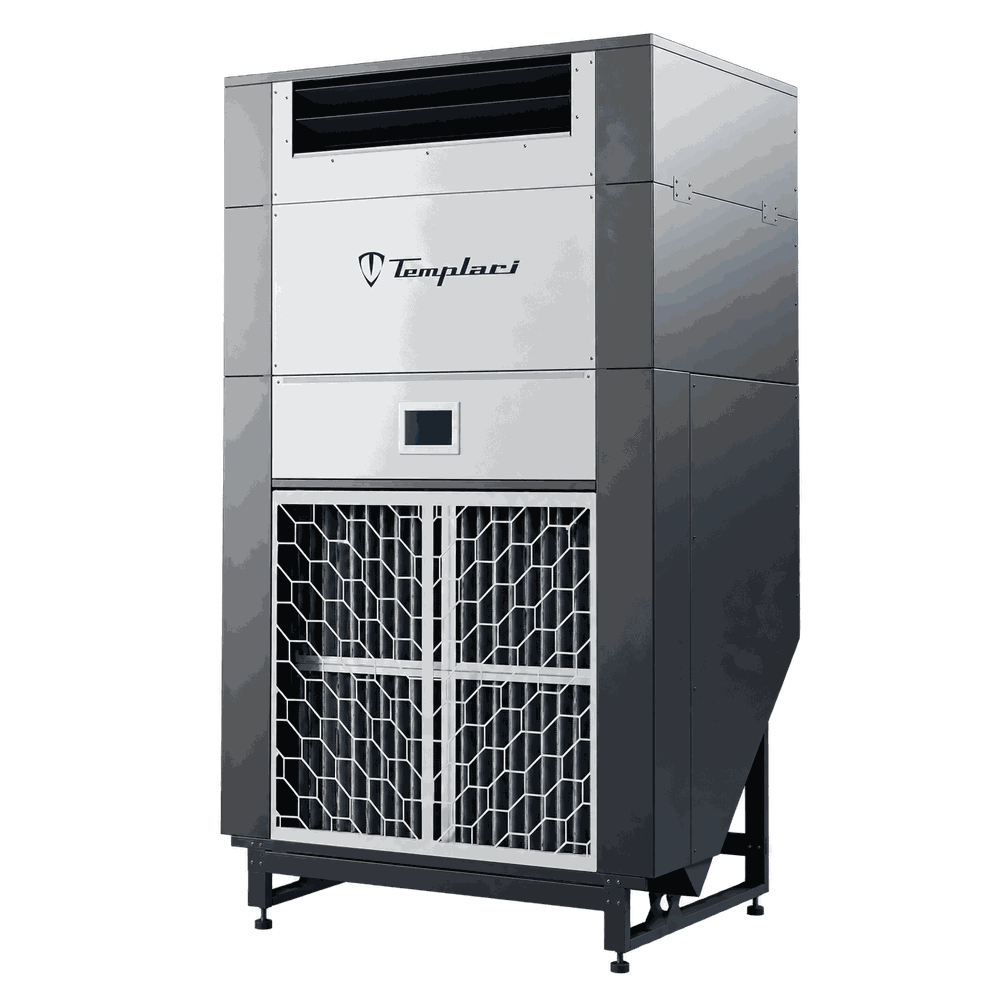
A Kita Air Plus delivers 47 kW at +7 °C and 42 kW at -7 °C, with SCOP 5.17. As a rule of thumb, one machine covers 400 to 500 m² of warehouse. Details on the Kita Air page.

Underfloor heating or air-to-air: the comparison
| Underfloor heating with propane heat pump | Kita Air air-to-air with floor unit | |
|---|---|---|
| Investment | pipes in the screed, manifolds, heat pump: high | outdoor and indoor unit, refrigerant lines: much lower |
| When | when the building is built | any time, also in existing buildings |
| Heat | even at floor level, slow to respond | warm air low down, within minutes |
| Summer | does not cool | cools, same machine |
| Floor | no drilling: heating pipes | free: anchor machines, move racking |
| Water in the building | yes | no |
Where underfloor heating is already in place, the propane heat pump runs it. In every other case the Kita Air with the floor unit is the economical solution: it costs less, cools in summer and leaves the floor free.
How many kW does warehouse heating need
You calculate on volume: external dimensions times height. For a first estimate, multiply the volume by the watts each cubic metre loses on the coldest day: about 10 W/m³ for a new, insulated building, 25-40 for a poorly insulated one with leaky doors, 40-60 and more for an uninsulated prefabricated shed. Those figures are for 20-22 °C; warehouses usually run at 15-18 °C, and the power needed drops. The exact calculation follows EN 12831 with the local design temperature. Step by step: how many kW to heat an industrial building.
Workshops, warehouses, factories
Workshops have their own page: workshop heating with diesel, infrared or a heat pump. For warehouses and factories the calculation above applies; examples with figures and photos are in our case studies.

Warehouse heating: frequently asked questions
What is the cheapest way to heat a warehouse?
A heat pump: it gives 3 to 5 kWh of heat from 1 kWh of electricity, depending on the outdoor temperature. Gas and oil burn fuel; infrared panels and fan heaters give 1 kWh of heat from 1 kWh of electricity.
Can a heat pump run underfloor heating in a warehouse?
Yes. The Kita L and L+ propane heat pumps supply water at 35 °C and deliver 26 and 29 kW at -7 °C; a new 70 kW machine at -7 °C is coming soon.
Which costs less, underfloor heating or air-to-air?
Air-to-air costs much less: no pipes in the screed, no water in the building, and the same machine cools in summer. Water-based heating is expensive and does not cool.
Does an air-to-air heat pump keep the heat at floor level?
With the Kita Air floor unit, yes: it draws air in at the bottom and forms an air curtain with motorised louvres, so the heat stays at floor level.
Can I drill into the warehouse floor?
With air-to-air heating, yes: the floor stays free for machine tools and racking. With underfloor heating, no, because the pipes are in the screed.
Tell us the floor area, the height, the year the building was built and whether it has underfloor heating: we will tell you which machine fits and how many. Contact us.


