

Heat pump or pellet boiler: efficiency, space, fine dust and maintenance compared
Anyone replacing a gas or oil boiler often asks: pellets or a heat pump? In Germany “Pelletheizung oder Wärmepumpe” is searched 1,300 times a month for each variant, in Poland “pompa ciepła czy pellet” 260, in France and Italy less, but with the same question. Here we compare the two routes on what matters every day: efficiency, space, deliveries, chimney, fine dust, summer and radiators. We do not give prices: they change from country to country and year to year.
01
Two very different ways of heating
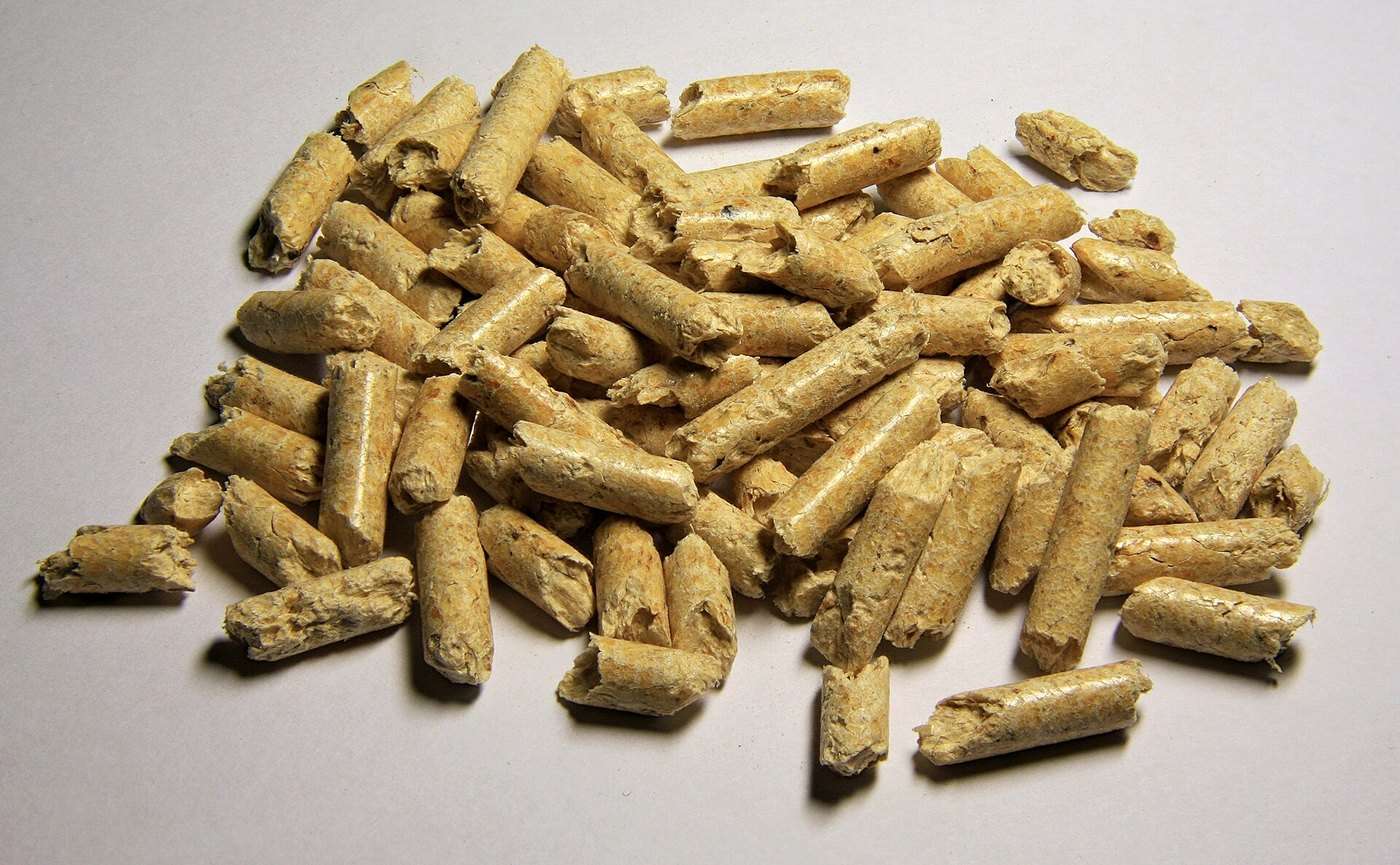
A pellet boiler burns pressed wood: the heat it gives is at most the heat in the pellets, minus what goes up the chimney. A heat pump burns nothing: it takes heat from the outdoor air and moves it inside, and for every kilowatt-hour of electricity it gives three, four or five of heat. How it works is explained in the article on how a heat pump works.
02
Efficiency: what the EU label says
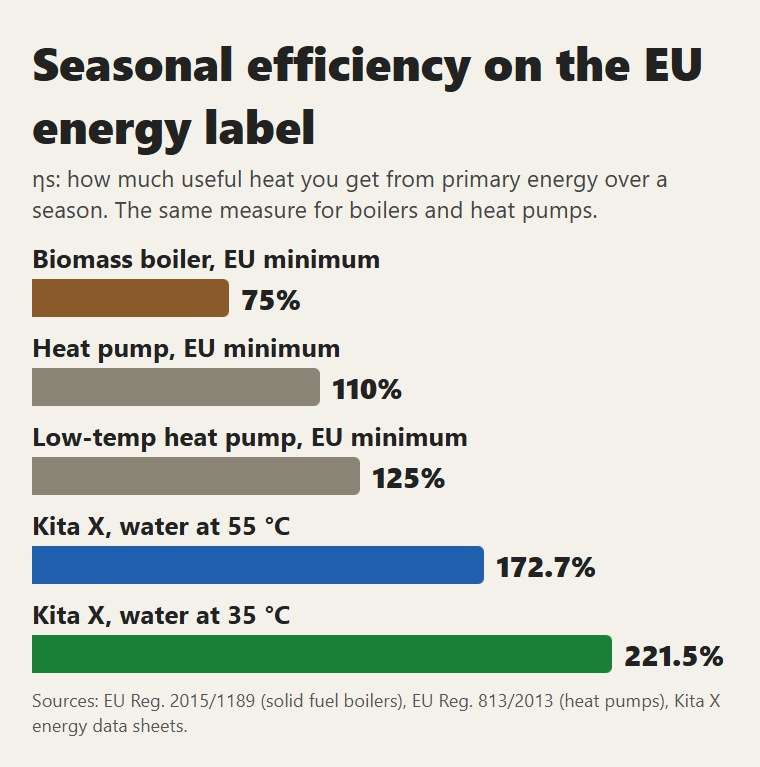
The European Union measures boilers and heat pumps with the same number, the seasonal space heating efficiency ηs on the energy label: how much useful heat you get from primary energy over a season. For a biomass boiler up to 20 kW the legal minimum is 75% (EU Regulation 2015/1189); for a heat pump it is 110%, and 125% for low-temperature ones (EU Regulation 813/2013). Our Kita X reaches 172.7% with water at 55 °C and 221.5% with water at 35 °C.
03
Space, deliveries, ash and chimney
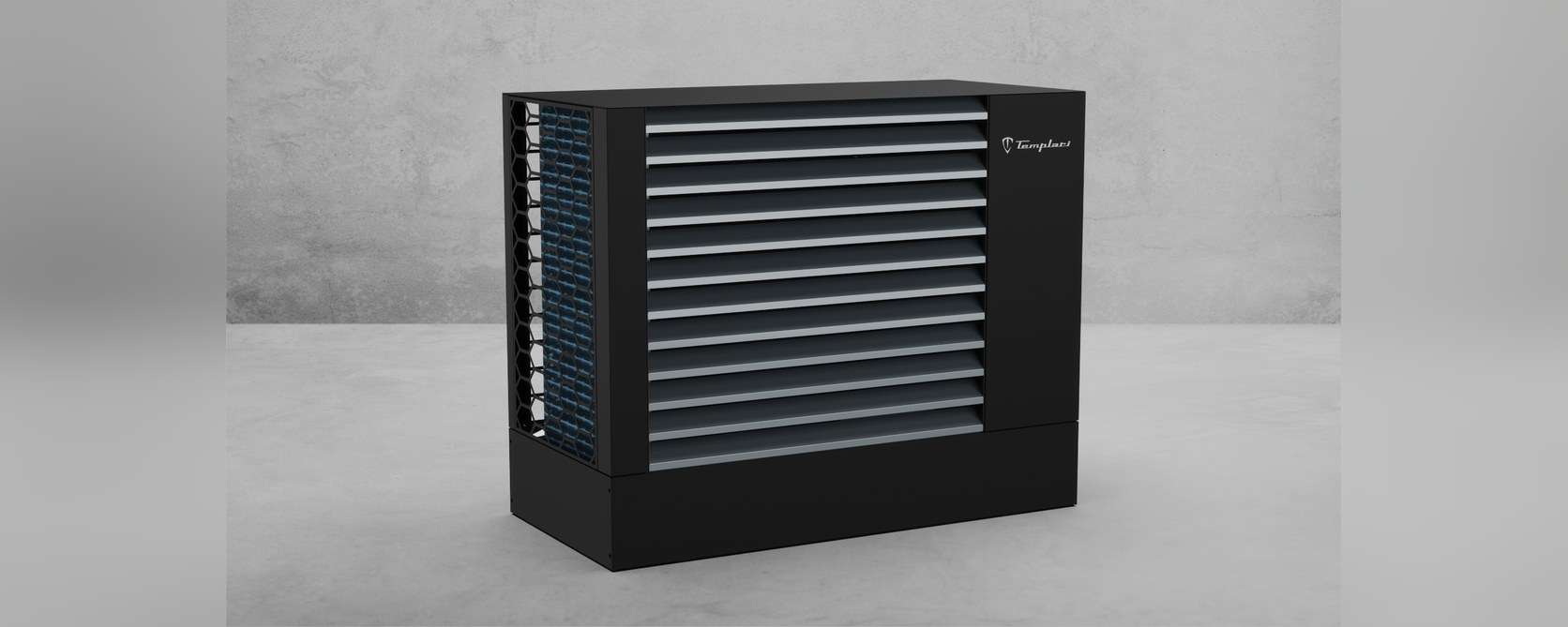
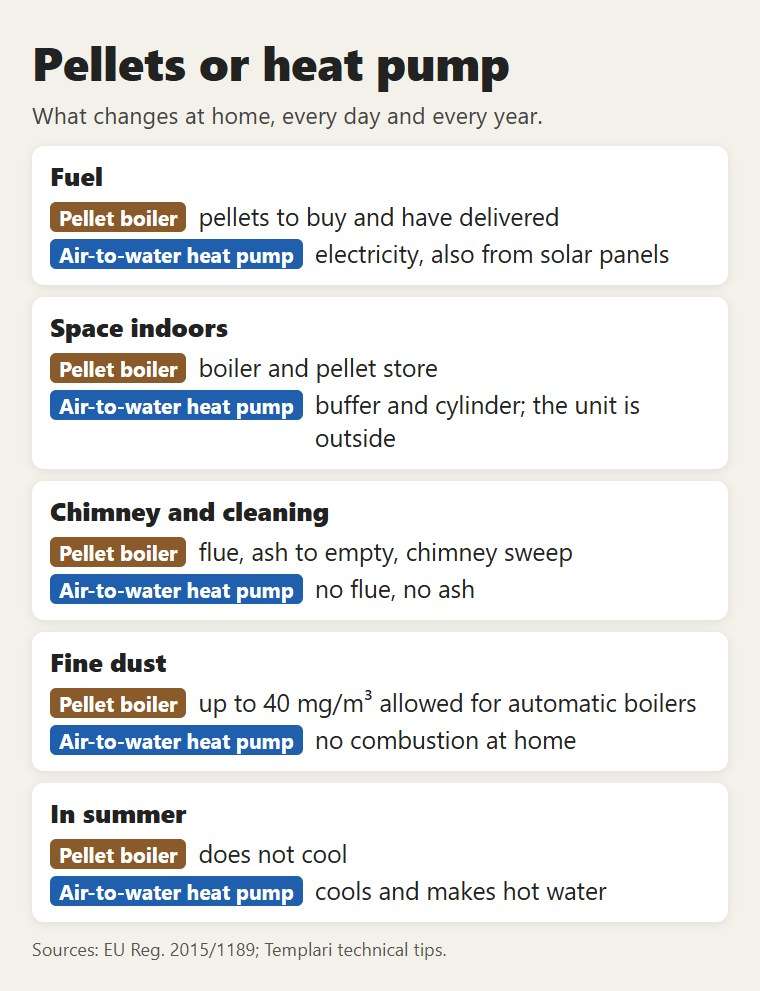
A pellet boiler needs a room, a pellet store, bags or a silo, deliveries, ash to empty, a flue and its cleaning. An air-to-water monobloc heat pump stands outside: indoors there are only the buffer tank and the cylinder, no flue and no ash. How it is installed is in the article on installation.
04
Fine dust
Every combustion makes dust. Automatic biomass boilers may emit up to 40 mg/m³ of particulates under the EU regulation, manual ones up to 60. In Germany the Umweltbundesamt calculated that in 2016 household wood stoves and boilers made 17% of fine PM2.5 dust emissions, as much as all road traffic. A heat pump burns nothing at home.

05
In summer
A pellet boiler does not cool in summer, and for hot water it has to fire up or leave it to another appliance. An air-to-water heat pump cools in summer, as we explain in the article on cooling, and makes hot water all year; in sunny hours the electricity can come from solar panels, as we explain in the article on heat pumps and solar panels.
06
Radiators and old houses
Pellets easily reach 70-80 °C, which is why people with old radiators like them. But a heat pump gets there too: our propane air-to-water units give 70 °C, and in the homes measured by Fraunhofer ISE with radiators only, the water averaged 38.5 °C. We cover it in the article on high temperature and in the one on old houses.
07
Pellets and a heat pump together?
Some think of keeping both. That means two heat generators, two maintenance plans, the chimney and the store. A well-sized heat pump that reaches 70 °C and works below -20 °C heats the house on its own: that is why we suggest a real heat pump to anyone thinking of a hybrid, as we explain in the article on hybrids.
08
What to ask before deciding
Five questions. What seasonal efficiency ηs the two units have, read on the label. Where the pellets are kept and who delivers them. How the chimney is cleaned and how often. Whether cooling is needed in summer. And whether the radiators are enough with water at 55-70 °C. If you want an opinion on your house, ask us for information.
09
Frequently asked questions
Is a heat pump or a pellet boiler better?
It depends on the house, but the heat pump has a higher seasonal efficiency (the Kita X 172.7% at 55 °C against a legal minimum of 75% for biomass boilers), burns nothing at home, has no chimney or ash and cools in summer.
How efficient is a pellet boiler compared to a heat pump?
The EU regulation requires biomass boilers up to 20 kW to have at least 75% seasonal efficiency, heat pumps at least 110%. Our Kita X reaches 221.5% with water at 35 °C.
Does a pellet boiler pollute?
Every combustion makes dust: the EU regulation allows up to 40 mg/m³ for automatic boilers. In Germany household wood stoves and boilers make 17% of fine PM2.5 dust (Umweltbundesamt).
Can pellets and a heat pump be kept together?
They can, but it means two generators, two maintenance plans, the chimney and the store. A well-sized heat pump heats the house on its own.
Are pellets better with radiators?
Not necessarily: our propane air-to-water units reach 70 °C, and radiators are often enough with cooler water. First run the test with the boiler at a lower temperature.
How much space do pellets need?
A boiler room and a dry store for bags or a silo. An air-to-water heat pump stands outside and leaves only the buffer tank and cylinder indoors.
Sources: Reg. (UE) 2015/1189 · Reg. (UE) 813/2013 · Umweltbundesamt, Feinstaub aus Holzfeuerungen
All the technical tips are on the series page.


