Electric warehouse heating: heaters, infrared, fan heaters, unit heaters or a heat pump, the real cost per kWh
“Electric heating” for a warehouse means four different kinds of warehouse heaters: an industrial resistance heater, an infrared panel, an electric hot-air generator, or a hot-water unit heater fed by something that heats the water. They cost little to buy and a lot to run, apart from one. Here we line up the four systems and the air-to-air heat pump with the same yardstick: how many kilowatt-hours of electricity it takes for every kilowatt-hour of heat in the warehouse, and what that means at the end of winter.
01
The yardstick that matters: kWh of heat per kWh of electricity
A resistance heater turns 1 kWh of electricity into 1 kWh of heat, always. It cannot do more: that is the physical limit of Joule heating. A heat pump takes heat from the outside air and carries it inside: with 1 kWh of electricity it delivers 3, 4 or 5, depending on the outdoor temperature. The ratio is called COP, and in our article on COP we explained how to read it. The whole comparison on this page rests on that number: 1 against 3-5.
02
Electric warehouse heaters and industrial fan heaters
The industrial resistance fan heater, from 3 to 30 kW, costs a few hundred euros and plugs into a three-phase socket. It heats the air where it stands, and hot air rises under the warehouse roof, where nobody needs it. Three limits: the COP is 1; it needs an enormous contracted electrical power, because a 400 m² warehouse asks for 20-40 kW of heat, which with resistances means 20-40 kW of electricity; and stratification forces it to heat the ceiling first. It is the right solution for an emergency or for a small room used for a few hours.
03
Infrared
Infrared panels and lamps do not heat the air but the surfaces and people they radiate on. For fixed workstations in an otherwise cold warehouse they work: whoever stands under them feels warm even with the air at 10 °C. The COP stays 1, and the warmth ends when you leave the cone. They do not heat the warehouse: they heat the people, as long as they stand still underneath. For a whole space they cost as much as resistance heaters.
04
Electric hot-air generators
These are bigger resistance heaters, from 20 to 100 kW, with ducts or outlets, often used as temporary site heating. Same COP of 1, same contracted power, plus the noise of the big fan. They make sense where there is nothing else and only for a short time.
05
Hot-water unit heaters
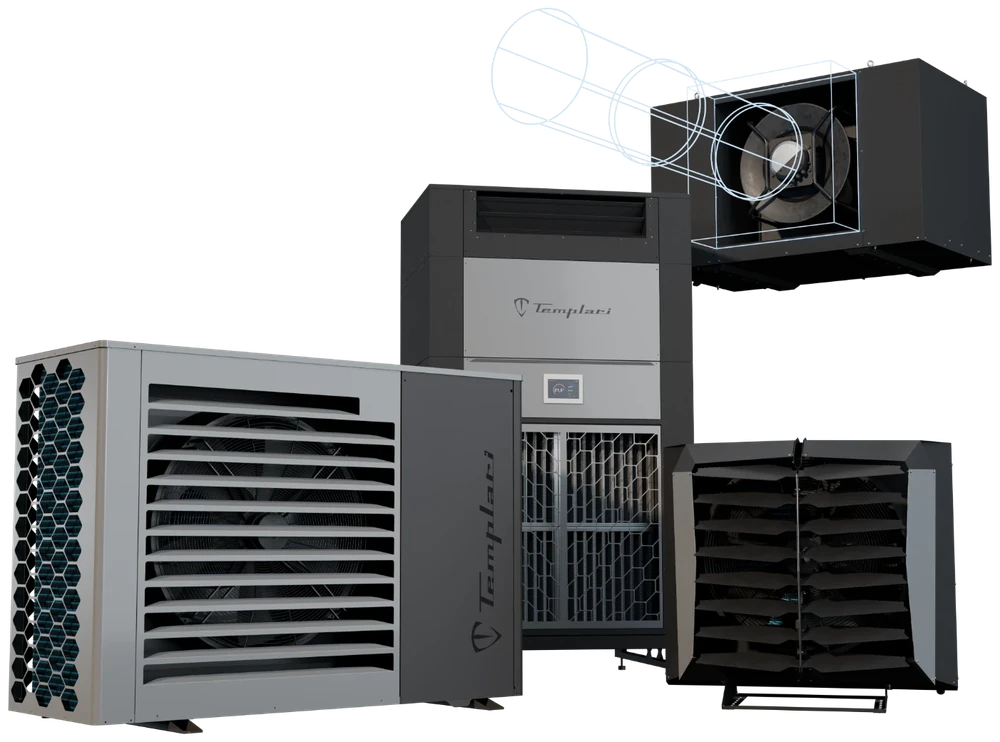
The hot-water unit heater is a terminal: a finned coil with a fan, hung on a wall or ceiling, with hot water flowing through it. Something else has to make the water: a gas or oil boiler, or an air-to-water heat pump. On its own it consumes almost nothing; the generator is what consumes. With a gas boiler you pay for the gas and you have two systems, hydronic and air handling, with pipes running through the whole warehouse. With an air-to-water heat pump the COP is there, but the water has to be brought to 45-50 °C to make the unit heaters perform, and part of the advantage is lost. It is the typical solution of warehouses built twenty years ago.
06
Air-to-air heat pump for warehouses
The Kita Air takes heat from the outside air and delivers it straight into the warehouse air, without water, without pipes, without a boiler. It has a seasonal COP of up to 5.15 as declared in the datasheet, and it heats in winter and cools in summer with the same machine. One machine covers 400-500 m²; large warehouses are done with several machines, from 300 to 30,000 m². The limit compared with the heater is the purchase price, much higher, and the installation, which has to be done by an installer. The advantage is all in the consumption.

07
The cost per kWh and per season, an example with stated assumptions
Assumptions: electricity at €0.25/kWh, gas at €1.10/m³ with 10 kWh per m³ and a boiler at 90%, air-to-air heat pump with a seasonal average COP of 3.5, cautious compared with the nameplate 5.15, a 400 m² warehouse that needs 40,000 kWh of heat in a season.
- Resistance heaters, infrared, electric generators: 40,000 kWh of electricity, €10,000.
- Hot-water unit heaters with gas boiler: 4,440 m³ of gas, €4,900, plus the boiler and the pipes.
- Air-to-air heat pump: 11,400 kWh of electricity, €2,860.
Change the assumptions and the numbers change, not the order: resistance heating costs three and a half times as much as the heat pump, every winter. Whoever has photovoltaics on the roof of the warehouse lowers the third number even further, because the heat pump works in the daytime.

08
When electric heating still makes sense
- Small room, used a few hours a week: the heater costs little and the consumption weighs little.
- Fixed workstation in a warehouse you do not want to heat entirely: infrared over the workstation.
- Emergency or building site: hot-air generator for hire.
In all other cases, a warehouse used eight hours a day, resistance electric heating is the most expensive system there is.
09
Incentives and contracted power
The Italian incentive, the Conto Termico, covers the heat pump for businesses, not resistance heaters: the details are on the incentives page. On electrical power: 40 kW of resistance heaters ask for 40 kW contracted, while a Kita Air of 40 kW thermal draws about 10. Often the difference decides on its own, because raising the meter’s power costs money and is sometimes not available. How many kW your warehouse needs is explained in the calculation guide; for a quote write to us with the square metres and the height.
10
Frequently asked questions
How much does an industrial electric heater consume?
As much as its power rating: a 15 kW unit consumes 15 kWh for every hour of operation, because the resistance turns all the electricity into heat and no more.
Is infrared worth it for a warehouse?
It is worth it for warming people at a fixed workstation, not the warehouse. The consumption per kWh of heat is the same as a resistance heater.
Is the hot-water unit heater electric?
No: it is a terminal that needs hot water produced by a boiler or an air-to-water heat pump. On its own it only consumes the fan.
How much do you save with a heat pump compared with resistance heaters?
With a seasonal COP of 3.5 you need less than a third of the electricity: in this page’s example €2,860 against €10,000 per season for a 400 m² warehouse.
How many kW does it take to heat a warehouse?
It depends on volume and insulation: the dedicated guide has the method, with the rule of thumb and the real calculation.
See also: How many kW it takes to heat a warehouse · Heat pump COP · Heat pump and photovoltaics · Heating industrial warehouses
All the heating expert’s tips are on the column page.