

Heat pump defrost cycle: the first thing to look at is the space between the fins
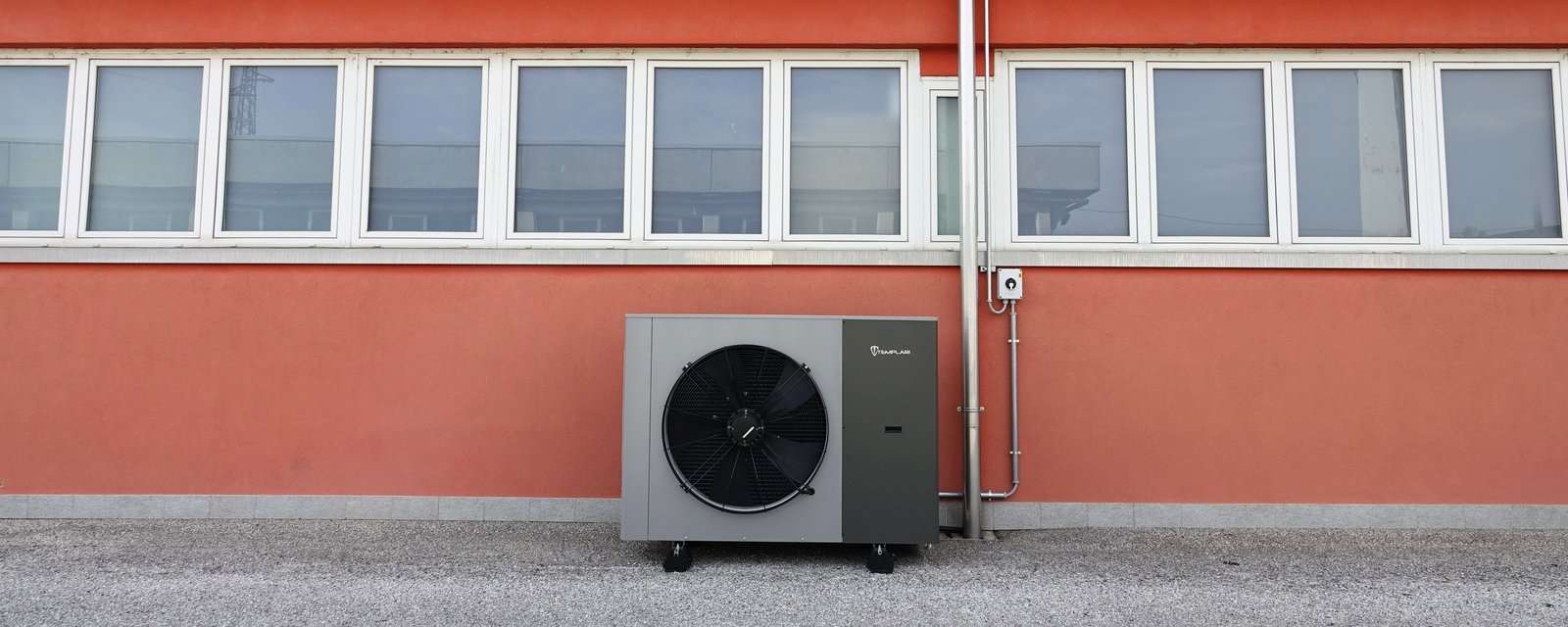
Not the COP, not the capacity, not the brand. The first thing to look at in a heat pump is the outdoor heat exchanger, the aluminium grille through which the unit takes heat from the air. And on that exchanger one figure matters that almost no data sheet gives: how much space there is between one fin and the next.
01
Why ice forms
In winter the exchanger runs colder than the air passing through it, otherwise it could not take any heat from it. Below 5-6 °C outside, with the humidity found on the plains, its surface drops below zero and the moisture in the air freezes onto it. That is frost. It grows fin by fin, and when it closes the air passage the unit has to stop and melt it off: that is a defrost.
02
What a defrost really costs
Not electricity, or not only. During a defrost the heat pump runs backwards: it takes heat from the system, which is warm, and sends it to the outdoor exchanger, which sits at zero degrees to melt the ice. With such a small temperature difference the compressor works little and the efficiency doubles: a unit that heats in winter with a COP of 3.5 defrosts at COP 7. We measured it on our own units. It looks like an advantage, and it is the opposite. That heat was taken from the building, and to put it back the unit works again at COP 3.5: for every kilowatt-hour spent defrosting, two are needed to bring back indoors the heat that went out. A defrost costs twice what the meter shows, plus the minutes in which the unit is not heating.
Counted in minutes it is even clearer. A 5-minute defrost at COP 7 takes from the building an amount of heat that the unit, working at COP 3.5, puts back in 10 minutes. The account is square after a quarter of an hour, in which the unit has run without adding any heat. If it defrosts every half hour, it really heats only one quarter of an hour out of two: half the energy is lost, and in those hours the unit goes from COP 3.5 to COP 1.75.
An Asian-import unit with narrow fins, on a humid night at zero degrees, defrosts up to twelve times: three hours without heating and twelve withdrawals of heat from the rooms, in the coldest hours. Ours, in the same conditions, do a fraction of that. The COP printed on the data sheet is measured without frost: defrosts are not in it.
03
The space between the fins
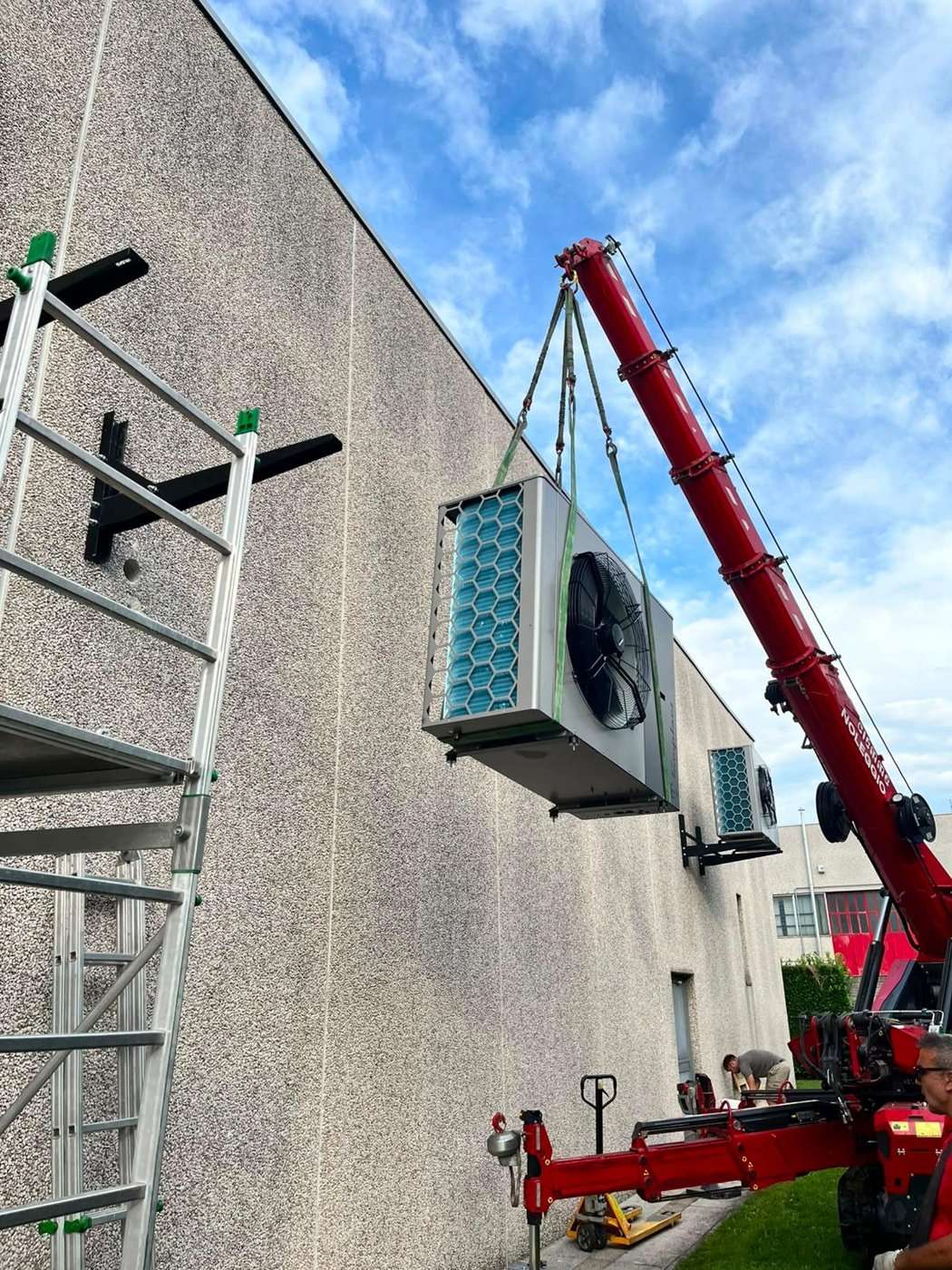
Our heat pumps, from the smallest for a house to the largest for an industrial building, share the same outdoor exchanger: fins spaced 2.5 millimetres apart. In Asian-import units the data sheets we have read give 1.5 millimetres, one millimetre less. It sounds like nothing. It is not: with one millimetre more, frost has twice the room to grow before it closes the passage, and the unit heats for longer between one defrost and the next. Narrow fins exist to make a small, light exchanger for the same surface area: it costs less, fits in a smaller casing, and defrosts more.

04
Fin thickness and the tube
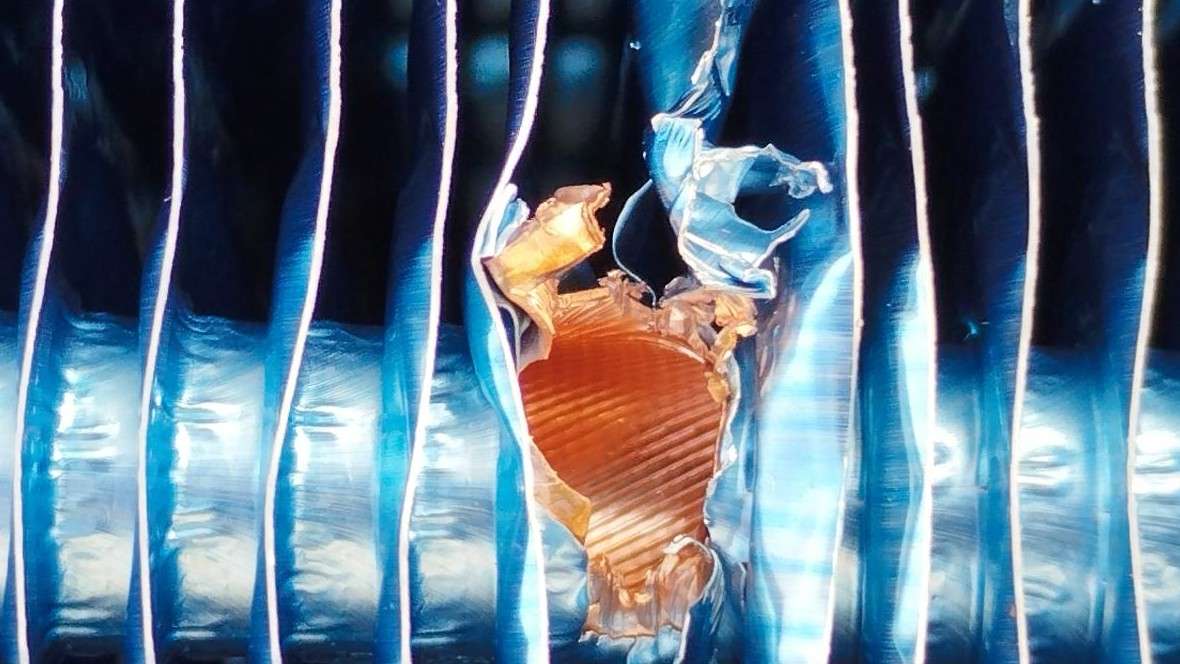
Pitch is not the only figure that matters: so does how thick the fin is. Ours are aluminium, 0.15 millimetres thick, the thickest in use; the market average is between 0.10 and 0.11. A thicker fin makes the heat exchanger heavier and more expensive, but it transfers heat and cold to the air better, because it increases the contact between the copper tube and the fin. It also stands up better to knocks: a 0.10 mm fin bends under a finger.
Inside, the copper tube is not smooth: it is internally grooved. The grooves increase the turbulence of the gas, and turbulent gas exchanges heat with the tube wall far better than gas flowing smoothly: the same tube surface transfers more power to the aluminium. This reduces the temperature difference between the gas and the air. In winter it means the gas evaporates at a temperature closer to that of the outdoor air: the unit performs better, and the heat exchanger, being less cold, builds up less frost.
The fins also have a hydrophilic coating, a treatment that makes water run off instead of leaving droplets between the fins. Thick fins, grooved tube and hydrophilic coating are the most expensive combination you can fit to a heat exchanger.

05
Big exchanger, big fan
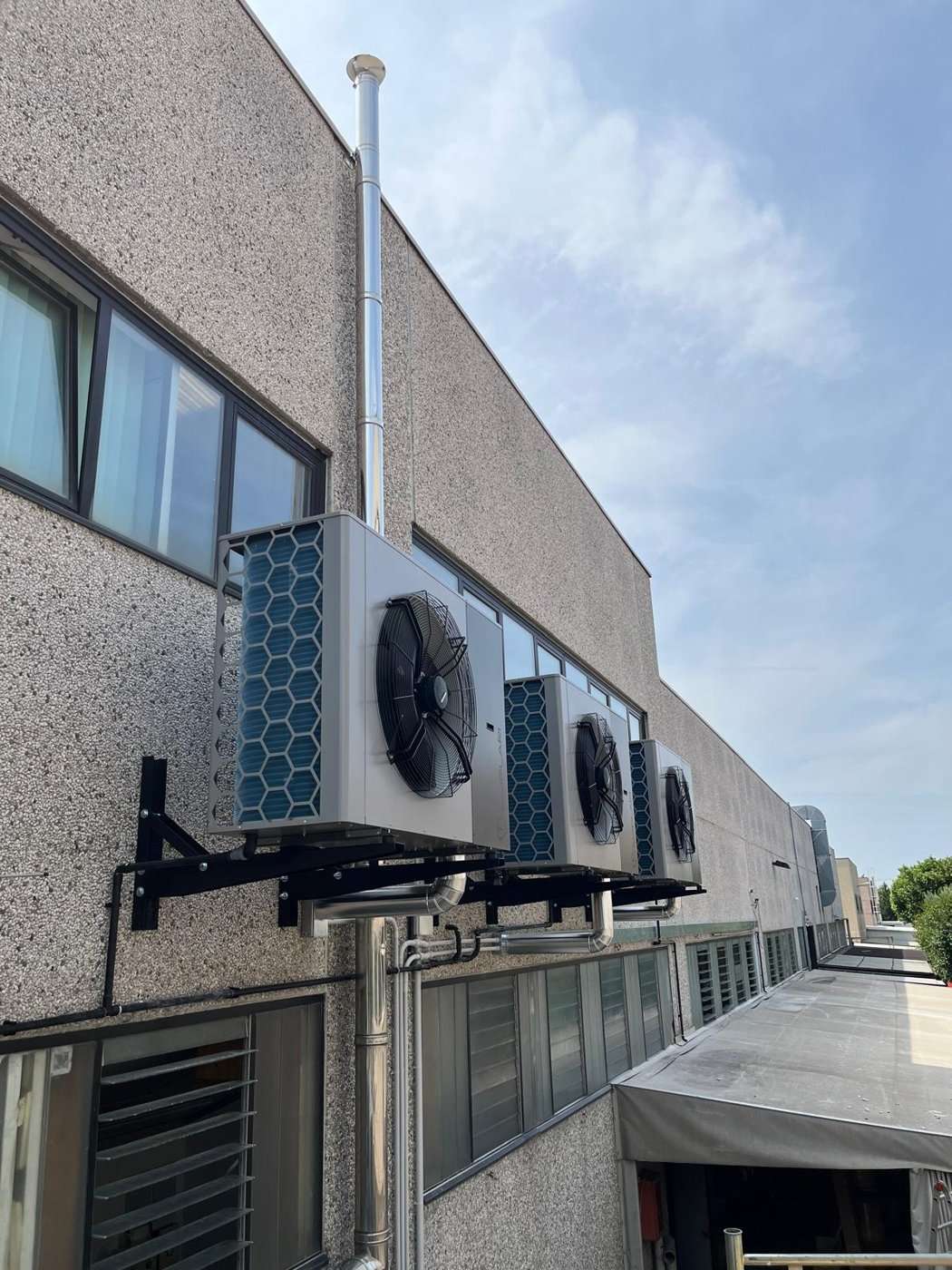
Wide fins alone are not enough: for the same capacity an exchanger with wider fin spacing has to be bigger, to have the same surface area. And a big exchanger needs a big fan, one that pushes a lot of air through it while turning slowly. On our units for industrial buildings the fan is 91 centimetres in diameter and moves 14,000 cubic metres of air an hour. The more air passes, the less the exchanger has to drop in temperature to take the same heat, and the less frost forms. A big fan turning slowly also makes less noise and uses less power than a small one turning fast: the big casing is not a flaw, it is the reason the unit works.
06
How to check, before you buy
Four things to ask about, because brochures usually leave them out:
- the spacing between the fins of the outdoor exchanger, in millimetres;
- the fin thickness and whether the copper tube is grooved inside;
- the fan diameter and the air flow, in cubic metres an hour;
- how many defrosts it does in a night at zero degrees with high humidity, or at least what triggers them: a timer, every so many minutes, or only when frost is actually there.
If the salesman cannot answer, that is the answer. Our units defrost only when the exchanger asks for it, and the control is done by electronics we designed ourselves, which see every variable of the machine.
The full data sheets of our air-to-water heat pumps and of the Kita Air for industrial buildings are on the site, with the fin spacing stated.
07
Frequently asked questions
Why does a heat pump build up frost in winter?
Because the outdoor heat exchanger runs colder than the air in order to take heat from it. Below 5-6 °C outside, with the humidity of low-lying areas, its surface drops below zero and the moisture in the air freezes on it.
What does a defrost really cost?
More than the meter shows. The machine takes heat out of the building at COP 7 and puts it back at COP 3.5: every kWh spent defrosting needs two more. With a defrost every half hour, the COP drops from 3.5 to 1.75.
How far apart should the heat exchanger fins be?
On our heat pumps 2.5 mm, against the 1.5 mm shown on the data sheets of Asian imported machines. With one millimetre more, frost has twice the space to grow before it blocks the air.
What should you ask about the heat exchanger before buying?
The fin spacing, the fin thickness and whether the copper tube is grooved inside, the fan diameter with the air flow, and what starts the defrost: a timer, or frost that is really there.
See also: How does a heat pump work: heat is not produced, it is moved · Heat pump COP: what it is, how it is measured, and why it is not the same in the fog · Heat pump maintenance and servicing: what to do, how often, and how long a heat pump lasts · Heat pump in cold weather: down to what temperature does it work? Below freezing, at -20 and -25 °C · Heat pump noise: how many decibels, how far from the neighbours and why it is louder in winter · Heat pump with ice, steam or water underneath: what is normal and when to call for service
The second tip is online: timed or demand defrost, when the heat pump decides to stop. Next: why an inverter heat pump is sized to run at half capacity, and why it is the heat exchanger, not the compressor, that has to be twice as big. Read it here.


